Elevating Primary Education Standards

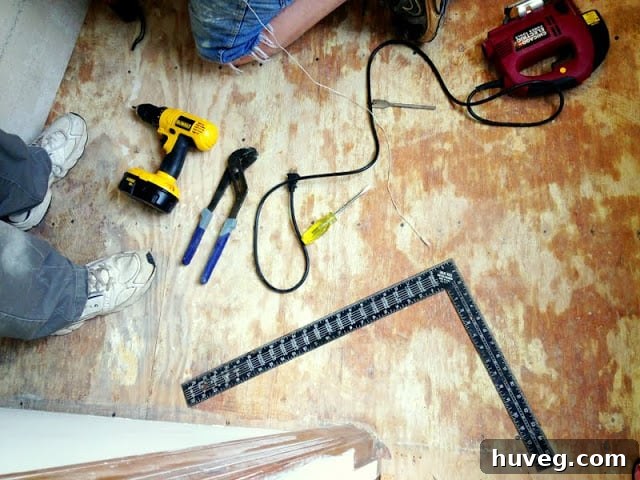
Another productive weekend, another step forward in our ongoing home renovation journey! It’s always a pleasure when my dad and Tony come over, not just for the extra set of hands and invaluable experience, but for the camaraderie that makes these projects truly enjoyable. You might recall their last visit, which involved a memorable encounter with a new vocabulary word – “frass.” It was an unexpected addition to my lexicon, one I probably could have navigated life without, yet it perfectly encapsulates the learning curve inherent in tackling ambitious DIY projects and the continuous discovery of new aspects of home improvement.
This time around, our focus shifted back to the bathroom, a space long overdue for a transformation. The old, worn linoleum had already been meticulously removed, revealing the subfloor beneath. With the surface thoroughly cleaned and prepped, we were eager to dive into the next critical phase: laying down the hardibacker (cement backer board) and meticulously planning our tile layout. This step is fundamental to ensuring a durable, long-lasting tile floor, providing a stable, moisture-resistant foundation that will withstand the test of time and daily use in a high-moisture environment like a bathroom.
The Foundation of Durability: Subfloor Preparation and Hardibacker Installation
The journey to a beautifully tiled bathroom floor begins long before the first tile is even considered. Removing the old linoleum was just the initial sweep. What followed was a thorough inspection and cleaning of the existing subfloor. Any lingering adhesive residues needed to be meticulously scraped away, and the surface had to be perfectly free of dust, debris, and any imperfections. A clean, smooth, and level subfloor is paramount, as any debris or unevenness can create high spots that will telegraph through the cement board and ultimately affect the tile installation, potentially leading to cracks or instability. We diligently swept, vacuumed, and even lightly sanded any stubborn spots to ensure a pristine and uniform base.
Once the subfloor was immaculate, our attention turned to the hardibacker – a robust cement backer board designed specifically for tile and stone applications. We were fortunate to have a generous supply of hardibacker stored in the garage, a leftover from a previous project where we needed some (and a strategic stockpile for the kitchen renovation, which I envision tackling “someday”). Cement board is a critical component for tiling in wet areas like bathrooms because it provides a stable, rigid substrate that resists moisture, unlike traditional drywall or plywood, which can warp or degrade when exposed to water. Its superior dimensional stability prevents movement that could lead to unsightly cracked grout lines or damaged tiles, ensuring the longevity of your tile floor.
Mastering the Lay: A Step-by-Step Hardibacker Guide
Installing hardibacker isn’t just about screwing it down; it’s a precise, multi-step process that sets the stage for the entire tile job. We started by dry-fitting the hardibacker sheets, carefully planning their placement to minimize cuts and avoid small, awkward pieces that could compromise stability. It’s crucial to stagger the seams, much like a brick pattern, to enhance the overall stability and prevent a continuous line of weakness across the floor. We also made sure to leave a small gap (typically 1/8 inch) between sheets and around the perimeter of the room to allow for natural expansion and contraction of the materials, preventing potential buckling or cracking in the future.
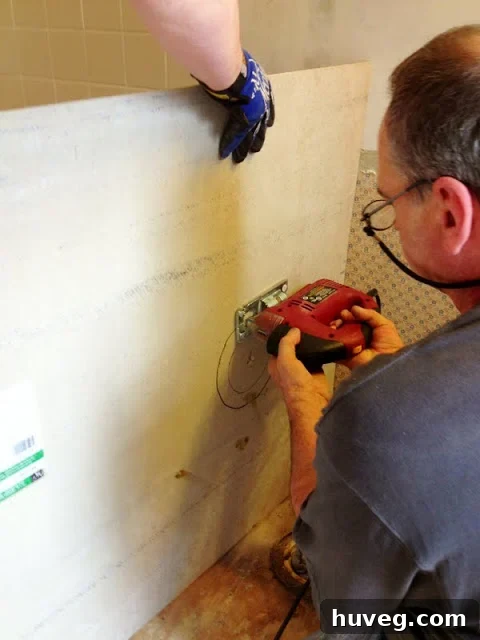
Cutting the hardibacker sheets to size is relatively straightforward. Using a heavy-duty utility knife and a straight edge, we scored the board deeply along the cut line multiple times. With a firm snap, the board breaks cleanly along the score. For more intricate cuts, such as curves or cutouts for pipes, a jigsaw equipped with a carbide-grit blade can be employed, though careful measurement and patience are always key to achieving clean lines. Safety is paramount during this process; wearing gloves to protect hands from rough edges and a dust mask to avoid inhaling cement board dust, which can be irritating, is highly advisable.
Before permanently fastening the hardibacker, we spread a thin, uniform layer of modified thin-set mortar over the subfloor using a 1/4-inch notched trowel. This step is often overlooked by beginners but is absolutely vital for a professional and durable tile installation. The thin-set creates a continuous, strong bond between the hardibacker and the subfloor, filling any small voids and preventing the board from flexing, which can lead to tile cracks down the line. It’s essentially “floating” the hardibacker on a solid bed of mortar, significantly enhancing the rigidity and structural integrity of the entire flooring assembly. Each hardibacker sheet was gently pressed into the thin-set, ensuring full contact.
Precision Cutting for Fixtures: The Toilet Flange
One of the more unique and critical cuts required in a bathroom floor is for the toilet flange. Achieving a perfectly sized and positioned hole is crucial not only for a clean aesthetic but also for proper toilet function and a watertight seal. For this, we employed a classic, tried-and-true DIY trick that guarantees accuracy: the twine and sharpie method. By anchoring a piece of twine at the exact center of the toilet flange and attaching a sharpie at the desired radius (the outer edge of the flange), we could easily draw a perfect circle directly onto the hardibacker sheet. This simple yet ingenious technique eliminates the need for complex measuring tools and ensures an accurate template for the cutout, even for irregular shapes if needed.
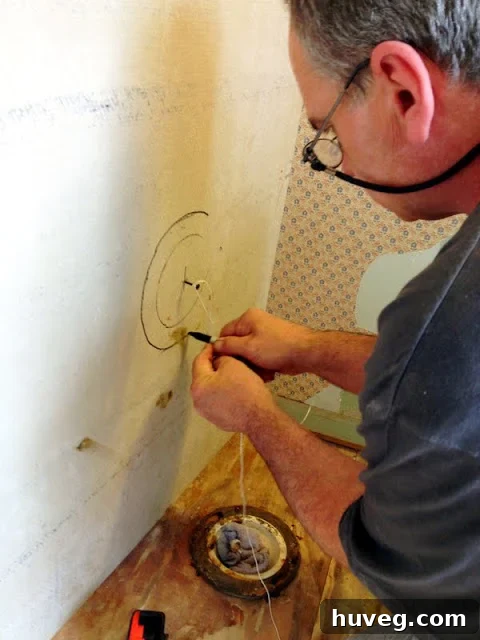
Once the circular outline was clearly marked on the hardibacker, we drilled a pilot hole inside the circumference, making it large enough to comfortably insert the blade of our jigsaw. With steady hands and careful control, we then meticulously followed the marked line, cutting out the precise opening for the toilet flange. This precision is essential to ensure that the toilet will sit flush and securely on the finished tiled floor, with no unsightly gaps around its base that could harbor dirt or allow moisture to penetrate. It’s these small details and accurate cuts that truly elevate a DIY project from amateur to professional-looking, ensuring both functionality and aesthetic appeal.
Final Touches: Securing and Sealing the Underlayment
With the hardibacker sheets carefully positioned and embedded into the thin-set mortar, the next crucial step was to secure them firmly to the subfloor. We used specialized cement board screws, which are designed with a coarse thread for superior grip and a flat head to sit perfectly flush with the board’s surface, preventing any protrusions that could affect tile placement. Screws were driven approximately every 6-8 inches along the perimeter of each board and within its field, ensuring full contact and maximum rigidity. It’s important not to over-tighten, as this can strip the screw hole or damage the board itself. Once all the screws were in place, providing a solid mechanical fastener, we moved to the critical step of sealing the seams.
We taped the seams between the hardibacker sheets with alkali-resistant fiberglass mesh tape, specifically designed for this purpose. This tape is then embedded in a thin layer of thin-set mortar, creating a continuous, reinforced surface. This final step is paramount as it helps prevent cracks from forming along the seams due to minor movements in the subfloor, providing a continuous, smooth, and robust surface that is perfectly prepared for tiling. This attention to detail ensures the integrity and longevity of the entire tile installation, protecting it from future issues and providing a flawless finish.
As the last screws went in and the thin-set for the seams began to cure, the bathroom transformed. It’s now about as clear and ready as it will be for a while, a pristine blank canvas awaiting its decorative tile. This completion of the underlayment is a significant milestone in any bathroom renovation project, marking the gratifying transition from structural preparation to the exciting phase of aesthetic design and tiling. There’s a tangible sense of accomplishment when you step back and see a perfectly flat, stable surface ready for the next layer of transformation – the beautiful tiles themselves.
After Dad and Tony departed, leaving behind a freshly prepped bathroom and a successful weekend of hard work, I found myself switching gears. My focus momentarily shifted from the bathroom to another ongoing project: the stairs. If you’ve been following my journey on Instagram, you’ve likely caught a few sneak peeks of the progress there. It’s a testament to the dynamic nature of home renovation that one project seamlessly flows into another, each bringing its own set of challenges and rewards. Whether it’s laying tile or tackling stair treads, the joy of creating and improving our home keeps the momentum going. More details on the stair project are definitely coming soon!
(A quick note on today’s post being a little delayed: life, as always, has a way of throwing unexpected curveballs! My first major exam of the semester is already upon me, and as most dedicated DIY bloggers know, content creation can become sparse and unpredictable during exam weeks. I’m incredibly grateful for the holiday just before it, as it means I’ll be spending the day with my nose firmly stuck in a book, attempting to unravel the intricacies of financial analysis of the stock market. Wish me luck – it’s a far cry from laying hardibacker, but equally challenging in its own way! Balancing passion projects with academic demands is always a juggle, but thankfully, the satisfaction of both makes it all worthwhile.)
Want to stay updated on all my DIY adventures and home improvement tips? I love sharing behind-the-scenes sneak peeks and daily progress updates on Facebook and Instagram. You can also connect with me and find more inspiration on Hometalk, and follow my quick updates and thoughts on Twitter at @uglyducklingDIY. Your support and engagement mean the world to me as I navigate these exciting (and sometimes messy) DIY projects! Please note that some links shared may contain affiliates – for more comprehensive information regarding my affiliate policies, kindly refer to my dedicated Disclaimer page.