Aqueous White Concrete Planter

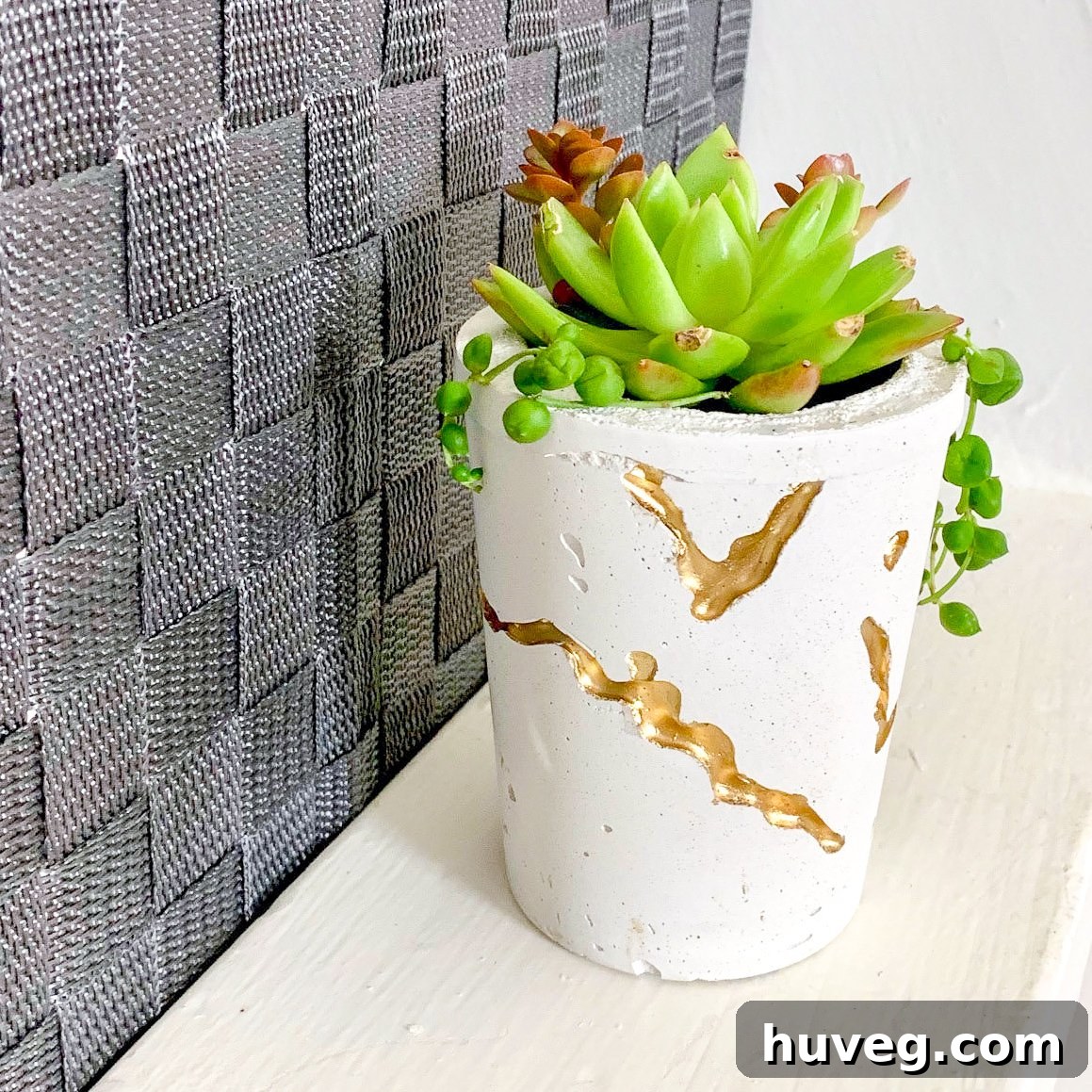
Unlock your creativity and craft a stunning white cement river planter, elegantly adorned with shimmering gold rivers! This unique DIY project promises a beautiful and durable addition to your home decor, perfect for showcasing your favorite plants with a touch of modern sophistication.
Hello, creative enthusiasts! I’m Ellen from Artsy Pretty Plants, and I’m thrilled to share yet another captivating cement crafting adventure with you today. If you’ve been following along, you might remember my previous cement project—a stylish candle holder. For those curious to learn more about my crafting journey and inspirations, feel free to explore my contributor profile here. Today, we’re diving into a project that truly tested my patience and determination, but the results are absolutely worth every bit of effort!
Crafting with cement can often be a delightful dance between precision and playful experimentation. Sometimes, the most rewarding projects are born from overcoming significant hurdles and countless adjustments, much like perfecting a cherished family recipe. I’ve certainly had my share of such experiences, as detailed in my adventures with the Cement Balloon Planter, which you can read about here. Each challenge is a learning opportunity, pushing the boundaries of what’s possible with this versatile material.
This particular white cement river planter proved to be quite the endeavor, requiring an astonishing 11 attempts to nail down the precise formula! Yes, you read that right – eleven tries until I achieved the perfect blend of consistency and curing time for this distinctive design. But rest assured, I didn’t stop there. To guarantee its success and ease for you, I meticulously replicated the process three more times, ensuring every detail was refined and foolproof. My dedication even led to an unexpected culinary surplus, leaving us with four large Tupperware containers (originally six!) of sour cream in our refrigerator. Thankfully, after much brainstorming, we’ve developed enough creative recipes to ensure not a single container goes to waste!
Therefore, to help you bypass my trials and tribulations and create this super cool DIY cement planter flawlessly on your very first try, I urge you to pay close attention to the important notes provided within the materials list. With my hard-earned insights, you’ll be able to complete this project with confidence and achieve a beautiful, professional-looking result – one and done!
Difficulty: Easy (with careful attention to notes and timing)
Essential Materials & Tools For Your White Cement River Planter
- Plastic drinking straw (for creating the perfect drainage hole)
- *Leaf Gold Metallic pen (for that stunning river effect)
- Tiny paintbrush (essential for intricate gold detailing)
- Scissors (for precise cutting of molds and straw)
- Hot Glue gun and 1-2 extra glue sticks (to create the unique river channels)
- Needle nose pliers (for carefully removing inner molds)
- Rapidset Cement-All (the core material for your durable planter)
- White Titanium Dioxide pigment (to achieve that pristine white finish)
- Plastic grocery bag (for easy cleanup and protection)
- Gloves (for hand protection when working with cement)
- Tablespoon measurer (for accurate pigment addition)
- Disposable mixing bowl (simplifies cleanup after cement mixing)
- Plastic cups (for scooping cement and holding water)
- Sand or small stones (to weigh down the inner mold)
- Baby oil or similar release agent (crucial for demolding the glue rivers)
- Q-tips (for precise application of lubricant)
- Permanent marker (for marking mold levels)
- Safety Glasses– sealed is better (essential for eye protection when mixing cement)
- X-acto knife (for precise cuts during demolding)
- Ruler (for accurate measurements)
Important Project Notes and Considerations
To ensure your success, please pay close attention to these crucial details regarding your molds and materials:
- **Outer Container:** I highly recommend using a 1 lb (16 oz) Daisy brand sour cream container. Its specific thickness, shape, size, and even color are ideal for this project, making the demolding process incredibly smooth and problem-free. Using these containers will significantly reduce any potential issues.
- **Inner Container:** The thin plastic top from a Play-Doh container is your ideal insert. This acetate sheet-type wrapper provides the perfect dimensions and flat bottom needed. The actual Play-Doh container itself is often a bit too wide and short. Many candles are also packaged with similar materials and may offer suitable alternatives.
Should you decide to use containers other than the ones specifically listed above, you might find the following tools helpful in troubleshooting potential demolding challenges:
- Tweezers (for delicate removal of stubborn glue pieces)
- Heat gun (useful for softening plastic molds during demolding)
- Multi-purpose lighter (BBQ type) (a last resort for softening inner molds)
**A Note on the Gold Metallic Pen:** I specifically recommend this particular type of paint pen for a very good reason: its unparalleled color vibrancy and exceptional coverage. I experimented with numerous other metallic paints, but none offered the rich, luminous gold or the smooth application that this pen provides. While you will still need a tiny paintbrush to meticulously trace into the narrower grooves of your “rivers,” the superior aesthetic quality it imparts makes this extra step entirely worthwhile for achieving that perfect, eye-catching finish.
**Outer Container Selection – A Deeper Dive:** While you certainly have flexibility in choosing your outer container, remember that all the instructions provided are meticulously tailored to the 1 lb Daisy sour cream container. This container’s unique properties—its specific plastic type, inherent flexibility, and consistent dimensions—are key to a successful demolding experience. If you opt for an alternative, ensure it possesses a shiny, smooth plastic surface. Containers with dull or textured finishes can dramatically increase the difficulty of separation from the cured cement. For instance, using a brand like Breakstone, which often features a mostly red plastic, might result in a subtle color transfer to your pristine white planter, which you may or may not desire. The crucial takeaway is the plastic’s inherent smoothness and non-porous nature to prevent adhesion issues.
**Inner Container Selection – Crucial Details:** The selection of your inner container is equally critical. It’s imperative to choose a mold that not only has a truly flat bottom but also allows for the planter walls to be sufficiently thick, ideally greater than ¼ inch. Finding a perfectly flat-bottomed plastic container can sometimes be a challenge, as many bottles have slight indentations. Furthermore, just like the outer mold, the plastic must be shiny and impeccably smooth; any texture or dullness on the inner surface will invariably lead to significant demolding difficulties, potentially marring your planter’s interior. During my own extensive experimentation, I discovered several excellent, cost-effective options at the Dollar Tree store that served perfectly as inserts, proving that you don’t need expensive molds to achieve professional results.
White Cement River Planter: Step-by-Step Tutorial
A special note on curing timing: The timing for curing is exceptionally important in this tutorial, particularly for ensuring the hot glue river inlays release cleanly and without issue. We will delve deeper into this critical aspect in Step 7. Please read all instructions thoroughly before beginning.
Step 1 | Preparing the Straw for Drainage Holes
Begin by plugging in your hot glue gun and allowing it to heat up to a low temperature. This initial step is vital for creating a functional drainage hole, a crucial feature for any healthy plant. The base of your finished planter should ideally be approximately ½ inch thick. The exact length of your straw segment will depend on the specific container you’ve chosen for your plastic insert. If you are using the recommended flat-bottomed Play-Doh insert, simply cut your plastic straw to a precise ½ inch length. Should your chosen bottle have a slight indentation at its base, ensure you account for this by adding that indentation’s depth to your ½ inch straw measurement, ensuring the drainage hole effectively pierces the planter’s base.
Once your glue gun is adequately heated, apply a generous dab of hot glue to one end of the cut straw segment. Allow this glue to cool and solidify briefly to prevent burning your fingers, then apply glue to the other end. Once both glued ends are dry and firm, carefully position the straw segment precisely in the bottom center of your sour cream (outer) container and firmly glue it in place. It is paramount that the straw is glued tightly and securely, exhibiting absolutely no wobble. If you detect any movement, do not hesitate to apply additional hot glue around its base to ensure a completely stable and watertight seal. This will guarantee a clear drainage path in your finished planter.
Step 2 | Designing Your Unique Inlay River Grooves
Now comes the truly artistic part of this project: creating the distinctive “river” effect that will later be highlighted with gold. You will achieve this by utilizing your hot glue gun to form intricate inlays on the interior sides of your sour cream container. With a steady hand, squeeze the hot glue onto the inner walls, designing any flowing, organic patterns that capture your imagination. Think of natural rivers, winding paths, or abstract designs – the possibilities are endless and entirely up to your personal aesthetic. As you create these glue lines, you will inevitably encounter those super thin, wispy stringy pieces of hot glue, often resembling delicate cobwebs. It is absolutely crucial to meticulously remove these immediately. If left in place, they will create unsightly hairline cracks and imperfections in the final cement surface, detracting from the pristine white finish. I found it significantly easier to carefully pull these strings out one “river” section at a time, ensuring I didn’t inadvertently disturb or mess up the other delicate glue patterns I had already created.
Step 3 | The Critical Step of Lubricating the Glue Lines
This step is absolutely non-negotiable for a successful demolding of your gold river inlays. To ensure that the hot glue “rivers” can be easily separated from the cured cement, they must be thoroughly lubricated. Take a Q-tip, dip it generously into your baby oil (or chosen release agent), and then apply the oil meticulously and thoroughly, but *only* to the hot glue lines and the drainage straw. Crucially, also apply it generously to the hot glue surrounding the straw. The hot glue has a strong tendency to bond firmly with cement, making it incredibly difficult to remove if not properly lubricated. Skipping this step will almost certainly lead to frustration and potential damage to your planter. A word of caution: do *not* lubricate the entire inner surface of the sour cream container. Any lubricant applied beyond the glue and straw can potentially cause an undesirable yellowish tint on the pristine white cement, compromising the aesthetic of your finished piece.
Step 4 | Precisely Aligning and Preparing Your Molds
Carefully insert your inner container (the Play-Doh lid or alternative) into the outer sour cream container. Gently push it down until it rests snugly. With a permanent marker, draw a clear line on the side of the inner container where it aligns perfectly with the top edge of the outer container. This mark will serve as a critical guide when pouring your cement and ensuring the inner mold is inserted to the correct depth. If your inner mold is indeed a flat-bottomed, smooth plastic container, you will be pleased to know that it does not require lubrication – its inherent smoothness will facilitate easy release. Now, to prevent the inner container from floating or shifting once the cement is poured, add a sufficient amount of sand or small stones into it. Follow this with a small amount of water to further stabilize the weight. This added ballast will keep the inner mold firmly in place, ensuring consistent wall thickness for your planter.
Step 5 | The Art and Science of Mixing Cement and White Pigment
Before you begin, don your safety glasses! Cement dust can be irritating, and eye protection is paramount. Pour approximately 2 cups of Rapidset Cement-All into your disposable mixing bowl. While this is slightly more than the exact amount you’ll likely need, it’s always prudent to have an excess. If you find yourself needing to mix a second batch mid-project, achieving an identical shade of white can be incredibly challenging, leading to noticeable inconsistencies in your finished planter. The leftover cement mix won’t go to waste; you’ll use it to craft your very own practical sanding block in Step 8. Next, add about 5-6 *rounded* tablespoons of White Titanium Dioxide pigment to the dry cement mix. Thoroughly stir the dry ingredients together until the pigment is mostly well-distributed and the mixture appears consistently white. There’s no benefit in adding more pigment than this amount; it will not make the cement any whiter, merely thicker.
Now, with careful attention, slowly begin to add *cold water* to the pigmented cement mixture and continue stirring. The goal is to ensure all the white pigment is fully incorporated and that there are no remaining lumps or dry pockets. The use of cool water is deliberate and important: it slows down the setting time of the cement, granting you precious extra minutes to work out any trapped air bubbles effectively. If you happen to be working in warmer temperatures, specifically above 80 degrees Fahrenheit, I highly recommend adding an ice cube or two to your water to help keep the mix cool and workable for longer. Observe the consistency carefully. The cement mix depicted in the image above was slightly too thick, which unfortunately resulted in a couple of small pits on the finished planter’s surface. Your ideal consistency should be pourable, akin to a thick milkshake or a smooth, pourable pancake batter – not too runny, but definitely not overly stiff. You may need to incrementally adjust the mix by adding a little more water or a small amount of additional cement until you achieve both the desired pourable consistency and the perfect shade of white. If you do add more cement, remember to compensate by adding a corresponding small amount of white pigment to maintain the color consistency.
Step 6 | Pouring the Cement into Your Prepared Mold
With your cement mix perfectly prepared, carefully pour it into the sour cream container. Fill it to just under ¾ inch full. Once poured, gently tap the container a few times on your work surface. This action helps the cement settle and begins the process of releasing any large, trapped air bubbles. Next, tap the sides of the container for approximately one minute to encourage further air bubble release. It’s important not to prolong this tapping for too much longer, as the Rapidset Cement-All begins to set quite quickly, and you need sufficient time to insert the inner container before it becomes too firm. As soon as you observe the air bubbles diminishing and stopping their rise to the surface, proceed immediately to insert the inner container into the outer container. Push it down gently yet firmly until you feel resistance where its bottom meets the drainage straw. Strive to ensure the inner bottle is perfectly centered within the outer mold, and carefully push it down until it aligns precisely with the line you marked in Step 3.
Any excess cement that overflows onto the top edges should be promptly wiped away. Now, with one hand holding the inner container firmly in place, use your other hand to gently shake and tap the entire mold several more times. This final series of taps helps to level out the top surface of the cement and ensures any remaining air bubbles are released. This meticulous process contributes to a smooth, flawless finish on your planter’s rim.
*Important Curing Note* Normally, you would allow cement to cure for more than an hour before attempting to demold. However, for this specific project, it is absolutely essential that you remove the outer container *early* in the curing process. This precise timing is critical for successfully extracting the hot glue inlays from the still-malleable cement. The optimal window for this will likely be between 45 minutes to just under an hour after pouring. At this stage, the container should feel distinctively warm to the touch, but not excessively hot. It is crucial *not* to allow the cement to fully cool and harden before attempting this step; otherwise, you risk the hot glue becoming irrevocably bonded to the cement, making its removal nearly impossible.
Step 8 | Crafting Your Custom Cement Sanding Block
While your cement planter begins its initial curing phase, let’s put that excess cement mix to good use. Take the leftover cement and form it into a compact, flattened “mud pie” shape. The goal is to create a block that is relatively flat on both sides, as this will serve as your incredibly effective and ergonomic sanding block. This simple trick is one of the easiest and most efficient ways to achieve smooth cement surfaces with minimal effort and no need for store-bought sandpaper. Set this homemade cement sanding block aside and allow it to fully cure and harden. It will be ready for use in the final finishing step of your planter.
Step 9 | The Delicate Process of Demolding Your White Cement Planter
When the container is still warm to the touch (remember, not hot, but definitely not fully cooled), it’s time to carefully remove the outer container. At this point, leave the inner bottle securely in place. Exercise extreme caution during this step: avoid applying any undue pressure on the inner container, as the cement has not yet fully cured and is still relatively delicate and susceptible to damage. To successfully remove the outer sour cream container, begin by making a small, initial slit in its top edge using your scissors. Then, carefully extend this slit downwards along the side of the container with your X-acto knife. With this incision, the container should begin to pull away and peel off quite readily. Work slowly and gently to avoid stressing the partially cured cement planter within.
Demolding Problem-Solving: Troubleshooting Common Issues
Should you have opted for containers different from the ones I’ve recommended, you might encounter some common demolding challenges. My own extensive experimentation with this project revealed several effective solutions:
Problem: The outer container is proving difficult to open sufficiently for removal.
Solution: In instances where the plastic of your outer mold is particularly rigid or resistant, a heat gun can be a valuable tool. Set your heat gun to a medium heat setting. Carefully and steadily run the heat gun straight up and down along the line where you intend to cut or tear the plastic. You should only need to make a few passes back and forth, totaling approximately 15 seconds, to achieve the desired pliability. Once adequately heated, the plastic should become sufficiently soft and flexible, allowing you to easily tear or peel the sides of the container away from the cement planter.
Problem: The hot glue is sticking stubbornly inside the inlay grooves.
Solution: This particular issue can be more challenging to resolve, and it’s important to note that the solution may not always be perfectly clean. Your primary approach can be to try lightly applying a heat gun set to a low temperature to the affected areas. The gentle heat should soften the glue, making it more pliable. Once softened, carefully use tweezers to gently pick and pull the softened glue pieces out of the grooves. Alternatively, very hot water can also be effective in softening the glue. In my trials, sometimes this method worked beautifully, yielding clean results; other times, it proved to be a bit messier, requiring more patience and careful manipulation. The key is gentle persistence to avoid damaging the delicate cement surface.
As you work your way down the planter, the bottom edge of the outer container may offer some resistance. If it doesn’t peel away easily, use your scissors to snip it again and, if necessary, apply the heat gun to further soften the plastic. At this point, you should be able to peel off the remainder of the container. With any luck and proper lubrication, most of the hot glue inlays should come away cleanly with the outer mold, leaving behind crisp, defined “river” channels in your white cement planter.
Step 11 | Releasing the Inner Container
After successfully removing the outer mold, allow the planter to rest for another 5-10 minutes to allow the cement to firm up a little more before attempting to extract the inner container. Prior to this step, always remember to put on your protective eye-wear. Using your scissors, carefully cut a long slit down the side of the inner container in a few different places. These slits will help break the suction and release the pressure, making it much easier to remove. Once the slits are made, grasp the container firmly with your needle-nose pliers and gently pull it out. Work slowly and methodically to avoid damaging the still-curing cement walls of your planter.
Problem: The inner mold remains stubbornly stuck inside.
Solution: If the inner mold proves particularly difficult to remove, a highly effective technique I found was to pour nearly boiling water directly into it. Allow the hot water to sit inside the mold for approximately 20 seconds. This heat will cause the plastic to soften and slightly contract, aiding its release. Carefully and quickly dump out the hot water, then immediately use your pliers to pull the mold out. Be extremely cautious to avoid burning yourself with the hot water or heated plastic. In most cases, this method will soften the plastic sufficiently for easy removal. If, however, the mold still won’t budge, the sticking point is often at the very bottom. As a last resort, you can use a long multi-purpose (BBQ-style) lighter to carefully and briefly apply heat directly to the bottom of the bottle from the inside. You should observe and hear the plastic begin to pull away from the cement base. Once this occurs, you should be able to remove it easily with your pliers. Only apply heat to the very bottom, and do so cautiously.
Step 13 | Refining Your Cement Planter with Sanding
Once your cement planter has been fully demolded, the next crucial step is sanding. Remember, the sooner you sand after demolding, the easier the process will be, as the cement is still relatively soft and workable. Retrieve your homemade cement sanding block. The goal is to smooth out the top edges of the planter, ensuring a perfectly refined and aesthetically pleasing finish. Identify the smoother side of your sanding block—this will be your primary sanding surface. To sand the edges, I found it easiest to simply place the sanding block flat on my work table and gently run the top rim of the planter across it, applying light, even pressure. This technique allows for consistent sanding and creates a beautifully smooth and level edge. After you’ve achieved the desired smoothness, thoroughly rinse the planter under water to remove all cement dust and allow it to dry completely. Ensuring it is bone dry is essential before proceeding to the final painting step, as any residual moisture can affect paint adhesion and finish.
Final Step | Illuminating Your Planter with Gold River Inlays
Now for the grand finale – bringing your “rivers” to life with a stunning metallic gold! Take your gold leaf pen and carefully begin to color in the recessed river channels you created with the hot glue. Work with precision, tracing the contours of each groove. You’ll likely encounter some lines that are too narrow or intricate for the tip of the pen. For these finer details, grab your tiny paintbrush. To access the paint, simply press the tip of your gold leaf pen onto a scrap piece of plastic or a small palette until a few drops of paint are released. Then, dip your paintbrush into this fresh paint and meticulously apply it to the smaller, more challenging lines. This technique allows for maximum control and ensures every part of your river design shimmers with brilliant gold. Take your time to fill each channel completely, achieving an even and opaque gold finish that truly makes your white cement planter a unique work of art.
And there you have it! Your very own handcrafted white cement river planter, complete with elegant gold accents, ready to house your favorite botanicals. This project not only yields a beautiful piece for your home but also a profound sense of accomplishment. For more inspiring DIY ideas and creative projects to beautify your space, be sure to check out the Artsy Pretty Plants blog here. Happy crafting!