Unbeleafable Discoveries!

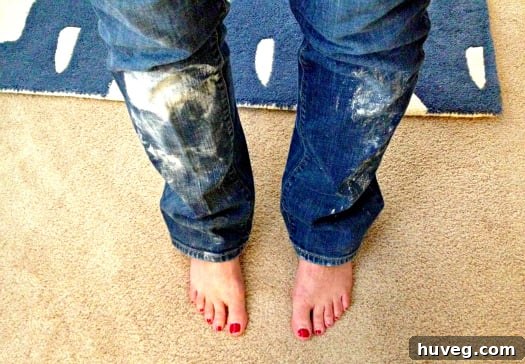
Unveiling the Hidden Horrors: My Home Renovation’s Grossest Discovery
When embarking on a home renovation journey, you mentally prepare for certain challenges: unexpected expenses, dust storms, the occasional burst pipe. What you don’t always anticipate are the truly grotesque revelations that lurk behind walls and under floors. If someone were to ask me, “What’s the absolute nastiest thing you’ve ever encountered while working on your house?” my mind would typically race through a series of equally revolting contenders.
There was, for instance, the unsettling discovery of press-on fingernails we unearthed in the fridge – a bizarre welcome gift from the previous occupants. And those weren’t isolated incidents; more fake nails continued to surface, nestled in closet corners, buried in the garage, and even embedded in the carpet. It was a macabre scavenger hunt that hinted at a peculiar past.
Then there was the kitchen, a true testament to neglect. It was so deeply encrusted with grime that standard cleaning agents proved useless. We resorted to industrial-strength oven cleaner just to tackle the countertops, and the very ceiling itself was an alarming shade of orange, a clear indicator of years, perhaps decades, of heavy chain-smoking by the former owner. The sheer scale of the filth was overwhelming, requiring days of intense scrubbing and airing out to render the space habitable. And let’s not forget the disgusting, caked-on dirt we found behind the stove, a thick, matted layer on the linoleum floor that seemed to defy all laws of hygiene. Any one of these repulsive finds could easily claim the title of “nastiest.”
But no. Despite these strong contenders, I now have a new champion in the realm of household horrors. And that, my friends, would be frass.
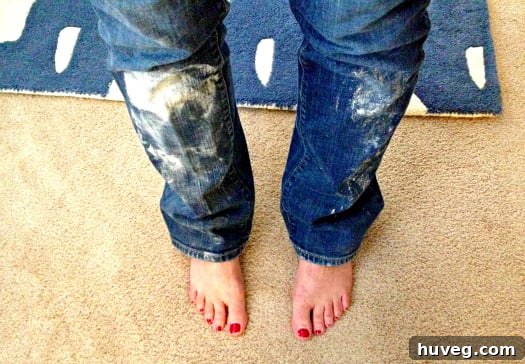
Understanding Frass: The Unsavory Truth About Insect Excrement
Yes, frass. I now possess (unfortunately) the precise and perfectly unappetizing vocabulary word for insect feces. Bug poo. Mite manure. Dragonfly dung. Entomological excrement. It’s one of those gross, nasty, creepy-crawly things in life that you desperately wish you could somehow unlearn or unsee. The mere mention of it conjures an involuntary shudder, a visceral reaction to something inherently repulsive and often unseen.
Frass isn’t just a fancy word for bug poop; it’s a critical indicator of insect activity, particularly in wood-boring pests. It often appears as fine, sawdust-like particles, sometimes granular, sometimes powdery, depending on the type of insect. Its composition usually includes digested wood fibers mixed with insect waste, and it can vary in color from light brown to black. While seemingly innocuous, frass can contain allergens, bacteria, and mold spores, posing potential health risks, especially if inhaled over time. It’s a silent testament to an infestation, a tell-tale sign that unwelcome guests have been making themselves at home, often hidden from plain sight.
Before you delve deeper into the narrative of my discovery, I must issue a few warnings. This story delves into some genuinely stomach-churning details, and I want to ensure you’re adequately prepared. For your comfort and general well-being, I strongly recommend avoiding the following activities before, during, or immediately after reading:
- Eating anything, especially anything delicious.
- Drinking any beverages, particularly those you hope to enjoy.
- Even thinking about eating or drinking, as it might irrevocably tarnish the experience.
- Changing diapers or engaging in any other activity that already involves dealing with bodily fluids or grossness, as this story might push you irrevocably over the edge.
- Having a cold, flu, or any other illness that might make you particularly queasy or sensitive to unpleasantness.
- Preparing yourself to be offended by my liberal (and entirely justified) overuse of references to poo and the occasional colorful expletive. Some situations simply demand such language.
The DIY Life: Project A.D.D. and the Value of Helping Hands
As the sole owner of my house, I often enjoy the luxury of dictating my own project schedule. Most of the time, I get to choose which room or task I feel like tackling next. I’ve affectionately dubbed this flexible approach “project A.D.D.” – a testament to the ever-shifting priorities and inspirations that come with renovating an older home. One week it might be painting a bedroom, the next it’s tackling a leaky faucet, and then suddenly, I’m drawn to refinishing a piece of furniture that wasn’t even on my radar.
However, this blissful autonomy takes a backseat when major undertakings require a crucial element: an extra set of skilled hands. When big, demanding jobs pop up, I don’t always get to control the timeline. This is where my incredibly helpful father and his equally handy friend, Tony, enter the picture. You see, Dad sometimes gets a free weekend, and he’ll suggest we work on something that isn’t necessarily at the top of my meticulously planned (or unplanned) to-do list. And when such an offer arises, you don’t say no.
For example, my primary bathroom has been a long-standing eyesore, but it wasn’t high on my immediate list of priorities. The entire lower level of the house is currently a chaotic war zone, thanks to every piece of furniture being crammed into the living room while I meticulously work on the dining room. Logistically, starting another major renovation, especially one as involved as a bathroom, seemed impossible. But when Dad calls, offering his and Tony’s time and expertise for a project I realistically couldn’t get to for another three months, I still say yes. Because that’s simply what you do when someone offers to lend their valuable time and skills to help you on a house, especially an old one that constantly demands attention. Their help isn’t just physical labor; it’s a huge psychological boost, transforming daunting tasks into manageable milestones.
Beginning the Primary Bathroom Demolition: A Journey into the Unknown
This past weekend, that exact scenario unfolded. Dad called and suggested he and Tony come over Sunday morning, ready to tackle a project. For those new to my renovation chronicles, Tony is my Dad’s incredibly handy fixer-friend who conveniently lives in my old neighborhood. His contributions to my house have been invaluable over the years. He helped paint the entire exterior of my house, added a sturdy gate to my backyard, and has assisted with all sorts of other projects that I would undoubtedly be lost attempting on my own. Their combined experience and practical problem-solving skills are a godsend.
This time, Dad and Tony arrived with a clear mission: to help me rip out my primary bathroom. This particular bathroom had been a target of renovation plans for over a year. Ironically, a previous attempt at renovation saw them come over while I was in class one weekend and, through a delightful mix-up, they ended up ripping out the *guest* bath instead! This time, however, we were focused. We started with the smallest but often most stubborn fixture – the toilet. It wasn’t long before the old toilet, complete with its rather quaint (and definitely dated) scalloped shell lid, was on its way out the door, signifying the official commencement of the demolition.
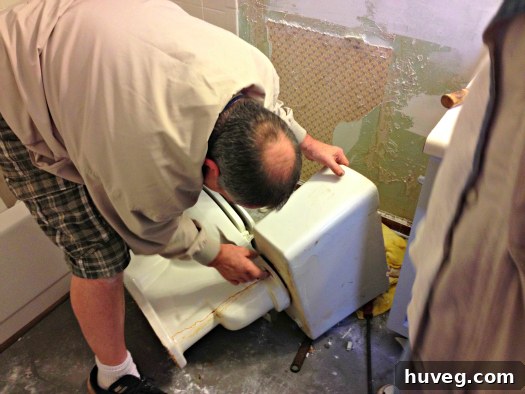
Next on the chopping block was the vanity. This proved to be a classic old-house challenge. Most of the screws holding the vanity in place were either stripped beyond recognition or simply weren’t anchored properly. The original builders seemed to have had an extraordinary amount of difficulty locating a stud to secure anything. One might ask, “Ya think?” It’s a common frustration in older homes, where construction practices often prioritized speed or simply differed from modern standards, leading to a precarious attachment of fixtures.
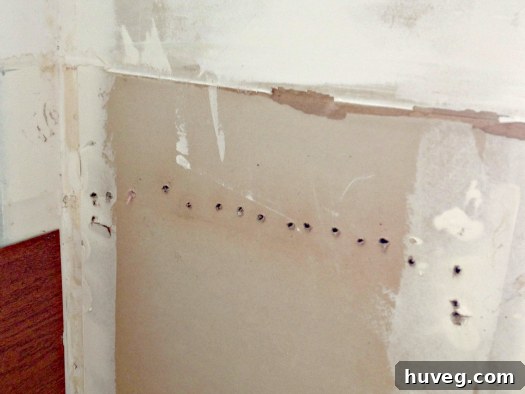
Given the stripped screws and lack of solid anchoring, a delicate removal was out of the question. We simply had to rip it out, piece by piece, leveraging sheer force and strategic prying. As they wrestled with the stubborn vanity, I positioned myself on the other side of the compact bathroom, gently prying away the baseboard. My aim was to salvage it, to carefully preserve the existing trim so I could reuse it once the new bathroom was ready. And by “other side of the room,” I mean I was approximately six inches from Tony’s feet – such are the joys of small bathroom renovations with multiple people. Dad, being the ever-resourceful supervisor and hauler, usually takes on the role of coordinating removal and taking away debris when the working space becomes too confined. He even got a crash course in iPhone photography that day, documenting our progress with slightly blurry, yet enthusiastic, snapshots.
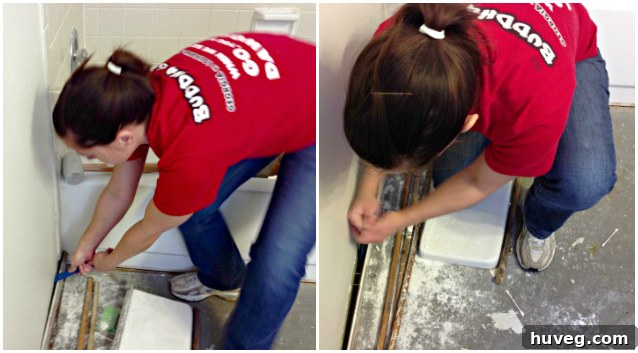
With the vanity and baseboards out, the next step was peeling up the old linoleum flooring. In many older homes, layers of flooring tell a silent story of changing tastes and decades of wear. This particular linoleum, bless its heart, had seen better days. To our combined surprise and grim satisfaction, it came up in pretty much one solid, albeit undeniably nasty, sheet. Underneath, a new layer of grimy history waited to be exposed, hinting at what lay beneath.
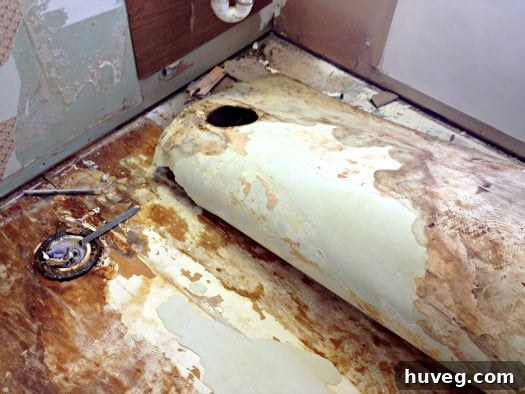
AND THEN… (prepare yourselves, a true warning is in order)
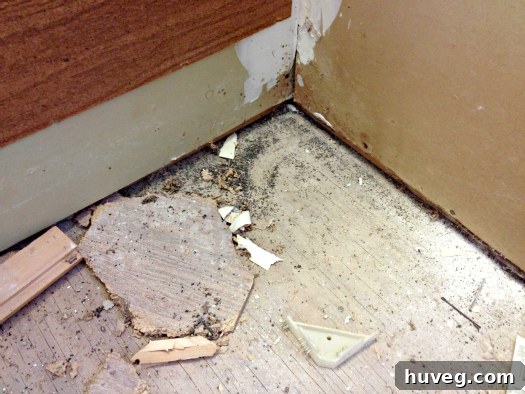
The Unsettling Revelation: A Pile of Frass
As the linoleum was removed, a dark, granular pile emerged in the corner where the vanity once stood. It wasn’t just dust or general construction debris; it had a distinct, almost organized appearance, a mound of something…organic. I just had to ask Tony, pointing a slightly trembling finger at the heap, “What the frick is that?” My stomach lurched, sensing something profoundly unpleasant.
Tony, ever the pragmatist with a remarkably high tolerance for grossness, simply glanced at it. “Oh, that’s just bug crap,” he stated casually, as if he were discussing the weather. My jaw dropped. “What? Um, bugs poop?” I stammered, the concept hitting me with a wave of utter disbelief and immediate revulsion. “Yep,” he confirmed, much to my horror, as he inexplicably and with startling nonchalance, swept it with his bare hand to get a closer look. He then added, with what he clearly intended as reassurance, “That’s been there a while though. I didn’t see any bugs, so they’re probably long gone by now.”
“Oh. Wait… Huh?” My brain struggled to process this information. Inside my head, a cacophony of horror, disgust, and primal fear erupted. Fear of breathing the very air that was now, in my mind, undoubtedly filled with microscopic bug poo particles. An intense, desperate need to immediately wash my hands, scrub them raw, and take a scalding hot shower to physically and psychologically cleanse myself of this unspeakable encounter. The thought of this vile substance having accumulated inside my house, possibly for years, sent shivers down my spine. The casualness with which Tony handled it only amplified my own extreme squeamishness. Tony and Dad, bless their oblivious hearts, left shortly after, satisfied that enough work had been accomplished for the day. But for me, the day was far from over. I absolutely had to get that shit (literally) out of my house. Donning a breathing mask, feeling like I was entering a biohazard zone, I swept, vacuumed, and scrubbed every inch of that corner and surrounding area until I felt a semblance of satisfaction, a belief that I could once again safely inhabit the same house as that room.
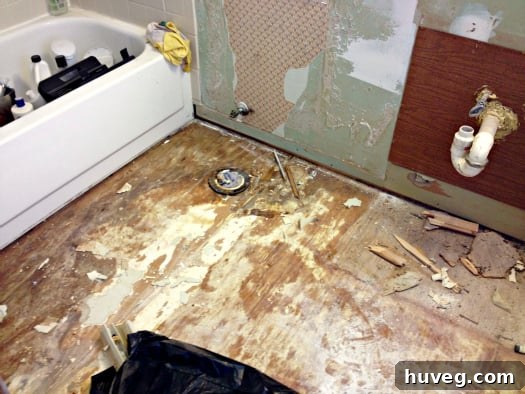
The Investigation: Connecting the Frass to a Larger History
After a good, long shower and several hand washings, my scientific curiosity (or perhaps just morbid fascination) kicked in. I embarked on a little bit of online research, diving into something I never thought I’d ever have to know: bug feces. I perused a few online forums and pest control articles, trying to make sense of what I had encountered. What I quickly learned is that bug poo indeed has a proper name – frass (it sounds so innocent, almost friendly, doesn’t it?). Most of the initial articles I found about frass were related to bed bugs, describing their tell-tale dark, digested blood spots. However, the location and appearance of the pile in my bathroom didn’t seem to align with bed bug activity, which typically occurs near sleeping areas and looks more like dark stains than granular debris.
Then, the pieces of the puzzle began to click into place. I put two and two together: termites. When I first moved into the house, I had a comprehensive termite inspection done, a standard procedure for older homes. My house, with its charming but susceptible cedar siding, had indeed shown signs of previous termite activity. Specifically, there was a fair amount of termite damage just outside of that very bathroom window, only about a foot from the corner where I discovered the pile of frass. We had diligently repaired the exterior damage, replacing affected wood prior to painting the house, taking preventative measures against future infestations. There have been no new signs of termite activity since I moved in – in fact, I had the inspector come by for another check in December, so I was confident that this was not a new or active problem. This comforting reassurance, however, led to a more unsettling realization: this considerable pile of shit must have been accumulating within my walls, hidden from view, for years. It was a silent, disgusting legacy of previous termite inhabitants, patiently waiting to be unearthed by an unsuspecting homeowner.
The things we learn about our houses, eh? Owning an older home is truly a continuous education, filled with unexpected lessons in history, architecture, and occasionally, entomology. It’s a journey that constantly reveals hidden stories, some charming, some challenging, and some – like the discovery of years-old frass – utterly, profoundly nasty. And while it was undeniably the most repulsive thing I’ve found to date, it’s also a stark reminder of the resilience of nature and the secrets old houses keep. This house, my “ugly duckling,” certainly continues to surprise me, proving that even after years, there are always new layers to uncover, for better or for worse.