My Secret to Invisible Cleaning Supplies


The laundry room, often a utilitarian space, has long presented a unique organizational challenge for homeowners. It’s where practicality often clashes with aesthetics, leading to a build-up of unsightly cleaning supplies, laundry essentials, and general clutter. However, with thoughtful design and clever storage solutions, it’s entirely possible to create a highly functional and visually appealing laundry room where everyday necessities are readily accessible yet neatly concealed. This is the guiding principle behind my redesigned laundry space, which holds a delightful secret: all the necessary, yet less-than-glamorous items are easily at hand, without being an eyesore when you step into the room.
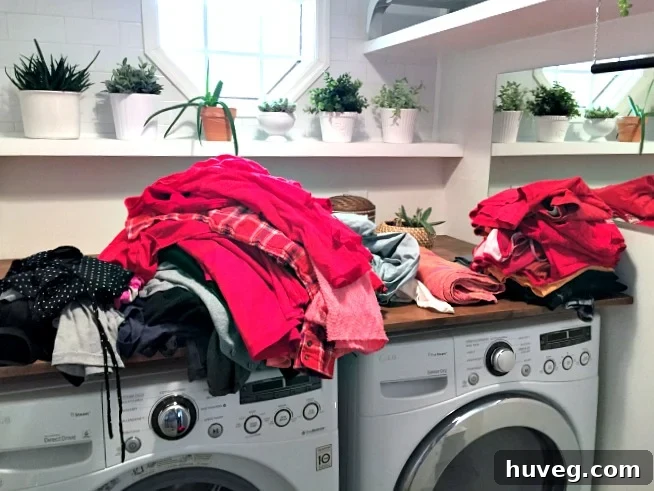
Admittedly, there are moments when the “hidden” aspect takes a backseat – particularly during the vibrant chaos of doing an entire load of red clothing. In those instances, the focus shifts entirely to the task at hand, and the art of concealment is momentarily forgotten. But these are brief interludes in an otherwise serene and organized environment.
For the most part, the comprehensive laundry room makeover project has delivered precisely what I’ve always yearned for: a laundry room equipped with a system that genuinely works, making daily chores more efficient and less burdensome. This transformation has not only enhanced the room’s appearance but also its overall utility, turning a formerly overlooked area into a highly functional and pleasant space.
When I initially revealed the refreshed room last month, a common question arose from some readers: was the presented picture merely a “pretty” version, carefully staged with unsightly cleaning supplies removed and styled to appear clutter-free? This is a valid question, as many home bloggers do, on occasion, present idealized versions of their spaces for photography.
However, those who have followed this blog for a while likely anticipated the answer: my approach leans heavily towards authenticity. I am both too naturally laid-back and too incompetent genuinely unprofessional as a stylist to orchestrate such an intentional staging stunt for mere appearances. After all, my blog has fearlessly delved into topics as unglamorous as discussing bug poop. My commitment has always been to share real-life projects and honest outcomes, even if they aren’t always picture-perfect in a traditional sense. Therefore, the direct answer to that query is both yes and no, but overwhelmingly, no. The only item typically found in the room that was absent from the initial reveal photos was a bottle of bleach, simply because I had run out. Everything else – the detergent pods, the dedicated lint trash can, the dryer sheets – was precisely where it usually resides, demonstrating the true, everyday functionality of the space.
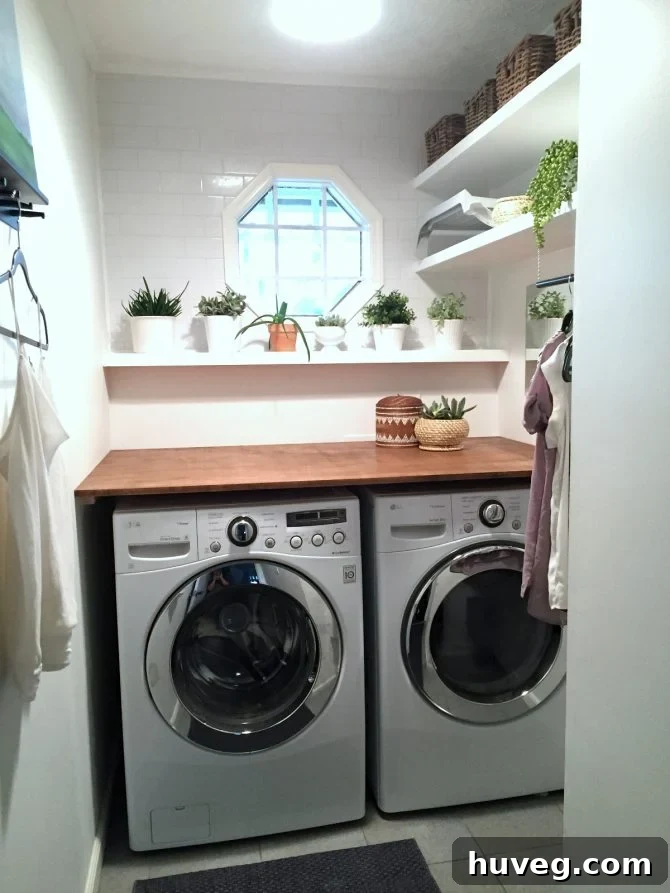
Below is a detailed breakdown of how these essential laundry items are thoughtfully integrated and discreetly stored, maintaining both order and visual harmony in the room. (Note: some links provided contain affiliate connections, which may result in a small commission if a purchase is made through them.)
Clever Storage for Dryer Sheets
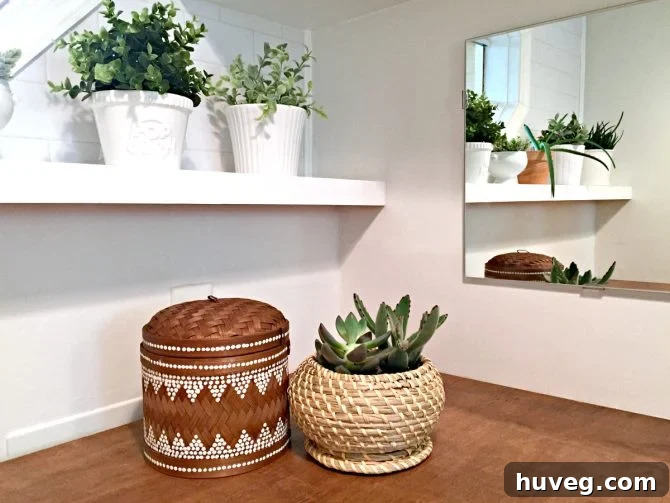
One of the simplest yet most effective ways to enhance your laundry room’s aesthetic is to elevate the storage of everyday items. Take dryer sheets, for instance. Instead of keeping them in their original, often visually unappealing cardboard box, I opted for a decorative basket on the counter. This specific basket, a clearance find from World Market some time ago, proved to be the perfect size – just large enough to neatly hold a supply of dryer sheets once they’ve been removed from their bulky packaging. This small change instantly elevates the look of the countertop, transforming a mundane item into part of the decor. A bonus benefit is that since the basket isn’t airtight, the subtle, fresh linen scent from the dryer sheets gently permeates the room, creating a pleasant aroma. This win-win solution combines practical storage with a subtle atmospheric enhancement, proving that even minor adjustments can make a significant difference in a laundry room’s appeal and functionality. Consider using woven baskets, ceramic jars, or even repurposed tins to achieve a similar effect, ensuring your dryer sheets are both accessible and artfully concealed.

Discreet Storage for Laundry Pods
Laundry pods have become a staple for many due to their convenience and pre-measured simplicity. However, their brightly colored packaging or clear plastic tubs often detract from a cohesive room design. My solution for laundry pod storage predates the full makeover: a sturdy ceramic container. I’ve been utilizing laundry pods since investing in my new washer and dryer, and this particular container has consistently served as their home, both before and after the renovation. I discovered this gem at Goodwill, originally intending to repurpose it for plants, much like I did with others along the window shelf. What made it perfect for pods, however, was the inclusion of a lid. This lid not only ensures the pods are completely out of sight but also helps protect them from moisture and curious pets or children – an important safety consideration for any household with these concentrated detergents. I’m actually considering darkening the lid with a touch of my favorite wood restorer to better complement the beautiful DIY wood countertop, further integrating it into the room’s aesthetic. This approach demonstrates how repurposing items and selecting containers with lids can effectively keep essentials hidden while maintaining easy access.
An Ingenious DIY Lint Trash Solution
One of the most satisfying and surprisingly impactful upgrades in the laundry room makeover, despite its inherent simplicity, was the transformation of the lint disposal system. In its previous incarnation, I had attempted a poorly executed DIY rope basket project, which had served as the designated lint trash for several years.
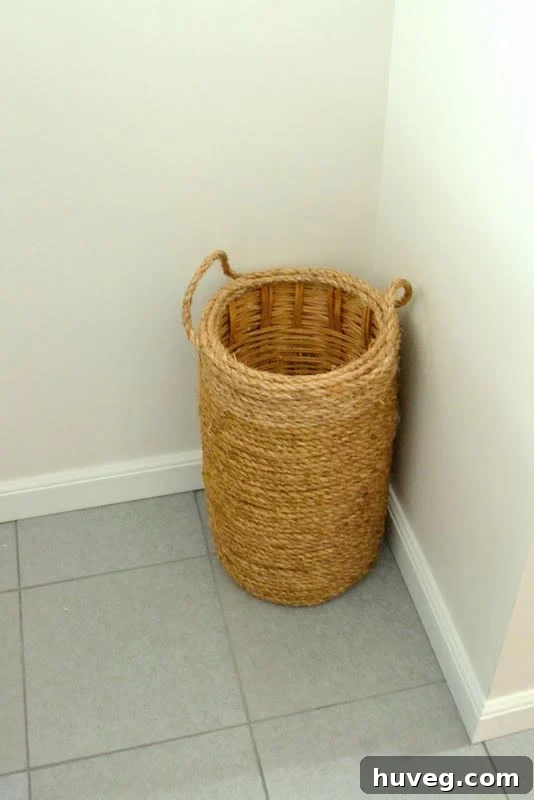
The fundamental flaw with that initial solution was its excessive size. While my dog, Charlie, certainly contributes a significant amount of shedding-related lint, the basket was still far too large for its intended purpose. It required an impractical amount of lint to fill, and my personal habit dictates that if a trash receptacle isn’t visibly full, it often gets ignored. This meant the lint would accumulate far longer than necessary, becoming an unsightly and inefficient element in the room. When the comprehensive room makeover commenced, prioritizing functionality and aesthetics, I resolved to replace it with something considerably smaller and, crucially, much easier to conceal and manage.
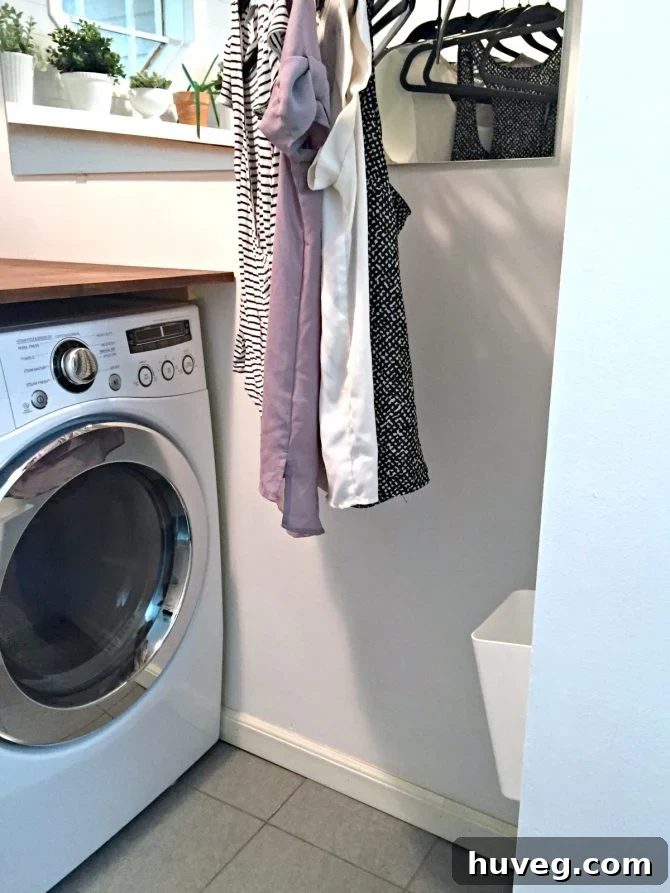
The laundry room’s layout is somewhat L-shaped, with the downstairs powder room situated on the opposite side of one wall. This configuration creates a small, recessed wall section that faces the washer and dryer but is not directly visible from the main doorway into the room. This overlooked space presented a perfect opportunity for a discreet lint disposal system. I formulated a new plan, repurposing a few pieces of scrap molding left over from the photography equipment stand in my office. With a touch of wood glue and a lick of paint, I crafted a small, minimalist lip that would serve as a makeshift hook. This piece was then securely screwed onto the wall at roughly knee height – a deliberate placement to ensure it remained unobtrusive and wouldn’t interfere with any items hanging to dry above it.
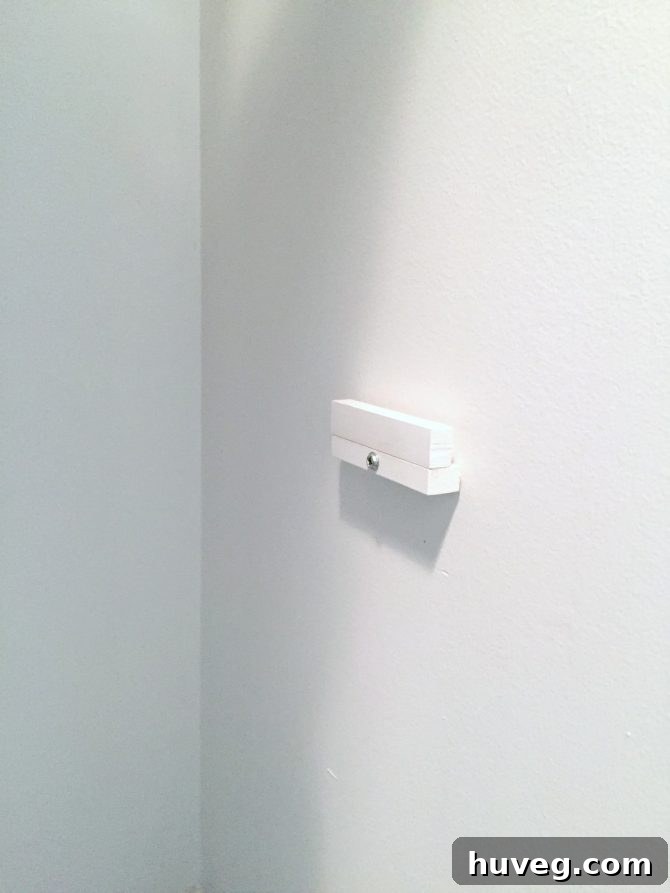
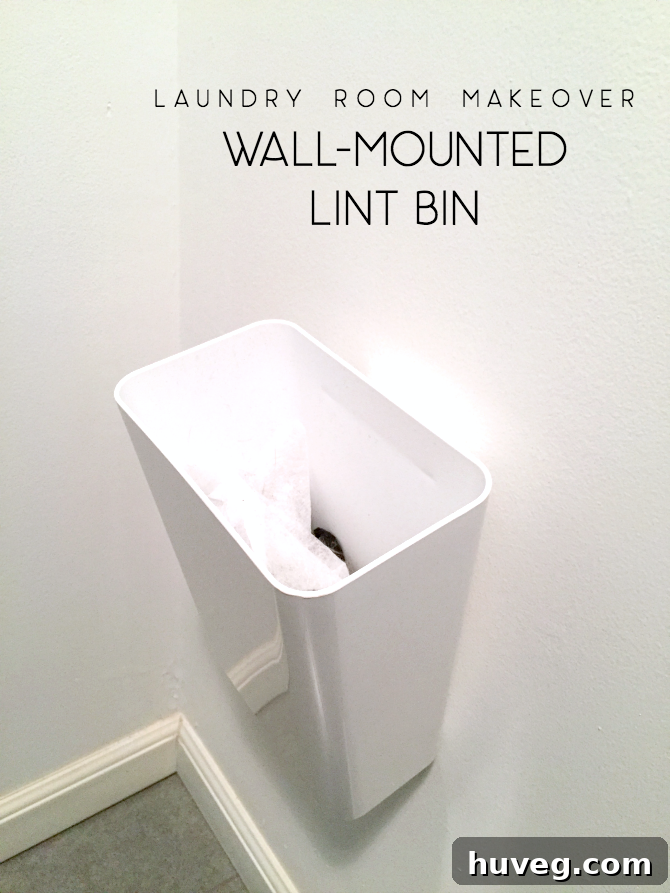
Next, I acquired a compact container during an IKEA shopping excursion, a store I affectionately refer to as my BFF. This container was ideal for the task. Its design included a small lip on the back, allowing it to hook perfectly onto the custom-made wall bracket I had installed. Blending seamlessly with the white wall color, the container offers just enough capacity to hold several loads’ worth of lint. Furthermore, its rigid structure makes emptying it a breeze – a simple inversion into the kitchen garbage is all that’s required. This is a stark improvement over the previous rope basket, where lint would cling and get trapped, demanding two hands and a wrestling match to properly clean it out. This new system is a wonderfully simple and effective solution to an annoying, everyday problem.
Positioned directly opposite the dryer door, it’s precisely where I need it when emptying the lint trap after each load, yet it remains completely out of the way and visually discreet. While I briefly considered making it more decorative, perhaps with a washi tape project, I ultimately preferred its plainness. This unassuming design actually enhances its invisibility, allowing it to blend into the background rather than draw attention. This tailored, wall-mounted lint bin not only resolves a practical issue but also contributes significantly to the overall clean and streamlined appearance of the laundry room, showcasing how even the smallest, most functional elements can be integrated thoughtfully into a design.
Organizing Lesser-Used Items
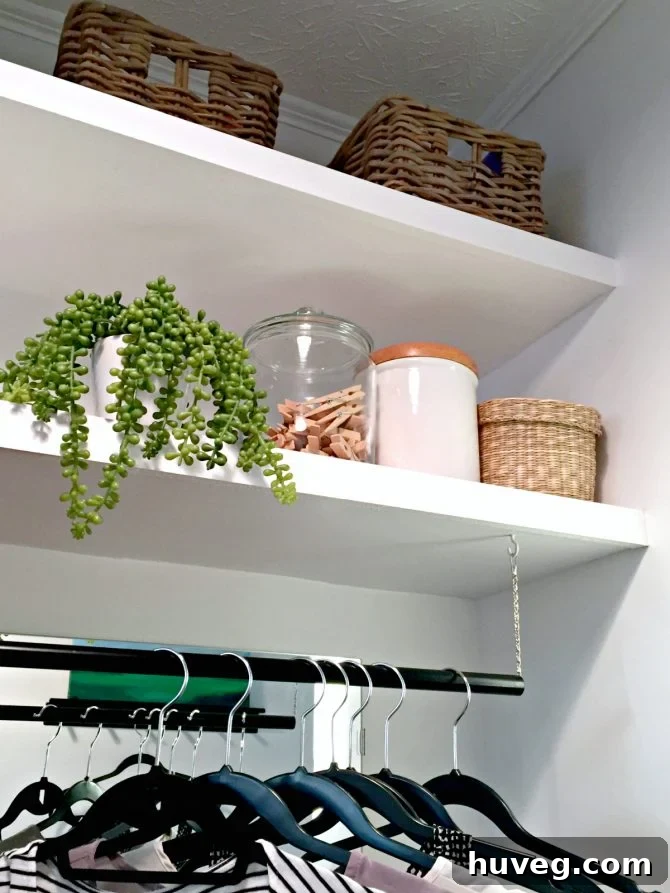
Beyond the daily essentials, every laundry room accumulates a variety of items that are used less frequently but are nonetheless important. These might include dry cleaning bags, bulk refill bags or boxes of laundry supplies, specialty stain removers, or fabric protectors. The key to maintaining a perpetually organized space is to have a dedicated, out-of-sight home for these items. In my laundry room, these “lesser-used items” are neatly tucked away in a series of coordinated baskets placed on the top shelf. Utilizing uniform baskets on open shelving is a fantastic design trick; it instantly creates a sense of order and reduces visual clutter, making the storage itself part of the room’s decor. By categorizing items and assigning them to specific baskets, it’s easy to retrieve what’s needed without disturbing the overall tidiness. This approach ensures that even the occasional-use items are easily accessible when required, yet remain concealed the rest of the time, contributing to a consistently polished and functional laundry environment.
The Power of Thoughtful Laundry Room Organization
Achieving a truly functional and beautiful laundry room isn’t about grand gestures alone; it’s often the cumulative effect of small, thoughtful tweaks and clever storage solutions. The methods discussed here – from decorative containers for dryer sheets and discreet ceramic jars for pods to an ingeniously designed, hidden lint bin and uniform baskets for bulk supplies – exemplify this philosophy. Each adjustment, while seemingly minor on its own, contributes to a cohesive system that minimizes clutter, maximizes efficiency, and enhances the overall aesthetic of the space. The result is a laundry room that manages to look spiffy and clean virtually all the time, making mundane chores a more pleasant experience. That picture of red laundry you saw earlier? That was taken mid-folding, a testament to the fact that even during active use, the underlying organization remains intact.
In a future post, I plan to delve deeper into broader laundry room organization principles, sharing more insights into maximizing vertical space, effective decluttering strategies, and the benefits of thoughtful labeling. I must confess, I’m quite surprised by my own transformation lately: I, the self-proclaimed and perpetually joking “slob,” seem to be genuinely making strides towards a more organized home for the long haul. It’s a journey, but one that is steadily turning years of labor into a truly personalized and functional home. Who would have ever thought such an evolution was possible?