Covert Glimpses

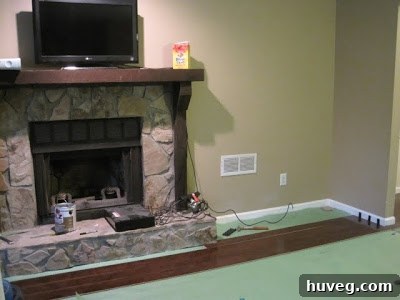
Transforming Our Living Space: Mastering Flooring Installation Around the Fireplace
Last week, we invited you into the heart of our home renovation project, sharing the initial steps as we meticulously cut into our fireplace to prepare for the much-anticipated installation of our new floors. The transformation began, and the excitement, along with a healthy dose of apprehension, was palpable. Now, with more progress under our belt, more sawdust on the lawn, and a few valuable lessons learned, are you ready for another peek at where we stand?
Oh, absolutely you are! Let’s dive in!
Yeah buddy, the progress is undeniable!
I would genuinely love to declare that the process of perfectly fitting the flooring pieces around the intricate contours of our fireplace was an absolute cakewalk, yielding flawless results on the very first attempt. Such a claim would, however, be a fabrication. Despite our careful preparations, which included the arduous task of cutting underneath the hearth to create a seamless transition, achieving a perfectly straight and continuous line of flooring across the entire length, from the dining room into the living room, proved to be far more challenging than anticipated. This crucial section demanded unparalleled precision, turning what we hoped would be a straightforward task into a testament to patience and perseverance.
Indeed, sometimes the simplest math equations become profoundly complex when applied to real-world, irregular surfaces. Math is hard, especially when it involves flooring.
Navigating the Labyrinth of Precision Cuts: The Fireplace Dilemma
The phrase “measure twice, cut once” is a mantra in DIY, but around a fireplace, it feels more like “measure ten times, cut very, very carefully, and still expect an ‘oops’ piece.” Scott, ever the perfectionist, found himself wrestling with angles, curves, and the stubborn realities of an uneven existing structure. The frustration mounted, and soon, a collection of miscut planks—each a casualty of a millimetric miscalculation or an unexpected variation in the hearth’s stonework—began to accumulate on our front lawn. These “oops” pieces served as humble reminders of the steep learning curve inherent in any detailed home improvement project.
Installing flooring around a fireplace is arguably one of the most intricate aspects of a floor renovation. Unlike straight runs across open rooms, the fireplace presents a unique set of architectural challenges. You’re dealing with a fixed, often irregular, obstacle that demands meticulous templating and cutting. Each plank must be custom-fitted, often requiring complex coping cuts or precise scribing to match the profile of the hearth perfectly. This isn’t merely about aesthetic appeal; proper fitting is crucial for the longevity of the floor, preventing unsightly gaps where dust and debris can collect, and ensuring the expansion gaps necessary for the material to naturally adjust to humidity and temperature changes. A poorly cut piece can compromise the entire look and structural integrity of the surrounding area, necessitating costly replacements or compromises.
Essential Tools and Techniques for Intricate Flooring Work
To conquer the fireplace challenge, a diverse arsenal of tools becomes indispensable. While a trusty miter saw handles the bulk of straight, angled cuts for the main body of the room, the delicate dance around the hearth demands specialized equipment. A high-quality jigsaw, with its ability to make curved and intricate cuts, is paramount. Often, a multi-tool or oscillating saw is employed for undercut cuts around door jambs or, in our case, to further refine the cuts where the flooring meets the hearth, ensuring a clean, professional finish. The process often involves creating cardboard templates first, precisely tracing the contours of the fireplace, and then transferring these exact shapes onto the flooring planks. This methodical approach minimizes waste and significantly boosts accuracy, transforming guesswork into informed decisions.
Beyond cutting, the success of a flooring project hinges on a range of other tools and techniques. Spacers are critical for maintaining uniform expansion gaps along walls and around fixed elements like the fireplace, allowing the floor to “breathe.” A tapping block and rubber mallet are used to gently, yet firmly, seat planks together, ensuring tight seams without damaging the tongue-and-groove system. For the final rows or in tight spaces, a flooring pull bar becomes invaluable for cinching planks into place. Learning to use each tool effectively, combined with a healthy dose of patience and a willingness to accept minor imperfections as part of the DIY journey, transforms a daunting task into a series of achievable steps. It’s a testament to the fact that home renovation is as much about skill development as it is about physical labor.
Our Unique Outdoor Workshop: A Georgia Dust Cloud Story
For those uninitiated in the ways of our household renovations, there’s a rather distinctive aspect to our operation that often elicits curious glances, if not outright bemusement, from our neighbors. I refer, of course, to our outdoor cutting station. You see, Scott conducts virtually all of his major cutting—be it for our new flooring, trim, lumber, or any material requiring the power of a saw—right in front of our house, squarely on our lawn.
One can only imagine the scene: dog walkers and joggers making their daily rounds are often greeted by a swirling cloud of sawdust, glistening in the relentless Georgia sun and humidity. It’s an unconventional sight, to be sure, far removed from the pristine manicured lawns often associated with suburban living. However, this isn’t merely an eccentric preference; it’s a practical necessity born from the architectural constraints of our home. We are the proud owners of a charming, yet compact, one-car garage. This limited space, while perfectly adequate for parking a single vehicle, quickly becomes an unmanageable jumble of tools, materials, and equipment when a serious renovation project is underway. The slightest addition can render the space cramped, unsafe, and utterly inefficient for operating large power tools.
Establishing our “workshop” outdoors offers a multitude of benefits that far outweigh the occasional odd look. Foremost among these is the sheer abundance of space. Long planks of flooring can be handled with ease, saws can be set up without fear of obstruction, and movement is unrestricted. More crucially, the outdoor environment provides unparalleled ventilation. Cutting wood generates a significant amount of fine dust, which, if concentrated indoors, poses a serious health hazard and creates an arduous cleanup task. By moving the operation outside, we effectively mitigate these risks, ensuring a healthier breathing environment and minimizing indoor dust accumulation. Of course, this strategy comes with its own set of considerations: the unpredictable Georgia weather, where a sudden downpour can halt progress, the need for ear protection to be mindful of noise for neighbors, and constant vigilance against curious pets or children. Yet, the overall efficiency, safety, and comfort derived from this open-air setup make it an indispensable part of our renovation process.
Despite the occasional spectacle and the need for frequent sweeping of the front porch, the advantages of our outdoor setup are invaluable. It’s a small compromise that provides ample room for Scott to truly do his “thang” – to cut, measure, and assemble with the freedom and safety that an enclosed space simply cannot offer. Moreover, it sometimes even sparks friendly conversations with neighbors, allowing us to share our renovation journey and perhaps inspire their own DIY adventures. The fresh air, even with a hint of pine, is infinitely preferable to the stuffy, dusty confines of a crowded garage, reinforcing our belief that every challenge has a creative solution in the world of DIY.
The Enduring Value of DIY and What Lies Ahead
This entire process, from the initial preparations and the meticulous cutting around the fireplace to the innovative solutions for our workspace, highlights the profound and enduring value of DIY home renovation. It is a journey rich with both triumphant successes and frustrating setbacks, moments of deep satisfaction intertwined with occasional exasperation. Each obstacle overcome, each new skill diligently acquired, and each visible improvement contributes not only to the aesthetic enhancement of our home but also significantly to its intrinsic value and our personal, emotional connection to the space we inhabit.
The visual progression of the new flooring slowly but surely coming together, plank by painstaking plank, offers an incredibly fulfilling reward. While the pile of “oops” pieces on the lawn might incrementally grow, so too does our sense of accomplishment and the depth of our practical knowledge. The transformation occurring within our home is tangible, real, and profound. Every ounce of effort, every frustrating miscut, and every cloud of sawdust floating gracefully in the Georgia breeze ultimately serves as a contributing factor to the grander vision we hold for our dream home. We are unequivocally getting there, steadily, one thoughtfully placed plank at a time, building not just a floor, but a future within these walls.
It’s truly worth every single bit of effort and every moment of dedication. The unwavering anticipation of seeing our carefully crafted vision materialize is the powerful force that propels us forward through the most challenging segments of this journey. And with that positive affirmation, we conclude another productive week of renovation progress. Happy Friday, everyone! We sincerely wish you a weekend brimming with successful projects, whether they are grand undertakings or small, satisfying tasks, and an abundance of well-deserved relaxation and rejuvenation.