Automated Arbor

Unlock Effortless Holiday Cheer and Everyday Convenience: The Power of Simple Programmable Timers
The holiday season, for all its joy and warmth, often brings its own set of challenges. This year, my festive preparations were abruptly halted by an unwelcome guest: a searing pain in my neck. What started as a suspected “slept wrong” crick has now persisted for nearly a week, turning simple tasks into agonizing endeavors. My neck and upper back muscles feel like a tangled knot, severely restricting my movement and making the usual decorating rituals – particularly wrestling with strings of lights – feel almost impossible.
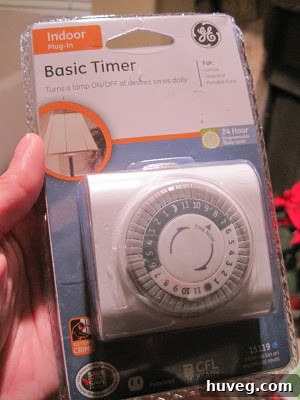
The struggle to get ready for work each morning, coupled with the desire to transform my home into a festive wonderland, underscored a critical need for smarter solutions. Bending, reaching, and constant manual effort were clearly exacerbating the problem. It was during this moment of discomfort that a small, unassuming device I picked up on Black Friday came to mind – a simple, yet remarkably effective, GE 24-hour programmable timer. Perhaps it was a stroke of subconscious genius, or perhaps just a pragmatic decision to curb my electric bill, but purchasing several of these timers has proven to be an invaluable investment in both my physical comfort and overall household efficiency.
The Elegant Simplicity of a Mechanical Timer
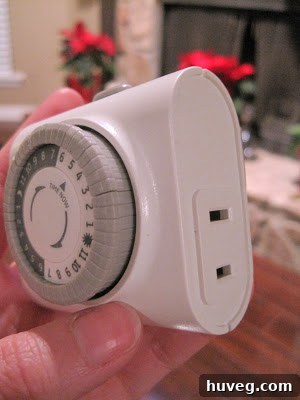
In an age dominated by complex smart home ecosystems and app-controlled devices, there’s a refreshing appeal to the mechanical timer. This particular GE model stands out for its straightforward design and robust functionality. It’s built for reliability and ease of use, offering a tangible solution without the need for Wi-Fi, batteries, or intricate programming sequences. The core of its operation lies within its intuitive dial, meticulously segmented to cover a full 24-hour cycle.
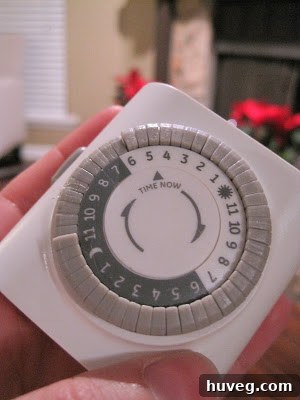
The dial is divided into 48 segments, each representing a half-hour increment throughout the day. For clarity, one half of the dial is distinctly shaded dark, symbolizing the evening and nighttime hours, while the other half remains white, signifying daytime. This visual cue makes it incredibly easy to distinguish between periods when you want your connected appliance to be active or inactive. The beauty of this design is that you don’t need a degree in electrical engineering to operate it; the mechanism is designed for the everyday user.
Decoding the Dial: A Minor Initial Hurdle, Major Long-Term Ease
When I first encountered the timer, there was a brief moment of head-scratching – a common experience, I’ve since learned. The initial instructions often imply that you need to *push down* segments to activate the timer. I spent an amusing, albeit frustrating, few minutes trying various implements – fingernails, pen caps, and even a fork – to depress what I thought were stubborn buttons. Each attempt was met with resistance, leading me to believe the timer was faulty, or perhaps I simply lacked the necessary strength.
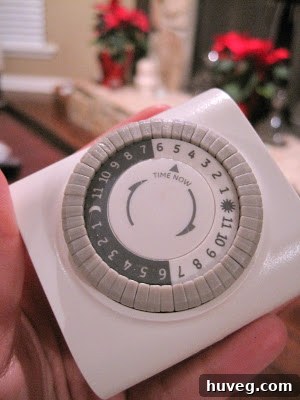
It was only after practically mangling one package and opening another that a lightbulb moment occurred. The segments weren’t meant to be pushed *down* to turn them on; they were already *down* by default, representing the “on” state. The trick, I discovered, was to *pull up* the segments corresponding to the half-hour periods when I wanted the lights or appliance to be *off*. This revelation was met with a mix of self-deprecating laughter and immediate relief. Once this minor operational quirk is understood, the timer’s logic becomes incredibly simple and intuitive. You effectively ‘punch out’ the times you want your device to be inactive, leaving the active periods recessed.
Step-by-Step Setup: Mastering Your Programmable Timer
Setting up these programmable timers is a straightforward process once you grasp the basic principle. Here’s a detailed guide to get your appliances running on an automated schedule:
- Set Your “ON” and “OFF” Times: As explained, the segments are initially “down” (representing “on”). Identify the specific half-hour increments during which you want your appliance to be *off*. Gently pull *up* each of these segments. For example, if you want your lights to be off between midnight and 6 AM, you would pull up all the segments from 12 AM to 6 AM. The remaining “down” segments will correspond to the times you want the appliance to be “on.”
- Align the Current Time: Once your desired schedule is set, rotate the entire dial until the small triangular arrow on the timer’s face points precisely to the current time of day. This synchronizes the timer’s internal clock with real-world time, ensuring your schedule runs accurately.
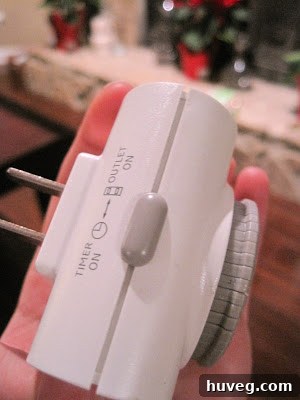
- Select “Timer” Mode: On the top of the unit, you’ll find a simple toggle switch. Ensure this switch is moved from “Outlet” (which provides continuous power like a regular wall socket) to “Timer.” This activates the programmed schedule you just set.
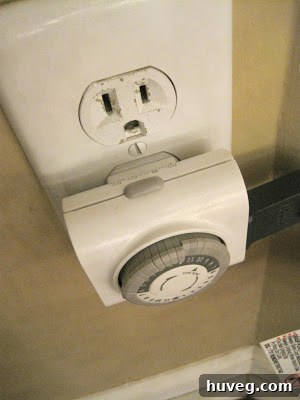
- Plug in Your Appliance: Finally, plug the appliance you wish to control – in my case, the festive Christmas tree lights – into the timer’s outlet.
That’s it! Your appliance is now on an automatic schedule, freeing you from the daily chore of plugging and unplugging. It’s a set-it-and-forget-it solution that brings surprising utility.
Beyond Convenience: The Multifaceted Benefits of Programmable Timers
Initially, I viewed these timers purely as a way to avoid bending over to plug in Christmas lights. However, their utility quickly expanded, revealing a host of benefits that extend far beyond simple convenience. These unassuming devices offer tangible advantages in physical comfort, energy conservation, and even home security, proving that smart solutions don’t always require high tech or a hefty price tag.
1. Alleviating Physical Strain and Enhancing Accessibility
For individuals grappling with back pain, neck stiffness, arthritis, or other mobility challenges, the simple act of bending down to access an outlet can be excruciating. These timers eliminate that necessity entirely. Imagine not having to awkwardly reach behind furniture or contort yourself to switch on your holiday decorations. For me, with my current neck pain, this feature alone has been a game-changer. It means I can still enjoy a beautifully lit home without worsening my condition, making the festive season more inclusive and enjoyable for everyone.
2. Significant Energy Savings and Reduced Utility Bills
Leaving lights or appliances on longer than necessary is a common habit that translates directly into wasted energy and higher electricity bills. The programmable timer addresses this efficiently. By allowing you to precisely dictate “on” and “off” times, it ensures that devices are only active when truly needed. For example, holiday lights can be programmed to switch off automatically just before bedtime and turn back on in the late afternoon. This prevents them from running all night, saving a significant amount of electricity over the entire season. This intelligent energy management also contributes positively to environmental conservation by reducing overall power consumption.
3. Enhanced Home Security and Burglar Deterrence
One of the most underrated benefits of programmable timers is their contribution to home security. An unoccupied house with consistently dark rooms is an obvious target for potential intruders. By connecting lamps or other light sources to a timer, you can create the illusion of occupancy even when you’re away. The lights can be set to turn on and off at varying times, mimicking the natural patterns of someone being home. While my trusty dog, Colby, remains our primary home invasion deterrent, these timers provide an excellent layer of backup. A dynamically lit home is far less appealing to would-be burglars, offering peace of mind whether you’re at work, on vacation, or simply out for the evening.
4. Unparalleled Convenience and Time Management
Beyond the specific benefits, these timers simply make life easier. The “set it and forget it” nature means one less thing to worry about in your daily routine. No more remembering to turn off the coffee maker, the fan, or the festive indoor lights. For busy individuals or those who simply prefer a more streamlined lifestyle, the convenience of automated appliances is invaluable. It frees up mental energy and time that can be better spent on other tasks or, better yet, on relaxation.
5. Versatile Applications Beyond Holiday Lights
While my initial application was for holiday lights, the versatility of these 24-hour programmable timers is immense. Consider using them for:
- Lamps: Automate indoor lighting for daily ambiance or security.
- Small Appliances: Control slow cookers, coffee makers, or humidifiers.
- Fans: Turn fans on during peak heat hours and off during cooler periods.
- Aquariums/Terrariums: Regulate lighting cycles for pets.
- Hydroponics/Indoor Plants: Provide consistent light schedules for optimal growth.
- Outdoor Lighting: (Ensure timer is rated for outdoor use) Automate porch lights or pathway lighting.
An Affordable Investment for a Smarter Home
The true marvel of these GE 24-hour programmable timers lies not just in their functionality, but also in their incredible affordability. At a modest price point of typically $3 to $4 apiece, they represent one of the most cost-effective ways to upgrade your home’s efficiency, security, and comfort. It’s a minimal investment that yields significant returns in multiple areas of daily life.
From physical pain relief by eliminating the need to bend and reach, to tangible energy savings that lighten your utility bills, and the crucial added layer of home security that deters potential threats, these timers are a testament to the power of simple innovation. In a world constantly pushing for complex, expensive “smart” solutions, the humble mechanical timer reminds us that sometimes, the most effective answers are also the most straightforward.
So, if you’re looking for an effortless way to manage your holiday lights, enhance your home’s security, or simply add a touch of automated convenience to your daily routine, consider picking up a few of these reliable programmable timers. Your back, your wallet, and your peace of mind will thank you.