Picture Frame Molding: Navigating Outlets and Windows

Mastering Picture Frame Molding: Overcoming Common Installation Challenges
Picture frame molding adds a touch of classic elegance and architectural interest to any room, transforming plain walls into sophisticated design statements. It’s a popular DIY project for homeowners looking to elevate their interior spaces without extensive renovations. However, the path to perfectly symmetrical and visually stunning wall molding is often fraught with common challenges. From navigating the physical obstacles of a room like electrical outlets and windows, to contending with the less-than-perfectly-level walls found in many homes, achieving a flawless finish requires careful planning and strategic execution. In this comprehensive guide, we’ll delve into the most prevalent hurdles faced during a picture frame molding project and provide practical, easy-to-follow solutions to ensure your results are nothing short of professional. Whether you’re a seasoned DIYer or just starting out, mastering these techniques will empower you to create beautiful, lasting wall decor.
The Allure of Picture Frame Molding: An Investment in Elegance
Before diving into the technicalities, it’s worth appreciating why picture frame molding remains a timeless choice for interior design. Also known as box molding or trim molding, it provides a subtle yet impactful way to add depth, texture, and a sense of grandeur to a room. This decorative trim works wonders in various styles, from traditional and transitional to even modern spaces seeking a touch of classic detail. It can make ceilings appear taller, break up expansive wall surfaces, and provide a sophisticated backdrop for artwork or furniture. The beauty of a well-executed molding project lies in its ability to look seamlessly integrated, as if it has always been a part of the home’s original architecture. However, this effortless appearance is the result of meticulous planning and execution, especially when faced with the inevitable imperfections of real-world rooms.
Essential Planning: Laying the Foundation for Success
The success of any picture frame molding project hinges significantly on thorough preparation. Rushing through the initial planning stages often leads to costly mistakes, wasted materials, and frustration. Before a single piece of molding is cut or nailed, take the time to meticulously measure, plan, and visualize your design. This foresight will save you immense effort and ensure a smoother installation process, especially when tackling the more complex aspects of working around existing room features.
Understanding Your Room’s Unique Characteristics
Every room is unique, and yours will present its own set of considerations. Begin by performing a detailed assessment of each wall where you plan to install molding. Look for existing architectural elements that will influence your design:
- Outlets and Light Switches: Note their exact positions and how many are on each wall.
- Windows and Doorways: Measure their frames and assess how the molding boxes will interact with them.
- Existing Trim: Consider the height of your baseboards and chair rail. Your new picture frame molding will need to complement these existing elements.
- Wall Imperfections: Be mindful of any significant bumps, bows, or unevenness in your walls, which will impact how you lay out your design.
The goal is to anticipate potential conflicts and integrate them into your design from the outset, rather than reacting to them mid-project.
Calculating Your Layout: Precision in Spacing
One of the most crucial aspects of picture frame molding is achieving consistent and aesthetically pleasing spacing. While there are no hard and fast rules set in stone, consistency is key to a professional look. The typical spacing between individual boxes and from the top and bottom of the boxes to the adjacent trim (like a chair rail or baseboard) usually ranges from 2¾ to 4 inches. The most important principle is that the spacing should be uniform across the entire room. You can choose different dimensions for the top/bottom spacing versus the side/between-box spacing, but once chosen, stick to them.
Defining Consistent Gaps
For my dining room project, I opted for a 4-inch spacing. I found it helpful to use a simple tool—a used paint stick—cut to exactly 4 inches to mark my initial lines around the room, starting from the chair rail. This provides a tangible guide that eliminates guesswork. Some prefer using a scrap piece of 2×4 for marking, which is equally effective. The goal is to establish a consistent border for your boxes, creating a visual framework for your design.
Step-by-Step Box Calculation
Once your overall top and bottom boundaries are marked, it’s time to determine the number and size of boxes for each wall section. This process involves a bit of simple arithmetic:
- Measure the Available Width: Measure the total horizontal distance on a wall section where boxes will be placed, after accounting for your chosen side spacing (e.g., if you want 4 inches from corners, subtract 8 inches from the total wall width).
- Estimate Number of Boxes: Based on the available width and your desired box proportions, estimate how many boxes might fit. For instance, on a 116-inch wall section, you might initially think five boxes.
- Calculate Inter-Box Spacing: For five boxes, you will need four spaces in between them. If your desired spacing between boxes is 4 inches, that’s 4 spaces x 4 inches/space = 16 inches of total spacing.
- Subtract Spacing from Total Width: Deduct the total inter-box spacing from your available width (e.g., 116 inches – 16 inches = 100 inches).
- Divide Remaining Width by Number of Boxes: This will give you the width of each individual box (e.g., 100 inches / 5 boxes = 20 inches per box).
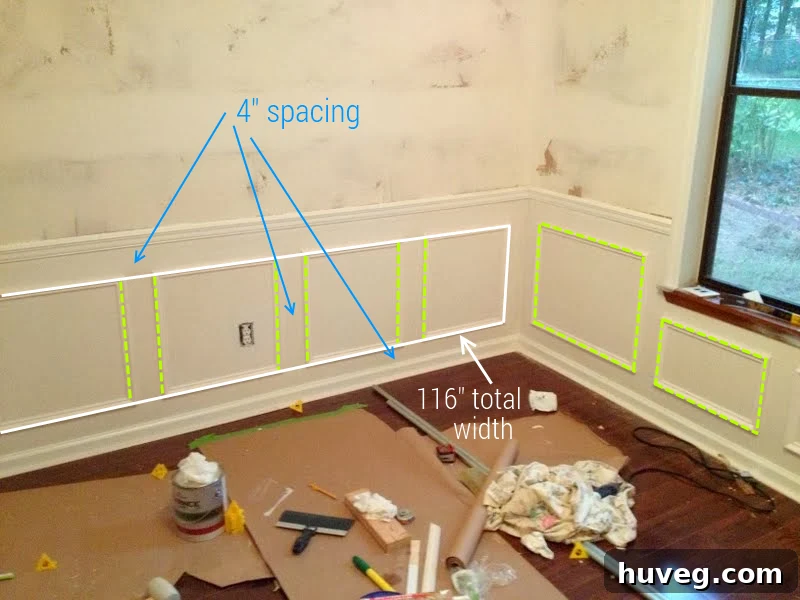
This systematic approach helps ensure that your boxes are evenly sized and spaced. Don’t be afraid to experiment with different box counts and dimensions on a piece of scrap paper until you find a layout that looks balanced and appealing for each wall.
Navigating Irregular Wall Sections
Not every wall will lend itself to perfectly uniform box sizes. Walls interrupted by doorways, windows, or other architectural features will often require variations in box dimensions. For example, a wall with a prominent doorway might only accommodate three boxes, resulting in widths like 19¾ inches. This is perfectly acceptable! The key is to maintain consistent spacing between boxes and from the top/bottom of the boxes to the surrounding trim. Your eye is much more forgiving of slightly different box widths on different walls than it is of inconsistent gaps. In these cases, your 4-inch perimeter marks will define the overall area, and the boxes within will simply adapt to the available space.
Conquering Uneven Surfaces: Achieving a Perfect Level
One of the most common and frustrating challenges in home renovation, especially in older homes, is dealing with walls that aren’t perfectly level or plumb. While your existing baseboards and chair rail might appear straight to the naked eye, relying solely on them as guides for your new molding can lead to noticeable discrepancies. Picture frame molding demands precise 90-degree angles for its corners, and even a slight deviation in your horizontal or vertical lines can throw the entire aesthetic off. This is where meticulous attention to leveling becomes paramount.
The Imperfections of Old Homes
It’s a common misconception that all walls are perfectly square and level. The reality, especially in older homes, is often quite different. Settling foundations, previous renovations, and general wear and tear can lead to walls that are slightly off-kilter. If you simply measure 4 inches down from your existing chair rail along the entire wall, you might find that your resulting line, while consistently 4 inches from the chair rail, is far from a true horizontal. This can create a visual dissonance, making your beautiful new molding appear crooked relative to the floor or ceiling.
Leveraging Laser Levels for Accuracy
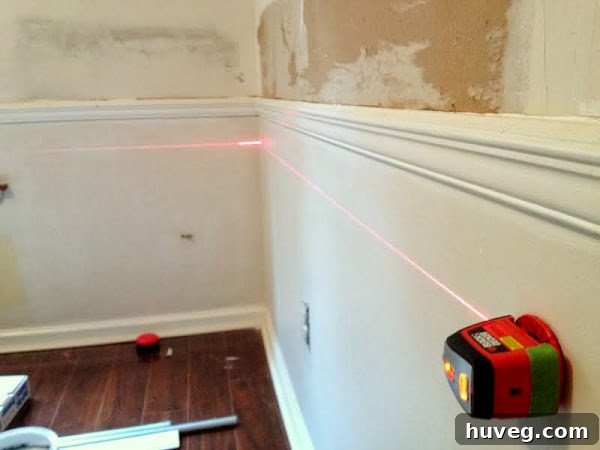
To counteract these imperfections, a laser level is an invaluable tool. After making your initial light pencil marks (e.g., 4 inches down from the chair rail), use a laser level to project a perfectly horizontal line across the entire wall. Compare your pencil marks to this laser line. You’ll likely discover that your original marks, consistent with the chair rail, drift away from the true level line. While it might be tempting to stick with your original marks to follow the existing trim, your eye is far more forgiving of a slight variation against existing trim than it is of an obviously crooked line of new molding.
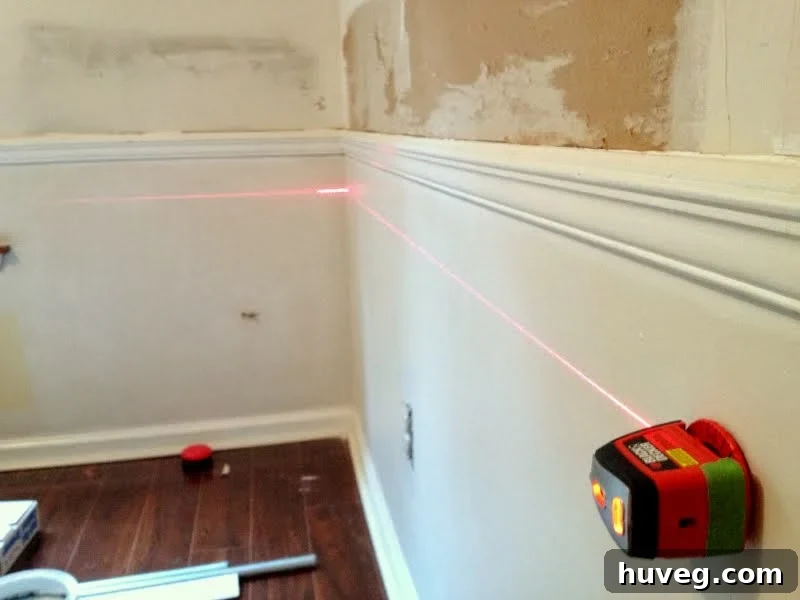
Where possible, choose to follow the truly level line projected by your laser. This will ensure that your picture frame boxes are perfectly square and level, creating a much more polished and professional look. It’s a subtle but significant detail that elevates the entire project. For longer walls, a chalk line can also be useful for snapping a straight reference line once you’ve established your key points with a level.
Strategies for Scribing and Adjusting
In some cases, especially with very old or significantly uneven walls, you may need to “scribe” your molding. Scribing involves marking and cutting the back of the molding to perfectly fit the contours of an uneven wall. While this is more advanced, for picture frame molding, simply ensuring your reference lines are level and plumb is usually sufficient. Any minor gaps that remain after installation can be easily filled with caulk, which provides a seamless finish and helps the molding blend perfectly with the wall. Remember, the goal is visual perfection, and a truly level line is critical for achieving that.
Working Around Obstacles: Outlets, Windows, and Doors
Rooms are rarely blank canvases; they come with essential features like electrical outlets, windows, and doorways that must be integrated seamlessly into your molding design. These elements often require creative adjustments to your standard spacing rules, but with a strategic approach, they can become opportunities for clever design rather than frustrating hindrances.
Integrating Around Electrical Outlets
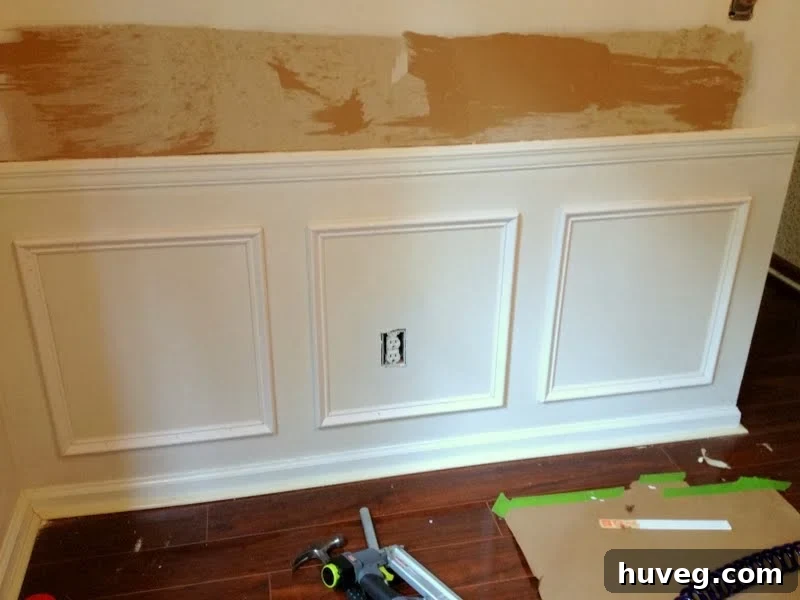
Electrical outlets are perhaps the most common obstacle. Your initial layout might place a molding box directly over an outlet. While a full box might be interrupted, it’s often better to slightly adjust your spacing or box height to accommodate the outlet rather than trying to cut intricate notches into the molding itself, which can look awkward.
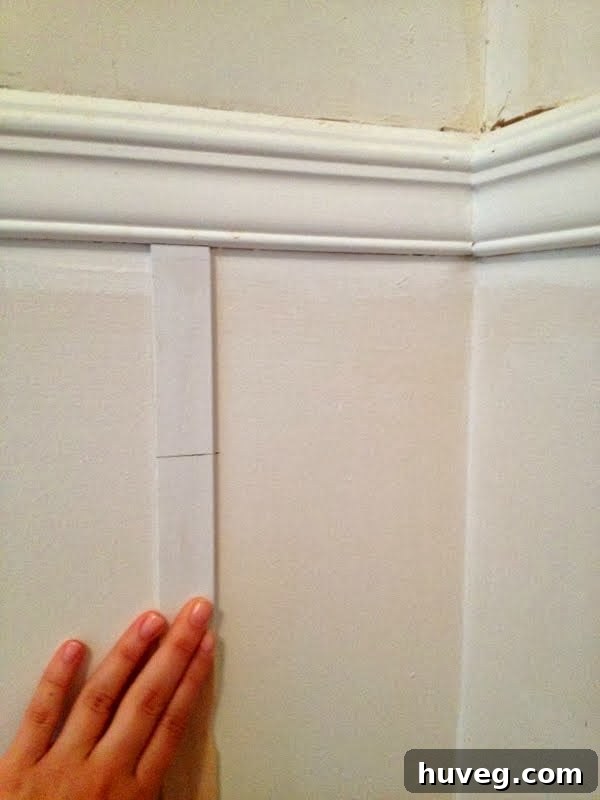
For example, if your standard 4-inch top spacing would cause the upper rail of your box to run directly across an outlet, consider reducing that top spacing specifically for that box. You might adjust it to 2¾ inches for that particular box, allowing the molding to sit above or below the outlet without obstruction. It’s crucial to maintain the original 4-inch spacing on the sides and bottom of the box to preserve overall consistency. Your eye will readily forgive a slight adjustment in vertical spacing around an outlet much more easily than a poorly cut molding piece. Alternatively, you might design smaller boxes around the outlet if the wall space permits, or even strategically place a box entirely above or below it. Always plan these adjustments visually on the wall with pencil first.
Framing Windows and Doors Seamlessly
Windows and doorways present similar, but often larger, challenges. The existing casing around windows and doors acts as a natural boundary. In many cases, you’ll want your picture frame molding to start its consistent spacing from the edge of this existing trim.
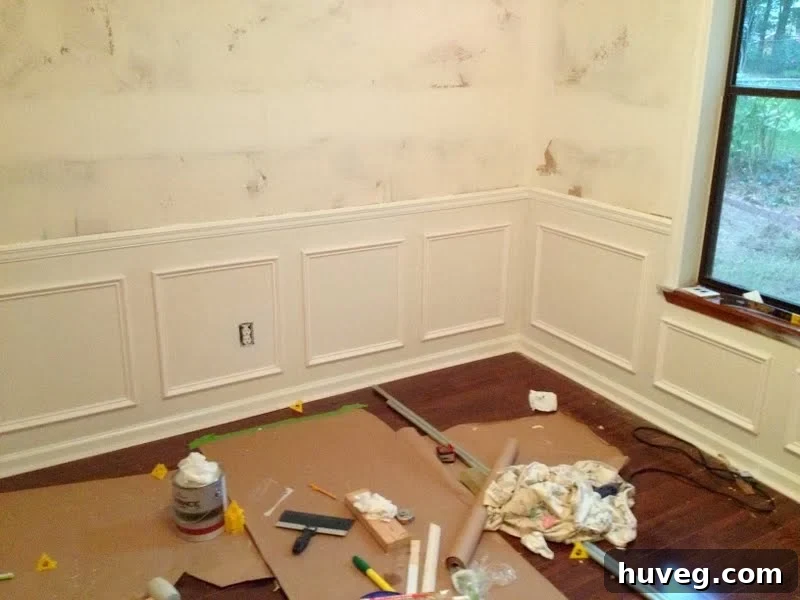
My large dining room window, for instance, had new casing added, which provided a perfect, clean edge from which to measure my 4-inch spacing for the adjacent molding boxes. This can sometimes simplify the layout, as the window casing essentially creates a “new wall” section to work from.
However, if your standard box layout would place a vertical or horizontal molding piece too close to a window or door frame (e.g., less than your chosen 2¾-4 inch spacing), you’ll need to make a judgment call. It’s often best to slightly narrow or widen the adjacent box, or even adjust the inter-box spacing for that specific wall section, to ensure a pleasing and consistent gap around the window/door frame. The goal is to maintain symmetry and a sense of intention in your design. Remember that the top and bottom of your boxes should ideally align across the room, even if the widths vary due to obstacles.
Sometimes, the space between two windows or a window and a door is too narrow to accommodate a full box, or even a partial one that looks balanced. In such instances, it’s perfectly acceptable to leave that section clear of molding. The beauty of picture frame molding is its adaptability; it doesn’t need to cover every inch of every wall, but rather enhance the overall architectural feel of the room.
Essential Tools for Your Molding Project
Having the right tools is crucial for tackling these challenges effectively and achieving a professional finish. Here’s a brief list of essentials:
- Tape Measure: For all your crucial measurements.
- Pencil and Eraser: For marking layouts and making adjustments.
- Laser Level or Long Spirit Level: Absolutely critical for ensuring perfectly level and plumb lines, especially on uneven walls.
- Speed Square or Combination Square: For marking precise 90-degree angles for your box corners.
- Miter Saw: For making accurate angle cuts on your molding pieces.
- Brad Nailer (preferably pneumatic or electric): For quickly and securely attaching molding to the wall.
- Construction Adhesive: For extra holding power, especially on potentially uneven surfaces.
- Caulk Gun and Paintable Caulk: Indispensable for filling gaps, seams, and nail holes to create a seamless, built-in look.
- Fine-Grit Sandpaper: For smoothing cut edges and filled areas.
- Safety Glasses and Ear Protection: Always prioritize safety when using power tools.
Beyond the Challenges: Installation and Finishing Touches
Once you’ve meticulously planned your layout and accounted for all obstacles, the actual installation of the molding pieces becomes a more straightforward process. This involves accurately cutting your molding at 45-degree angles to form perfect 90-degree corners for your boxes. Each piece is then secured to the wall using a combination of construction adhesive and a brad nailer. While the focus of this article is on overcoming planning challenges, remember that careful cutting and precise attachment are the next critical steps. For more in-depth guidance on the physical cutting and attachment process, always refer to detailed tutorials or resources.
After all the molding is installed, the magic truly happens during the finishing stages. Filling every nail hole and seam with paintable caulk, sanding any rough edges, and then applying a fresh coat of paint will transform your individual molding pieces into a cohesive, elegant architectural feature that looks like it was custom-built with your home. This final step is what truly marries the molding to your wall, hiding any minor imperfections and making all your careful planning and problem-solving pay off.
Conclusion: Achieve a Professional Finish in Your Home
Installing picture frame molding is a rewarding DIY project that significantly enhances the aesthetic appeal of any room. While it presents its share of challenges—from the intricate dance around electrical outlets and windows to the battle against uneven walls—these hurdles are entirely surmountable with careful planning, precise measurement, and the right techniques. By taking the time to calculate your spacing, verify your levels with accurate tools like a laser level, and thoughtfully adapt your design to existing room features, you can achieve results that rival professional installations. Don’t be intimidated by the imperfections of your home; instead, embrace them as opportunities to apply clever solutions. With patience and attention to detail, you’ll successfully transform your walls, adding timeless elegance and character that you can proudly say you created yourself. Happy molding!