DIY Frosted Film: The Secret to a Quiet Dog

Transforming a home space can be both exciting and challenging, especially when balancing natural light with essential privacy. My primary bedroom and bathroom, once bright but overtly exposed, now enjoy a beautiful synergy of abundant sunshine and complete seclusion, all thanks to the simple yet effective solution of frosted window film. An added, much-welcomed bonus? My furry companion, Charlie, has ceased her incessant barking at unsuspecting neighbors passing by. In this comprehensive guide, I’ll share the journey of this easy installation, complete with frustration-free tips to help you achieve similar results in your own home.
Why Frosted Window Film Outshines Traditional Curtains and Blinds for Privacy
When I initially shared my plans for installing frosted window film on social media, the most common immediate reaction was a flurry of questions concerning more conventional window treatments. “Why not simply use blinds or curtains?” many asked, some with genuine curiosity, others with a hint of playful incredulity. It’s a perfectly natural first thought, so let’s address it head-on. The truth is, these traditional options were not only considered but attempted – and ultimately, they fell short of meeting our specific needs.
The Canine Conundrum: How Charlie Influenced Our Window Treatment Choices
Our primary bedroom presents a unique challenge: it faces directly onto the street. As one of the largest and most frequently used rooms in the house, it’s a space where we seek relaxation and comfort. However, its street-facing orientation meant a constant battle with privacy concerns. Initially, I installed elegant 2-inch faux wood blinds, a style I genuinely love and have since incorporated throughout the rest of our home. These blinds offered a sleek look and adjustable light control, but their functionality was severely tested once Charlie, our spirited dog, joined the family.
Charlie, with her boundless curiosity, developed a habit of peering—or rather, vigorously barking—out of the window at every passerby. If the blinds were fully lowered, she’d forcefully push her nose between the slats, inevitably bending and damaging them over time. To preserve the blinds and allow her a vantage point, we reluctantly kept them partially open, typically at what I can only describe as “bum/crotch height.” This, as you can imagine, was far from ideal for a bedroom where one desires complete discretion while changing clothes, getting ready after a shower, or simply enjoying private moments.
The bathroom presented its own set of challenges. While I cherished the natural light it provided, sheer curtains, often touted for their ability to diffuse light while offering some privacy, proved utterly insufficient. During midday sun or with indoor lights on at night, they offered little to no concealment from the street. The thought of neighbors inadvertently catching a glimpse of someone on the toilet was, to put it mildly, unsettling. Frosted film offered a much more robust and permanent solution to this delicate issue, maintaining brightness without sacrificing dignity.
Furthermore, while curtains might work aesthetically in a bay window area—a future plan for the bedroom—they posed a potential tripping hazard in the narrower hallway window. The goal was to find a consistent privacy solution that could be seamlessly applied across multiple windows without resorting to a patchwork of different window treatments. Frosted window film emerged as the clear victor, offering a versatile, elegant, and practical alternative to the shortcomings of blinds and curtains.
Dispelling Myths: Why One-Way Mirror or Tinted Film Don’t Deliver All-Day Privacy
Following the discussion about curtains and blinds, the next most frequently asked question often revolves around other types of window films, specifically one-way mirror or tinted films. The core distinction, and the simple answer, is that most of these alternatives primarily offer effective privacy only during daylight hours. My objective, however, was to secure comprehensive privacy around the clock, extending well into the evening and night.
The fundamental principle behind one-way mirror film relies on a significant difference in light levels between the two sides of the glass. During the day, when the sun illuminates the exterior far more brightly than the interior, the film reflects the outdoor light, creating a mirror-like effect from the outside while allowing occupants to see out. However, this illusion completely vanishes when the dominant light source shifts. As soon as indoor lights are switched on at night, rendering the interior brighter than the darkened exterior, the film’s reflective properties reverse. It becomes a transparent pane, offering a clear view into your home from the outside. My parents, for instance, installed this very type of mirror film on their French doors, only to discover that at night, it provided no privacy whatsoever; everything inside was still plainly visible.
It’s quite amusing, and perhaps a touch deceptive, how manufacturers cleverly market these limitations as “features.” You’ll often find these products explicitly labeled “for daytime privacy” or “with nighttime vision,” subtly acknowledging their nighttime transparency without overtly stating the lack of privacy. This intelligent (or arguably, sly) marketing tactic is something to be aware of. Now you know the crucial difference and can make an informed decision!
Separately, tinted window film was also dismissed as a viable option for my specific needs. My primary desire was to retain as much natural light as possible while simultaneously achieving full privacy at all hours. Tinted film, by its very nature, darkens the light that passes through it, effectively reducing the brightness of a room. Frosted film, in contrast, diffuses light, scattering it gently to create a soft, even glow throughout the space without significantly diminishing its intensity. While tinted film undeniably offers benefits such as enhanced energy efficiency by reducing heat gain, which can be a significant consideration for some, it wasn’t the top priority for these particular windows. (I plan to address energy efficiency with additional curtains in the main part of the bedroom, creating a layered approach to window treatments.)
The Ultimate Guide: Installing Frosted Window Film for Lasting Privacy
The installation of frosted window film is remarkably straightforward, making it an accessible DIY project for almost anyone. While the individual steps are simple, covering multiple windows, especially those with numerous individual panes as I did, can become quite repetitive. I highly recommend allocating a couple of evenings for the task. Patience is your best friend here; take your time, and you’ll soon settle into a comfortable and efficient rhythm. Given that I tackled an impressive 40 individual window panes, I was able to refine my technique and compile both a detailed video tutorial and a comprehensive written guide, which you’ll find below.
Don’t worry if you don’t grasp every detail in the video on your first watch. I intentionally included multiple applications and angles so you can observe each step repeatedly, ensuring you master the technique for a flawless finish.
Essential Materials for Frosted Window Film Installation:
Before you begin, gather these key supplies to ensure a smooth and successful installation:
- Window cleaner: A high-quality, streak-free cleaner is crucial for a spotless surface.
- Frosted window film (large or small roll): Measure your windows carefully to determine the appropriate quantity.
- Window film kit: This convenient kit typically includes a lint-free cloth, application solution, a squeegee for smoothing, and a cutting tool.
- Paper towels: Essential for cleaning up excess solution and protecting surrounding surfaces.
- Utility knife: A sharp utility knife with a fresh blade will provide precise, clean cuts.
Step 1: Prepare by Rolling Out and Roughly Cutting the Window Film
Begin by carefully unrolling your frosted window film. For each window pane, cut a piece of film that is slightly larger than the actual glass area. Aim for an overhang of about half an inch to an inch on all sides. This excess material provides a valuable buffer, allowing for minor adjustments if the film shifts or goes on slightly crooked during application, ensuring you have enough to trim a perfectly straight edge later. I found it most effective to establish a straight edge along one side of the film and use that as my primary guide for initial placement. To streamline the process, especially when dealing with multiple panes, I often pre-cut a batch of film pieces at once, enabling me to complete entire sections of windows in a continuous flow.
Step 2: Achieve a Spotless Surface by Thoroughly Cleaning the Window
This step is absolutely critical for a professional-looking finish. Any tiny speck of dust, lint, fuzz, or pet hair left on the window will create a visible bubble or imperfection under the film. With two dogs in the house, ensuring a lint-free surface required extra diligence. I first cleaned the window meticulously with standard glass cleaner, then followed up immediately with the specialized lint-free cloth included in the window film kit. The key is to move from the cleaning step directly to the application step as quickly as possible, minimizing the chance for airborne dust or particles to resettle on the glass. Consider preparing the area by wiping down window sills and nearby surfaces beforehand.
As part of this preparation, I also lined the window sill with paper towels. This seemingly small detail is incredibly helpful for catching any excess application solution that will inevitably drip during the subsequent steps, protecting your sills and floors from getting soaked.
Step 3: Liberally Spray the Window with Application Solution
Now, generously spray the entire surface of the window pane with the application solution. Don’t be shy with the spray; the window needs to be thoroughly saturated, almost dripping. The solution acts as a lubricant, allowing you to slide and reposition the film easily once it’s applied. While the solution will attempt to run off relatively quickly, maintaining a wet surface is paramount. A well-saturated window provides ample working time and helps prevent the film from sticking prematurely or unevenly.
Step 4: Carefully Separate the Film from its Backing and Apply to the Wet Window
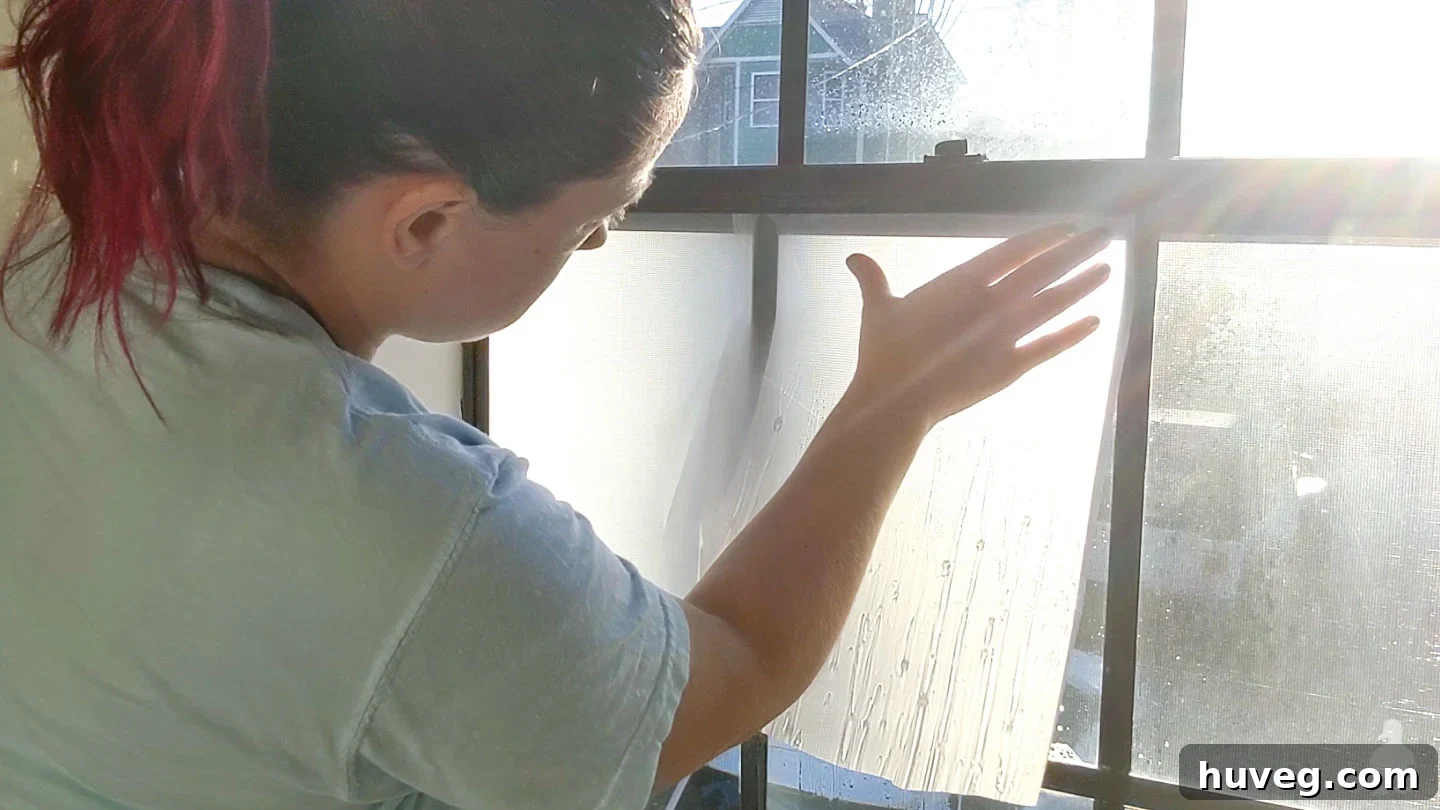
Separating the protective backing from the adhesive film can initially be one of the more challenging steps. I found my utility knife to be an invaluable tool here. The sharp, thin blade easily slipped between the two layers, making it simple to get the separation started. Once a small corner or edge was peeled back, I would carefully attach this separated portion to the very top corner of the wet window. With one hand holding the applied section, my other hand would then steadily and continuously peel away the rest of the backing, immediately pressing the sticky film onto the saturated window surface. This method minimizes the exposure of the adhesive side to air, reducing the chance of dust or lint settling on it.
There were instances when the backing proved particularly stubborn, causing a slight delay. During these moments, I noticed the solution on the window beginning to dry. Having a spray bottle of solution readily at hand for a quick re-spray ensured the surface remained perfectly wet, preventing any issues with the film adhering prematurely.
Maintaining a thoroughly wet window is a definite advantage. With the window generously saturated with solution, the film became incredibly slippery, allowing me to effortlessly slide the piece into its ideal position, especially when trying to align a perfectly straight top edge. On the rare occasions when I needed to adjust the initial placement, the film could be gently nudged or shifted without needing to lift it completely, significantly reducing the risk of trapping air or foreign particles underneath. This “float” period is essential for achieving a bubble-free and perfectly aligned application.
Step 5: Apply More Solution and Smooth Out Air Bubbles
Once the film is in its approximate position, you will almost certainly notice air bubbles trapped underneath. To address these, lightly mist the exterior surface of the film with a bit more application solution. This lubrication helps the squeegee glide smoothly without scratching the film. Then, using your smoothing tool (the yellow squeegee typically found in the kit), begin to gently but firmly push all the air bubbles and excess solution out from under the film. Start from the center of the film and work your way outwards to the edges, using overlapping strokes. The goal is to expel every last bit of air and liquid.
It might seem like a considerable amount of solution is being “wasted” during this process, but rest assured, the small bottle included in most kits offers excellent coverage. If you’re tackling many windows, you can purchase additional solution separately, which is often more economical than buying a whole new kit if only the solution runs low (though some standalone solutions do come with a new lint cloth, which is a bonus). For my extensive project, I managed to complete almost all windows with a single bottle of solution, eventually needing only two bottles for three boxes of film.
Step 6: Precisely Trim Away Any Excess Film
With the film smoothed and secure, the final step is to trim away the excess material for a clean, professional finish. Use the cutting tool provided in your kit, or preferably, a sharp utility knife, to achieve this. Position the smoothing tool (squeegee) firmly along the edge of the window frame as a straight guide. Then, carefully run your blade along the edge of the squeegee, cutting away the surplus film. I found my personal utility knife to be superior for navigating the corners and achieving truly sharp lines. Over time, the blade in the kit might become slightly gummed up with adhesive residue, so having a reliable, sharp utility knife as a default is highly recommended.
For the bathroom window, which features a slightly protruding bottom half, I adopted a strategy of applying and trimming the bottom section first before moving to the top. This allowed me to place additional paper towels in the space created by the protrusion, effectively catching all the excess dripping solution and maintaining a tidier workspace.
As you can clearly see in the image, even with the frosted film applied, the room remains wonderfully bright and filled with natural light. The film diffuses the light, creating a soft, inviting glow without darkening the space. In the accompanying video, I also showcase the ample light in the rest of the bathroom. A practical tip for installation: choose an overcast day or even work at night. This prevents you from staring directly into bright sunlight, which can make it harder to spot bubbles and imperfections during the application process.
An Unexpected Serenity: How Frosted Privacy Film Ended Charlie’s Barking Habit
Admittedly, in hindsight, the solution to Charlie’s persistent barking might seem like an incredibly obvious “aha!” moment. But prior to installing the frosted film, particularly in the hallway, Charlie dedicated a significant portion of her day to this familiar routine:
While there’s inherently nothing wrong with a dog looking out the window, apart from the constant need to wipe nose prints off the glass, Charlie’s interest frequently escalated. She would bark fiercely at neighbors strolling past the house or, more intensely, at other dogs being walked in the vicinity. With Stella, our other dog, now part of the household, Charlie’s barking often instigated a chain reaction, setting Stella off, which in turn sometimes re-triggered Charlie, creating a cacophony that echoed through the house. For someone who works from home, this scenario was far from ideal, transforming what should be a peaceful work environment into a disruptive soundscape.
Unfortunately, my dog possesses a stubborn streak that rivals my own. While her downstairs barking was somewhat manageable, her preferred vantage point was one of the upstairs bedroom windows whenever I was working on that floor. After years of attempting various training methods and interventions to curb this behavior, I, like any reasonable but exhausted adult, eventually threw in the towel. I needed a different approach.
When I finally got around to installing the privacy film, I was about 99% certain I would simply trade wiping nose prints off the glass for wiping them off the film—at least until Charlie fully accepted that her clear view was gone. Or worse, I worried the film might make cleaning the windows more difficult. This uncertainty was precisely why the box of film languished in the corner of my bedroom, collecting dust for months after I purchased it!
(That procrastination, incidentally, turned out to be a mistake. Somehow, the box and the film inside sustained some damage during that time, leading to creases I had to painstakingly cut around. I double-checked the subsequent boxes I bought to finish the rest of the windows and encountered no such issues. So, a pro-tip: always open the box and inspect the film roll immediately after purchase.)
As it turns out, my worries about nose prints were entirely unfounded! To my surprise and immense relief, Charlie adapted almost immediately. Without a clear view to stimulate her, she simply began ignoring the windows altogether. She still occasionally heads downstairs to observe the world, but that activity is far easier to manage and far less disruptive to the household. It was an unexpected, but truly triumphant, win!
While the frosted window film has fundamentally transformed our comfort and privacy, the journey of enhancing our window treatments isn’t fully complete. In the bedroom, I still plan to add new shades to the top half of the windows, which will offer additional light control and decorative flair, along with some dark, elegant curtains in the bay window for aesthetic appeal and further light-blocking capabilities when needed. For the bathroom, I envision a different style of shade installation, though the specific design is still in the planning stages. The film has now been installed for several weeks, and its impact on my comfort level—especially when moving freely in front of the windows—has been profound. My partner, K, even ventured outside to confirm that the interior is indeed comfortably obscured from view. I’ll be sure to keep you updated on these forthcoming additions and the broader primary bedroom makeover as it progresses!