Safeguarding Butcher Block Countertops from Project Damage

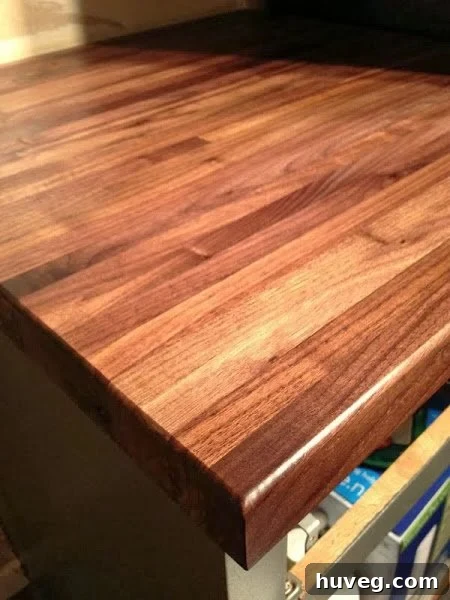
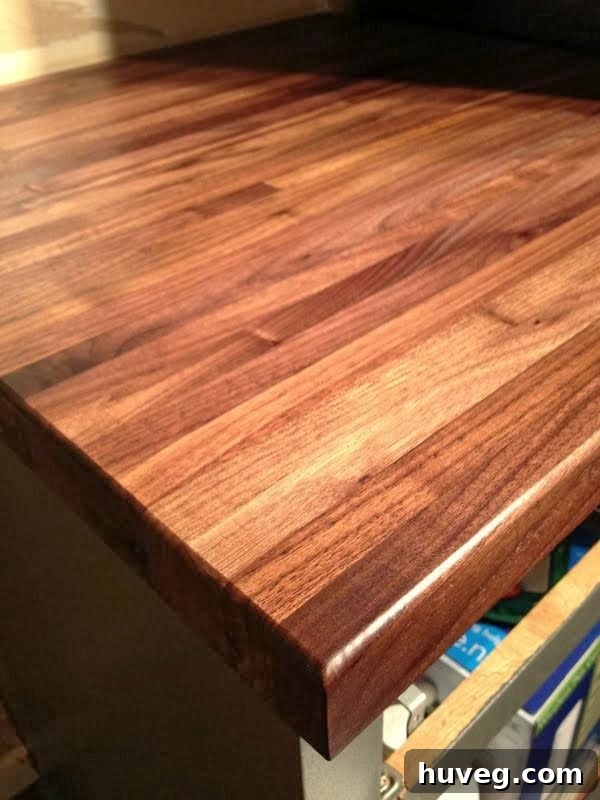
Transforming a kitchen is a journey filled with exciting decisions, from cabinet styles to fixture choices. But for many DIY enthusiasts, the countertop often becomes the focal point, blending functionality with aesthetic appeal. My personal kitchen renovation adventure led me to a stunning walnut butcher block countertop, a choice that elevated the entire space with its natural warmth and rich character. This wasn’t just any countertop; it was a significant investment, costing substantially more than simpler alternatives I had considered, such as those readily available from major retailers. However, the moment that first luxurious coat of oil and beeswax soaked into its surface, revealing the intricate grain patterns and gorgeous color variations, I knew I had made the absolute right decision. This piece of natural wood instantly captivated me, confirming its status as the heart of my kitchen. Yet, as with many ambitious DIY projects, this beautiful choice introduced its own unique set of challenges, particularly when it came to subsequent kitchen finishing touches like installing a tiled backsplash. The very treatment that made the butcher block so exquisite — its oiled coating — also made traditional protection methods surprisingly difficult.
The Essential First Step: Why Early Oiling Was Non-Negotiable for My Butcher Block
Before diving into the intricacies of protecting the counter during messy tiling work, a fundamental question often arises: why not simply wait to oil the butcher block until all other kitchen projects are complete? This is a perfectly logical thought for many, as it would seemingly avoid the very issues I encountered. However, the answer is rooted deeply in the nature of butcher block itself and the practicalities of a functional kitchen. Raw wood, while beautiful, is incredibly vulnerable. It’s a porous material highly susceptible to moisture, stains, and even bacterial growth. To ensure the longevity and hygiene of my valuable walnut countertop, immediate treatment was paramount. Think of it as an essential first layer of defense, a proactive measure to safeguard a significant investment.
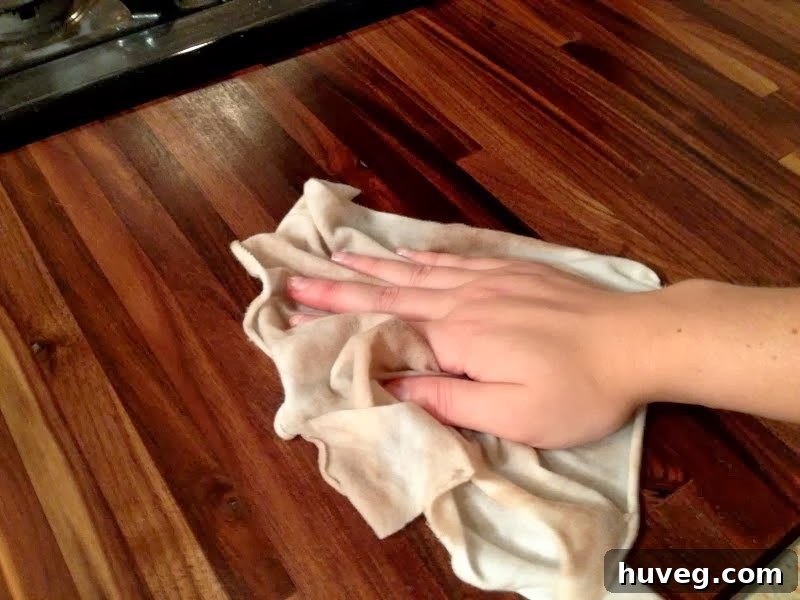
My kitchen renovation, like many DIY endeavors, wasn’t a sprint; it was a marathon. If I had left the counters untreated for weeks or even months while other projects slowly progressed, they would have been exposed to countless potential hazards. Water splashes from the sink area – an absolute necessity even in a construction zone – could lead to unsightly water rings, warping, or even mold. Accidental spills from paint, plaster, or just everyday cooking mishaps could permanently stain the untreated wood. Delaying the oiling process would have risked irreparable damage to a significant investment, leading to immense regret and potentially costly repairs or replacements. Therefore, applying the protective oil and beeswax mixture as soon as the countertops were installed was not merely a preference but a crucial step to safeguard against the inevitable wear and tear, even before the kitchen was fully operational. For a deeper dive into my specific countertop treatment and why I chose this particular oil and beeswax blend, you can refer back to this detailed post on butcher block care.
Navigating the DIY Dilemma: When Standard Methods Fail on Oiled Surfaces
With the butcher block beautifully oiled and protected, the next phase of the kitchen renovation, specifically installing the tiled backsplash, brought unforeseen hurdles. Many standard DIY tutorials and conventional wisdom for protecting adjacent surfaces during messy tasks simply didn’t apply. The primary culprit? Painter’s tape. A staple in nearly every home improvement project, painter’s tape thrives on clean, dry, and non-greasy surfaces. My meticulously oiled walnut countertop, however, was the antithesis of this requirement. The rich, protective layer of oil and beeswax, while wonderful for the wood, rendered painter’s tape utterly useless; it simply refused to adhere effectively, peeling away almost immediately.
This presented a significant challenge. Installing tile involves a series of sticky and potentially messy materials: thin-set mortar for adhesion, grout for filling the gaps, and caulk for sealing edges. Traditionally, one would use tape and paper or plastic sheeting to create a neat barrier, protecting the countertop from drips, smears, and spills. Without the ability for tape to stick securely, my conventional protection strategies were rendered ineffective. The fear of errant thin-set or grout splattering onto the pristine wood was very real. Moreover, creating a clean, professional-looking caulk line between the newly installed tile and the countertop typically relies on painter’s tape as a crisp guide. This left me in a predicament: how could I protect my beloved butcher block and achieve crisp, clean finishes without the most basic and commonly recommended DIY tool? The situation called for creative thinking and unconventional methods.
Innovative Solutions for a Flawless Tiled Backsplash
Necessity, as they say, is the mother of invention. Faced with the inability to use painter’s tape on my oiled butcher block, I had to devise alternative strategies to protect the countertops and ensure a clean, professional result for my tiled backsplash. My solutions revolved around a combination of unexpected materials and a change in perspective regarding the oiled surface itself, proving that sometimes the simplest tools can be the most effective.
Plastic Wrap: The Unexpected Hero for Countertop Protection
My primary workaround turned out to be surprisingly simple and incredibly effective: ordinary kitchen plastic wrap. Its inherent clinginess proved to be its greatest asset. Unlike tape, plastic wrap doesn’t rely on adhesive; instead, it uses static electricity and its thin, flexible nature to adhere to itself and gently conform to surfaces. This was crucial for several reasons:
- **Non-Adhesive Cling**: It clung sufficiently to the oiled countertop surface without requiring any sticky backing, thus avoiding the non-adhesion problem entirely. Its lightweight nature meant it wouldn’t pull away under its own weight.
- **Conformity to Gaps**: Its thin profile allowed it to be gently tucked into the narrow 1/8-inch gap between the bottom edge of the newly installed tile and the butcher block, providing an excellent, impermeable barrier during grouting without creating an overly thick obstruction.
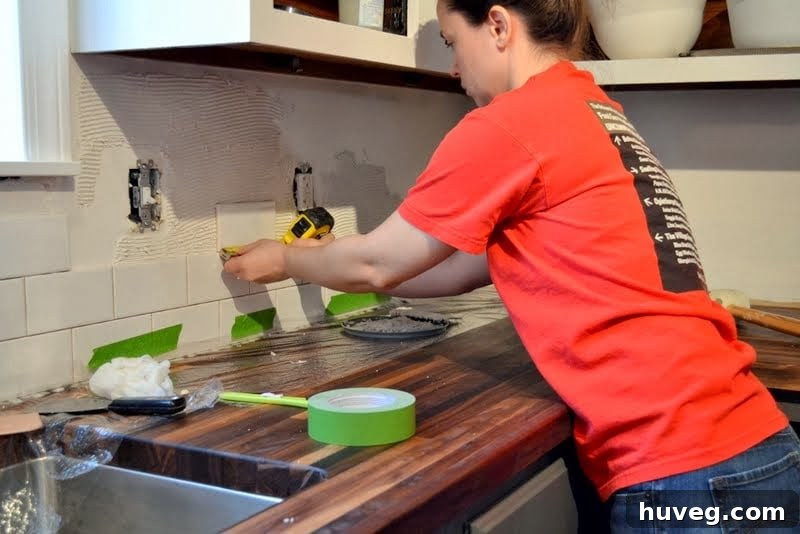
- **Versatile Protection**: I deployed plastic wrap during both critical stages of the tile installation. First, when applying the thin-set mortar to adhere the tiles to the wall, it acted as a robust shield against drips and smears. Then, after the thin-set had cured and before beginning the next messy step, I replaced it with fresh plastic wrap for the grouting phase, ensuring no grout residue found its way onto the wood and preventing any accidental mixing of materials.
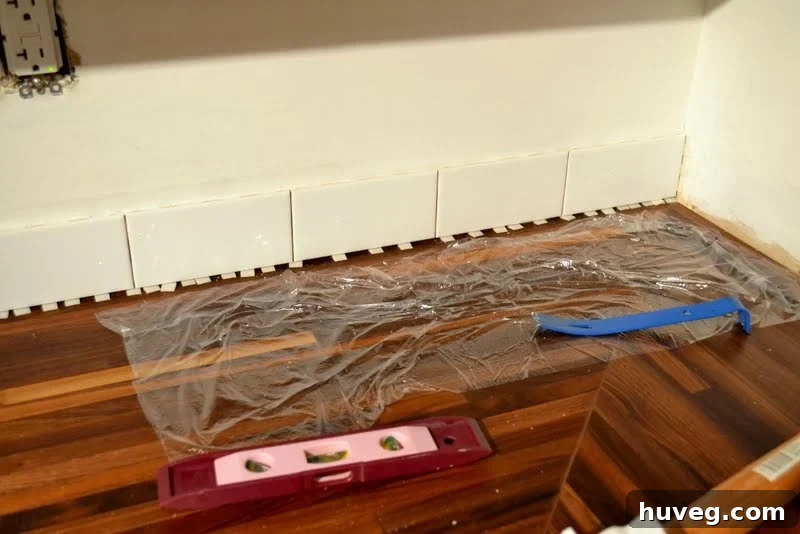
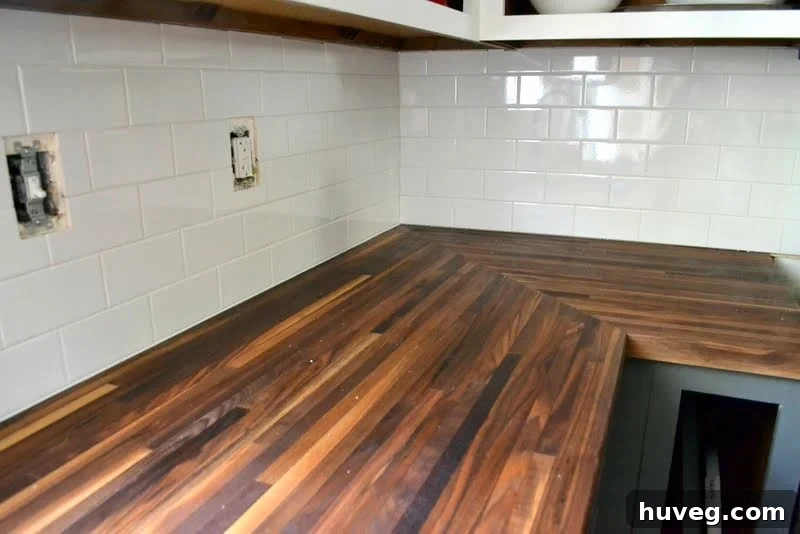
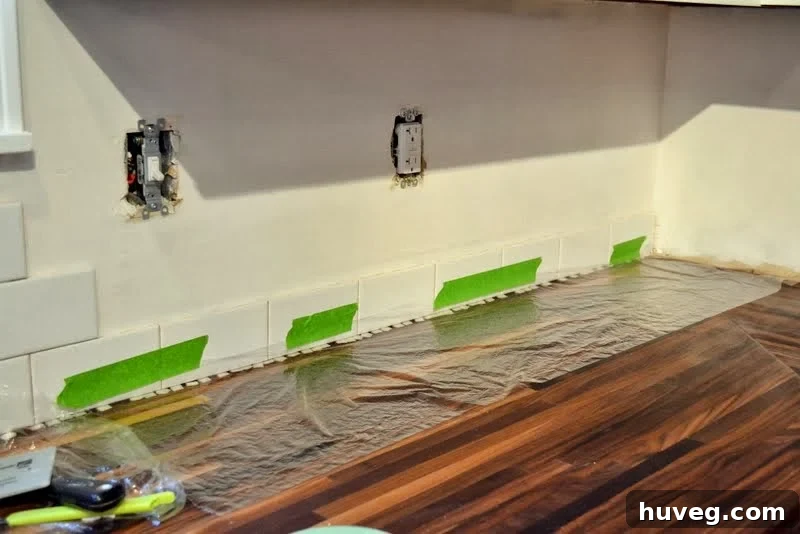
While the plastic wrap wouldn’t stick to the oiled counter, it *could* be secured to the wall above the tiling area where tape would stick (especially to the initial row of painter’s tape holding the first line of tiles in place, as seen in the image below). This allowed me to create a robust, upward-extending barrier, effectively a protective apron hanging over the counter. The plastic wrap was remarkably effective at catching all the wet drips and clumps from both the thin-set and the grout, preventing them from contaminating the beautiful wood. When it was time to remove the protection, I simply gathered the plastic wrap in sections. My technique involved carefully folding the portion closest to the tile inward first, creating a pouch that trapped any wet or dried materials. Then, I folded in the remaining corners, effectively encapsulating any mess within the center of the wrap, ready for a clean disposal into the trash. Using fresh pieces of plastic wrap between the thin-set and grouting stages ensured maximum cleanliness and prevented cross-contamination, ensuring that each step was as tidy as possible and that no cured thin-set bits could accidentally mix with fresh grout.
Leveraging the Oiled Surface as a Natural Barrier
My second key realization was to embrace, rather than fight, the inherent characteristics of the oiled surface. Initially, I debated whether to try to “dry out” the counter to encourage tape adhesion, but this idea was quickly discarded. Not only would it compromise the essential protective treatment of the wood, but past attempts had also proven it to be largely ineffective. Instead, I recognized that the nicely oiled surface inherently offered a slick, non-stick barrier. This wasn’t just a happy accident; it was precisely why the oil treatment is applied in the first place – to create a resilient, water-resistant, and stain-resistant surface for everyday kitchen use. Therefore, it made perfect sense that it would also provide a degree of protection against building materials that might fall or splatter during the renovation process.
Any wet clumps of thin-set or grout that accidentally landed on the oiled butcher block surface were remarkably easy to clean. A quick wipe with a damp towel was often all it took to remove them completely, leaving no trace behind. Even if a spot went unnoticed and dried, a little gentle scraping with a fingernail or a soft, non-abrasive putty knife was usually sufficient to lift the dried material without harming the wood underneath. The oil created a barrier that prevented these substances from truly bonding or soaking into the wood fibers, acting much like a non-stick coating on cookware. This characteristic made cleanup incredibly efficient and stress-free, turning a potential disaster into a minor inconvenience. This approach saved a significant amount of time and prevented potential damage, proving that sometimes, the best defense is to lean into the material’s natural, treated properties, rather than trying to force a conventional method that isn’t suitable.
Mastering the Perfect Caulk Line with Ease
The final step in achieving a polished backsplash is applying a neat bead of caulk where the tile meets the countertop. This transition line is crucial for both aesthetics and hygiene, sealing the gap against moisture, preventing water infiltration, and inhibiting the accumulation of debris. Given the challenges with painter’s tape, a conventional approach to creating a perfectly straight caulk line seemed out of reach. However, my trusty putty knife emerged as the unsung hero once again, offering a simple yet ingenious solution.
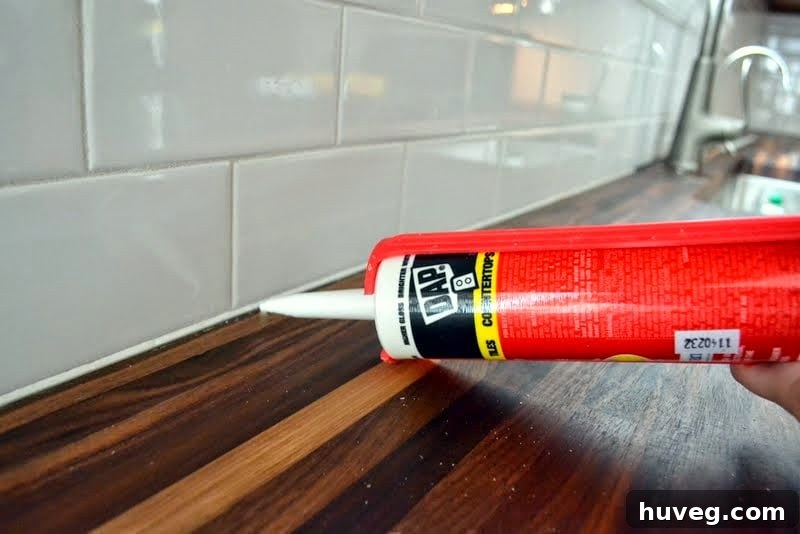
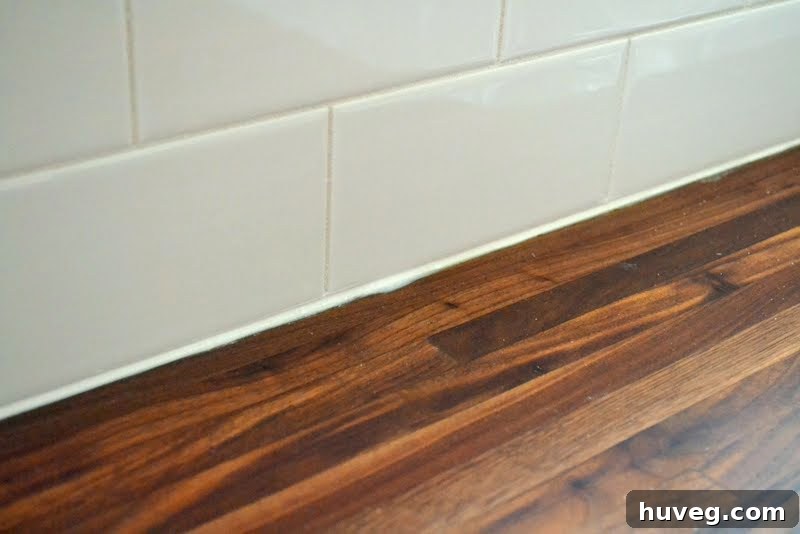
The process was straightforward: I applied the bead of caulk (using a latex/silicone mix for optimal durability and flexibility, ideal for kitchen environments) along the seam as usual, ensuring even coverage. Then, after smoothing it out with a gloved finger to achieve the initial shape and consolidate the bead, I immediately reached for my putty knife. By holding the putty knife firmly against the tile, I was able to glide it along the caulk line, using the tile edge as a precise guide. The key was to apply a slight, consistent pressure on the end of the knife closest to the caulk bead. This action neatly collected any excess caulk, creating an impeccably straight and uniform line, effectively “cutting” a clean edge. Thanks to the non-stick quality of the oiled butcher block surface, any caulk that was scraped off came up cleanly without leaving sticky residue or marring the wood. This method allowed me to achieve a professional-grade finish that looked like it had been meticulously taped, but without the hassle of adhesion issues or the tedious process of removing tape from a delicate surface. The putty knife acted as a perfect, reusable, and infinitely adaptable guide.
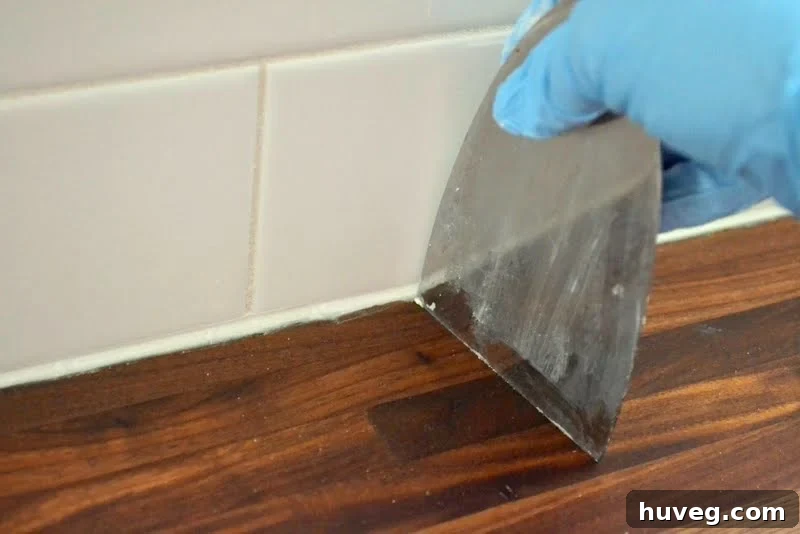
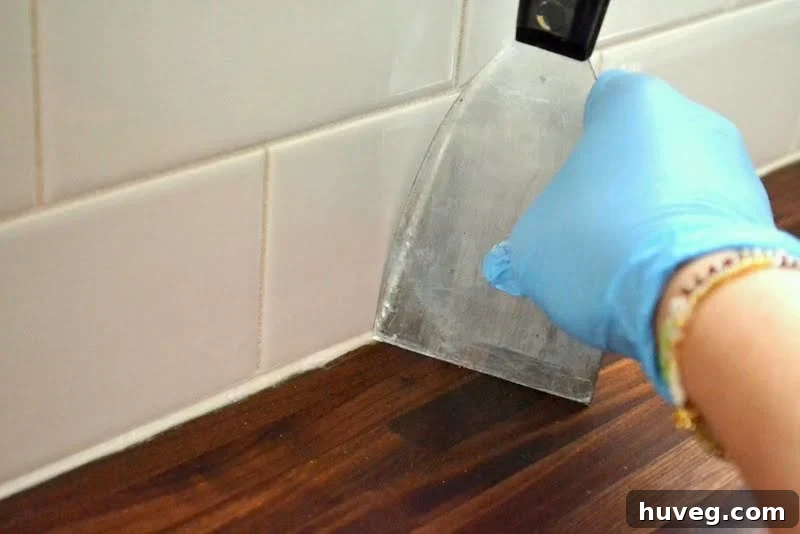
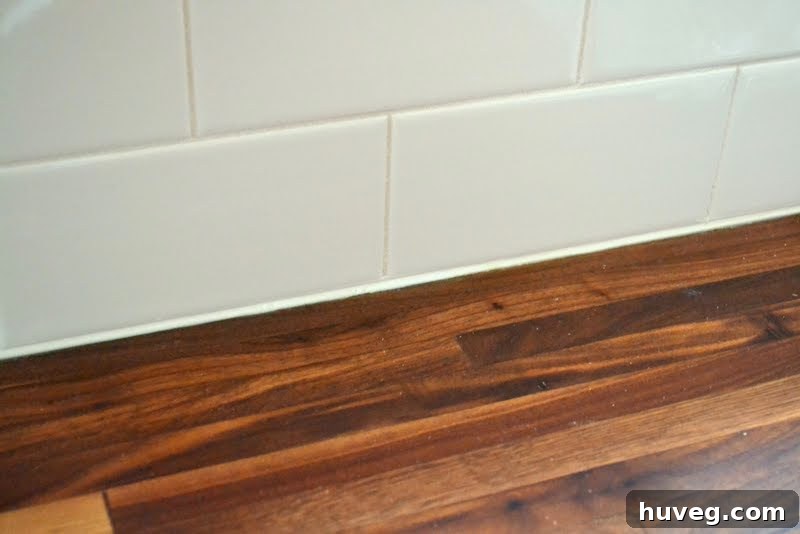
And just like that, a perfectly straight caulk line was achieved, completing the backsplash with a crisp, clean edge that beautifully complemented the walnut butcher block. This method proved to be surprisingly easy and effective, even when faced with the unique challenges of an oiled surface. The final result was a testament to problem-solving and adapting techniques to specific material properties, leading to a truly professional finish without compromise.
Learning from Experience: The Mysterious Caulk Yellowing
While the techniques described above successfully addressed the immediate protection and finishing challenges, the DIY journey often presents new mysteries and learning opportunities. Shortly after the caulk was applied, a perplexing issue arose: certain areas of the caulk inexplicably yellowed overnight. This was unexpected and certainly not the desired pristine aesthetic for a newly finished kitchen. Initially, I, like many others, theorized that the oil from the butcher block or even the natural tannins in the walnut wood itself might have reacted with the caulk, causing the discoloration. This is a common concern when dealing with natural materials and their potential interactions with sealants.
However, further observation and investigation revealed a more complex scenario. Interestingly, the yellowing wasn’t uniform; it only occurred in areas where the caulk was applied more thickly, creating a noticeable contrast. Crucially, some sections of caulk that had yellowed were not in direct contact with the countertop at all, such as vertical joints on the backsplash itself, suggesting that the butcher block wasn’t the sole or even primary culprit for the discoloration. This led me to believe that the issue might be more related to the caulk’s curing process, its specific formulation, or perhaps the environmental conditions at the time of application, rather than a direct interaction with the wood’s oil or tannins. My contact at DAP, the caulk manufacturer, also indicated that the thickness of application could indeed be a contributing factor or point to another underlying issue related to insufficient air exposure during curing. The thinner applications of caulk, conversely, remained perfectly white, reinforcing this hypothesis. Troubleshooting such unexpected outcomes is a vital part of any DIY project, offering valuable lessons for future endeavors and emphasizing the importance of detailed observation. I am still actively working on pinpointing the exact cause of this yellowing phenomenon and intend to provide an update once a definitive solution or explanation is found. It’s a reminder that even the most well-planned projects can offer a curveball, but with persistence, understanding and mastery follow.
Final Thoughts on Protecting Your Investment
Protecting a valuable investment like a walnut butcher block countertop during intense kitchen renovation projects requires a blend of foresight, adaptability, and a willingness to think outside the box when traditional methods fall short. My experience highlights that while the beauty of natural wood is undeniable, its care and protection demand specific considerations, especially when integrating it into a dynamic DIY environment. Embracing innovative solutions like plastic wrap for barriers and leveraging the inherent properties of an oiled surface for easy cleanup can turn potential frustrations into triumphs, ensuring your beautiful wood remains pristine. The satisfaction of a well-executed project, even one with a few unexpected turns and troubleshooting moments, makes every effort worthwhile and adds immeasurable value to your home. What creative solutions have you discovered in your own home improvement adventures? Sharing these insights helps build a stronger, more resourceful DIY community.