Personalized Jewelry Storage: Free DIY Blueprints

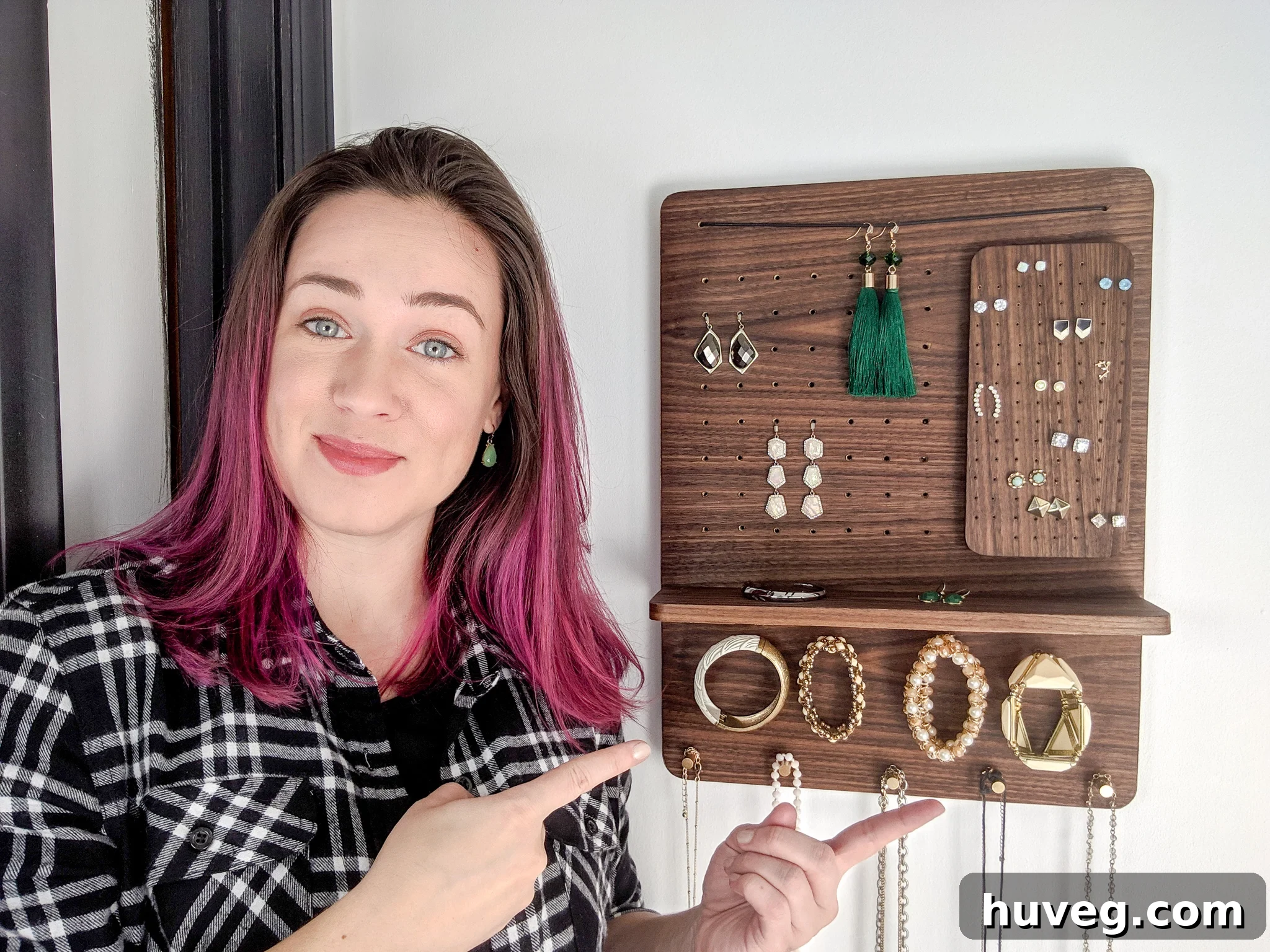
Are you tired of tangled necklaces, lost earrings, and a cluttered jewelry box? Imagine a sophisticated, modern, and highly functional solution that not only organizes your precious accessories but also enhances your bedroom or hallway decor. This custom-designed jewelry organizer, crafted from beautiful walnut wood and elegant brass accents, is engineered to transform your daily routine. It leverages the power of magnets and strategic design to provide ample storage for every type of jewelry, from your tiniest studs to your statement dangle earrings and long necklaces.
For many, jewelry organization remains a persistent challenge. While countless organizers exist on the market, few effectively address the specific needs of diverse collections, particularly larger earrings and stud earrings that are frequently worn. This project was born out of that very frustration, participating in a Spring Organization Challenge to create a truly bespoke solution. The result is a stunning organizer, perfect for a primary bedroom hallway, that houses all favorites in an easily accessible and visually appealing manner. Studs, once prone to getting lost, now have a designated, visible spot, attaching seamlessly to the main organizer with innovative magnetic holders.


Craft Your Own Modern Walnut & Brass Jewelry Organizer
Embarking on a DIY project offers immense satisfaction, especially when the outcome is as practical and beautiful as this jewelry organizer. While I typically strive to keep my materials list concise, this particular project delivers exceptional value and functionality within a compact footprint, necessitating a slightly more comprehensive set of elements. Each component, from the rich walnut to the shimmering brass and discreet magnets, plays a crucial role in its design and utility, making every step a rewarding part of the creation process.

To guide you through this exciting build, I’ve prepared extensive written instructions below, covering everything from the precise supplies you’ll need to links for detailed plans and essential tips. If you prefer a visual learning experience, a comprehensive video tutorial is also available, offering a step-by-step walkthrough of the entire process. You can find the video tutorial embedded here and on my dedicated YouTube channel. Watching the video can provide invaluable insights, especially for visual learners, helping to clarify techniques and ensure a smooth building experience.
Watch the full DIY Jewelry Organizer tutorial:
Essential Materials for Your Jewelry Organizer
Gathering the right materials is the first crucial step towards a successful project. This organizer combines the natural elegance of walnut with the modern appeal of brass and the practicality of magnets. Here’s a detailed list of what you’ll need:
- 1/4″ Walnut Plywood: This forms the main face of your organizer. I recommend a 2′ x 4′ sheet if available, as it provides enough material for the main sections and allows for mistakes. Walnut offers a beautiful grain and rich color that stands out.
- 1/2″ Scrap Wood/Plywood: Used for the backing, this material provides structural support and creates the necessary negative space for earring backings. Any sturdy scrap wood will do.
- Assorted Brass Rods: These rods are key for bracelet and necklace storage, adding a touch of elegance. For this project, you’ll specifically need 8mm and 6mm diameters.
- Walnut Edge Banding: This iron-on veneer is essential for concealing the exposed edges of the plywood, giving your organizer a clean, finished, and professional look.
- Super Glue: Perfect for quickly securing small components like magnets and brass rods, offering a strong and fast bond.
- Wood Glue: The primary adhesive for assembling the larger wooden components, providing a durable bond that strengthens over time.
- Pencil: For precise marking and layout.
- Mint Tin (rounded edge): A surprisingly useful hack for tracing perfect rounded corners, eliminating the need for specialized jigs.
- Double-Sided Tape: Handy for temporary holds and keeping small pieces in place during drilling or assembly.
- Black Stretch Cord: Used for the top section to provide flexible storage, especially useful for hair ties or headbands.
- 1/2″ Wooden Dowel: These will be cut into small pieces to create standoffs for the magnetic stud earring holder.
- Mini Magnets: The innovative solution for holding your stud earrings securely and visibly. Ensure they are strong enough for the task.
- Maker Brand Simple Finish: A high-quality wood finish that brings out the natural beauty of the walnut while protecting it.
- Monkey Hooks: Simple yet effective hardware for hanging your finished organizer on the wall without needing to find studs.
Essential Tools for Your DIY Project
Having the right tools makes all the difference in a woodworking project, ensuring precision and ease of construction. Here are the tools that will assist you in creating this elegant jewelry organizer:
- Circular Saw: Essential for making straight, accurate cuts on your plywood. A mini circular saw is particularly handy for managing smaller sheets.
- Jigsaw: While not used in my specific build, a jigsaw is highly recommended for cutting the negative space in the backing board, offering more control than other methods.
- Assorted Drill Bits: You’ll need various sizes for different hole types: 5/64″ for small earring studs, 5/32″ for dangle earrings and stretch cord, 15/64″ for 6mm brass rods, and 5/16″ for 8mm brass rods. Precision in bit size is crucial for securing the brass rods.
- 1/4″ Forstner Bit: This specialized bit creates clean, flat-bottomed holes, perfect for recessing magnets and stretch cord knots.
- Drill: A cordless or corded drill is indispensable for all your drilling needs. A drill press, if available, would significantly improve accuracy for perpendicular holes.
- Benchtop Sander: Ideal for smoothing edges, refining cuts, and especially useful for rounding corners.
- Angle Grinder with Metal Cutting Wheel: Necessary for precisely cutting the brass rods to length. Always use appropriate safety gear.
- Carpenter’s Square: Ensures all your cuts and alignments are perfectly square and accurate.
- Micro Zip Sander & Sanding Pads: Great for detailed sanding in tight spaces and for achieving a super smooth finish.
- Pull Saw: Excellent for fine cuts and trimming excess edge banding flush.
- Clamps: Essential for holding pieces securely during gluing, ensuring strong and even bonds.
- Tape Measure: For all your measuring needs, ensuring precise dimensions throughout the project.
Key Measurements and Detailed Plans
The overall dimensions of this elegant jewelry organizer are approximately 13″ x 17″. This size was carefully chosen to offer substantial storage capacity while maintaining a pleasing aesthetic proportion, similar to popular 12×16 frames often used as visual guides. Achieving precise measurements is vital for a professional-looking finish. For highly detailed measurement diagrams, including specific placement for holes and component sizes, you can access my comprehensive woodworking plans. These plans are available free to all email subscribers, offering a step-by-step visual guide to ensure accuracy in your build.
Precise Cut List for Your Project
Accuracy in cutting your materials is paramount for a seamless assembly. This cut list provides the exact dimensions for each wooden component, ensuring you have all pieces ready before you begin the assembly process. Always double-check your measurements before making cuts.
- 1 – 13″ x 17″ – Walnut Plywood: This will be the main visible face of your jewelry organizer, showcasing the beautiful walnut grain.
- 1 – 13″ x 17″ – Scrap Wood: This piece serves as the structural backer board, providing rigidity and support.
- 1 – 4″ X 8″ – Walnut Plywood: Designated for the magnetic stud earring holder, this smaller piece complements the main face.
- 1 – 3″ X 13″ – Walnut Plywood: This forms the elegant shelf at the bottom of the organizer, offering additional storage space.
- 1 – 3″ X 13″ – Scrap Wood: Used as a hidden support or backing for the shelf, adding strength.
- 4 – 1/2″ – Wooden Dowels: These small dowel pieces are used as standoffs for the stud earring holder.
- 4 – 1″ – 6mm Brass Rods: These shorter rods are ideal for hanging bracelets or smaller items.
- 5 – 1-1/4″ – 8mm Brass Rods: These slightly longer and thicker rods are perfect for neatly displaying necklaces.
Builder’s Note: The order of some finishing steps can be flexible. For instance, drilling holes and applying edge banding might be easier to accomplish before the entire organizer is fully assembled. This approach can minimize challenges in tight spaces later on. Furthermore, remember that this design is highly customizable! Feel free to adjust the height, omit the shelf, or modify any feature to perfectly suit your specific needs and aesthetic preferences. Make it truly yours!
1. Precision Cutting the Walnut Plywood Components
Begin by cutting your most visible and critical pieces: the walnut plywood face, the stud earring holder, and the shelf. I always start with the most important cuts first, as this allows for recutting if any mistakes occur without wasting the entire sheet. For this project, I opted for 1/4″ thick walnut plywood. While this thickness is elegant, I planned to laminate it with a scrap wood backing to achieve a more substantial, visually appealing final thickness, essentially using the more expensive hardwood plywood as a beautiful veneer.
Cutting plywood, especially veneer-faced varieties like walnut, can be tricky due to the risk of splintering. Initially, I tried a technique I’d successfully used before: applying painter’s tape along the cut line to minimize tear-out. Unfortunately, this method didn’t prove effective with this specific plywood. After some experimentation, I discovered that cutting from the back side (the side opposite the walnut face) yielded the cleanest results with the least amount of splintering when using my circular saw. Conversely, when using my miter saw for cross-cuts, I found that cutting directly on the face (again, without tape) provided the best outcome. This highlights the importance of testing on scrap pieces to find the optimal cutting method for your specific tools and materials.
2. Preparing and Attaching the Backing Board
Once your main walnut components are cut, the next step involves preparing and attaching the backing board. I creatively utilized pieces from my scrap bin for this, carefully arranging them to form the backer. A crucial design element here is to intentionally leave a significant blank section on the left side of the backing. This negative space is vital because it allows the backings of your dangle earrings to protrude through the drilled holes from the front, ensuring they hang freely and securely without hitting a solid surface.

In retrospect, there are several alternative approaches to creating this backing piece, potentially offering a flatter, more unified surface. Beyond my initial method, consider these options:
- Using a Jigsaw on Solid Plywood: You could take a single piece of 1/2″ plywood (any species, as it will be hidden) and use a jigsaw to cut out the negative space required for earring backings. Then, you would glue the 1/4″ walnut plywood face on top. This is actually how I designed the downloadable plans, as it simplifies the process compared to piecing together warped scrap wood, as I initially did.
- Router Method for Recessing: For those with access to a router, you could start with a thicker, solid piece of walnut (e.g., 3/4″) and use the router to precisely cut down a 1/4″ deep recess in the specific area where the earrings will hang. This creates a seamlessly integrated negative space.
- CNC for Precision: The most technologically advanced option would be to use a CNC machine on a solid piece of walnut to achieve the same recessed earring section. While this offers unparalleled precision and a flawless finish, it’s typically the most expensive route unless you already own or have access to such equipment. (I admit, I’d be quite jealous if you did!)
Important Note: If you choose to use a solid piece of walnut (around 3/4″ thickness) for the entire main body, you can completely eliminate the need for walnut edge banding, as the edges will already be solid walnut. Additionally, the shelf would naturally integrate and appear slightly thicker, adding to the robust feel of the organizer.
3. Precise Drilling: Earring, Cord, Magnet, & Brass Rod Holes
Prepare yourself for an extensive drilling session, as this step is crucial for the functionality of your organizer! Precision here is key, and taking your time will yield the best results.

While I do own a drill press, which would have significantly simplified maintaining perfect 90-degree angles for each hole, my workshop setup (still recovering from a garage rehab and being quite cramped) prevented me from taking the time to set it up. Instead, I relied on a regular handheld drill. My forearm definitely felt the workout, so if you have access to a drill press, I highly recommend using it for greater accuracy and less fatigue!
- For the Earring Areas: All holes for earrings must be drilled completely through the material.
- Stud Earrings: Use a 5/64″ drill bit. These holes should be spaced approximately 1/2″ apart to accommodate various stud sizes.
- Dangle Earrings: Use a 5/32″ drill bit. These holes should be spaced about 1″ apart. Based on experience, a slightly larger drill bit might be beneficial here to better accommodate thicker earring backings or hooks – don’t hesitate to go up a size if you find it necessary or if you don’t have these exact bit sizes on hand.
- For the Bracelet and Necklace Rods: These holes are drilled only deep enough to securely mount and support the brass rods, not all the way through.
- Bracelet Rods (6mm): Use a 15/64″ drill bit. This size is critical to be an exact match or slightly under the 6mm rod diameter for a snug fit.
- Necklace Rods (8mm): Use a 5/16″ drill bit. Again, this must be precisely sized to the 8mm rod for proper adhesion and stability.
- For the Stretch Cord at the Top:
- First, drill all the way through the material using the same 5/32″ drill bit used for the dangling earring section.
- Then, on the back side of the organizer, use a 1/4″ Forstner bit to re-drill these holes, creating a small recess. This crucial step allows the knots of the stretch cord to sit flush within the organizer’s back, preventing any bumps that would interfere with hanging it flat against the wall.
*A quick aside: I swear, nearly every woodworking task involving drilling or cutting makes me think of classic office humor, like “That’s what she said” moments from The Office or the “Sex-Tape” episode from Brooklyn Nine-Nine. It’s all about context!
4. Thoughtfully Rounding Over the Corners
You might find my method for rounding corners amusing, but sometimes the best solutions come from unexpected places! Lacking expensive corner jigs favored by professional woodworkers, I turned to a readily available household item: a humble mint tin (think generic Altoids brand) with its perfectly rounded edges. I simply placed the tin at each corner of my walnut piece and traced around its curve with a pencil, establishing a consistent radius.
Once marked, I used my new benchtop sander (a wonderful Christmas gift!) to carefully round over each corner. I quickly noticed that due to the relatively thinness of the 1/4″ plywood, guiding the corner along the belt sander portion proved much safer and resulted in significantly less splintering compared to using the disc sander. When I experimented with the disc sander on a scrap piece, it tore out the veneer quite aggressively. This experience reinforced the importance of choosing the right sanding technique for delicate materials, highlighting that careful application and tool choice are paramount to achieving a clean, professional finish.
5. Cutting and Securing the Wooden Dowels
The wooden dowels play a crucial role in creating the magnetic stud earring holder, providing the necessary standoff from the main organizer. This step requires careful cutting and precise placement.

I cut four individual 1/2-inch pieces from a 1/2″ wooden dowel. After cutting, I meticulously sanded each piece until it was perfectly smooth. These small, rounded dowel pieces were then securely glued to the back of the smaller stud earring organizer section, positioning them approximately 1/2″ in from each edge at the corners. This spacing ensures that when the stud earring holder is attached to the main organizer, it stands off slightly, allowing enough room for the magnets and creating a subtle, attractive depth.
Safety Tip: This project was my very first time using my benchtop sander, and unfortunately, I sustained a minor injury during the process. I’m sharing this both here and in the accompanying video because you’ll see me sanding the dowels, and that part went smoothly with my fingers relatively close to the sandpaper. However, when I moved on to sanding the brass rods (always the last piece, isn’t it?), one piece slipped from my grip. The speed and coarseness of the sandpaper quickly nipped the nail on my thumb and middle finger. My main takeaway and advice to you is this: it is significantly safer to grip small items like dowels or brass rods with a clamp or a holding jig. This keeps your fingers a safe distance away from the rotating sandpaper or cutting action. Even if I’m learning from my own mistakes, I believe in sharing these lessons so you can build better and safer!
6. Precise Placement and Gluing of Magnets
The magnetic stud earring holder is a standout feature of this organizer, and securing the magnets properly is key to its functionality. Using a 1/4″ Forstner bit, I carefully drilled a shallow hole into the center of each wooden dowel piece that you just cut and glued onto the back of the stud earring organizer. These flat-bottomed holes are ideal for housing the mini magnets.
Once the holes were ready, I applied super glue to secure the magnets within each dowel. A critical step here is to ensure the polarity of the magnets is correct before the glue sets. Place the stud earring holder onto the right side of your main organizer where it will eventually attach. Use the position of the magnets in the dowels to mark and drill corresponding holes in the main organizer. Then, test the magnet attraction: make sure that the magnets in the dowels attract the magnets in the main organizer. If you accidentally glue one in the wrong direction (repelling instead of attracting), you’ll have a problem! Once confirmed, glue the magnets into the main organizer’s holes as well. This ensures a strong, reliable magnetic connection, allowing your stud earrings to be displayed securely and accessed with ease.

7. Applying Walnut Edge Banding for a Refined Finish
This step is often one of the most satisfying, as it dramatically transforms the raw edges of your plywood into a smooth, finished surface, elevating the overall aesthetic of your organizer. Applying the walnut edge banding requires patience and a steady hand, especially around the rounded corners.
Walnut edge banding typically comes with a heat-activated adhesive on the back. To apply it, simply place the banding along the exposed edge of your plywood and carefully run a household iron over it. The heat from the iron melts the adhesive, bonding the banding to the plywood. The trickiest part is navigating the tight, rounded corners. I found that if I allowed the iron to hover near the banding for a moment before pressing down, gently warming up the adhesive and making the wood veneer more pliable, it significantly reduced the chance of splintering or cracking the banding as it conformed to the curve. Work slowly and steadily, ensuring good adhesion all the way around. Once cooled, you can use a utility knife or a specialized edge banding trimmer to carefully trim any excess banding flush with the plywood surface, followed by a light sanding to smooth the edges. This meticulous attention to detail truly makes the piece look professionally crafted.
8. Securely Attaching the Bottom Shelf
With the main frame and edge banding in place, it’s time to attach the functional bottom shelf. This shelf adds extra utility, perfect for holding rings, watches, or other small accessories. Using good quality wood glue, I carefully positioned the shelf and secured it firmly with clamps. The clamps are essential here, applying even pressure while the wood glue cures, ensuring a strong and lasting bond.
I initially considered adding screws or nails for extra reinforcement, but I ultimately decided against it. My primary concern was the risk of accidentally misaligning a screw and piercing through the beautiful walnut plywood, which would compromise the aesthetic. Given the robust nature of modern wood glues and the adequate clamping pressure, the shelf felt incredibly secure without additional fasteners. I have no concerns about its stability or ability to hold items. It’s a testament to the strength of a well-glued joint when executed properly, contributing to the clean, hardware-free look of the organizer.

9. Cutting and Installing the Elegant Brass Rods
The brass rods are a key feature, providing stylish and practical storage for your necklaces and bracelets. This step involves precise cutting and secure installation.
Using my angle grinder equipped with a metal cutting wheel (always remember safety glasses and hearing protection when using power tools for metal cutting), I meticulously cut the brass rods to their specified lengths. The 6mm brass rods were cut into four 1-inch pieces, perfect for bracelets, while the 8mm rods were cut into five 1-1/4 inch pieces, ideal for necklaces. Because the holes for these rods were already pre-drilled in a previous step, the installation was straightforward. I initially used E-6000 glue to secure them, a strong adhesive I had leftover from making magnetic needle minders. However, after starting to hang some bracelets, I noticed a slight wiggle in the 6mm rods. Realizing the need for a stronger, faster bond, I switched to super glue, which proved to be significantly more effective and quicker to set. For this reason, I’ve linked super glue in the materials list, as it’s the superior choice for this application.

Helpful Tip: I received one brass rod in the box that was noticeably tarnished. Instead of discarding it, I found an unexpected, yet highly effective, cleaning solution: ordinary ketchup! A little bit of ketchup applied to the tarnished area, left for a few minutes, and then wiped clean with a soft cloth, brought back its original shine beautifully.
10. Attaching the Functional Stretch Cord
The stretch cord at the top of the organizer adds a versatile storage option, perfect for headbands, hair ties, or even lightweight scarves. When I sourced the cord, I was somewhat underwhelmed by the options available; most multi-yard lengths were quite thin and not robust enough for the aesthetic and function I envisioned. The thickest cord I could find at a reasonable price point was actually pre-cut for necklaces. I creatively adapted these by simply cutting off the connectors at their ends.
To install, I threaded the now-unconnected stretch cords through the pre-drilled holes at the top of the organizer. To ensure maximum security and prevent any slippage, I tied each end with a triple knot. For an extra layer of permanence and peace of mind, I highly recommend dabbing a small amount of super glue onto each knot. This will solidify the knot and guarantee it never comes undone, keeping your items securely organized.
11. Final Sanding, Finishing, and Wall Mounting
The final steps bring your beautiful jewelry organizer to life, revealing the true character of the walnut and preparing it for display. This involves a thorough sanding, applying a protective finish, and finally, hanging it in its designated spot.
Begin with a final light sanding over all surfaces to ensure they are perfectly smooth to the touch. Pay attention to any rough spots or lingering imperfections. Once satisfied with the smoothness, it’s time to apply a finish. I had been eager to try Maker Brand Simple Finish for some time, and this project provided the perfect opportunity. I applied it according to the manufacturer’s instructions, and I was absolutely thrilled with the results! The Simple Finish dramatically brought out the rich, deep tones and intricate grain patterns in the walnut, giving it a stunning, lustrous appearance that truly made the wood pop.

And there you have it! Your custom-designed, modern walnut and brass jewelry organizer is complete. I’m incredibly pleased to add this functional and beautiful piece to my primary bedroom, finally providing a dedicated home for all my jewelry in a way that prevents frustrating tangles and clutter. No more rummaging through drawers or untangling delicate necklaces!
This organizer is more than just a storage solution; it’s a statement piece that combines practicality with elegant design. If you’re seeking more innovative and practical organization ideas to enhance your home, be sure to explore the inspiring projects from the other talented bloggers who participated in this organization challenge. You’ll find a wealth of creativity and useful DIY solutions. Remember, if you have any questions or need further clarification on any step, my YouTube video of this project offers a detailed visual guide and can often answer common queries.
Happy organizing and happy crafting!
- Ugly Duckling House (that’s here!)
- The House of Wood – DIY Shoe Organizer
- House Becoming Home – Simple DIY Closet Organization
- Anika’s DIY Life – DIY Corner Vegetable Storage Bin
- 100Things2Do.ca – Organize Small Parts Bins
- Addicted 2 DIY – French Cleat Wall Organizer
- RemodelaCasa – DIY Organization Project
- Jaime Costiglio – Easy Closet Shelves
- The Created Home – Shoe Storage Cabinet with Trays
- Woodshop Diaries – DIY Closet Cabinets
- The Inspired Workshop – DIY Ziploc Bag Storage Organizer
- Her Toolbelt – Backpack Storage Bench Plans
- My Love 2 Create – Between Studs Workshop Organization
- My Repurposed Life – Between Studs Broom Closet
- Hazel and Gold Designs – DIY Bathroom Drawer Organizer
- Place of My Taste – Easy DIY Wine Rack
- Joyful Derivatives – DIY Spice Rack & Organizing Spices
