My Neighbor’s Tree, My Lumber: Portable Sawmilling Unleashed

From Wood Chipper to Workshop: Portable Sawmilling and Repurposing a Magnolia Tree
Witness a remarkable transformation as discarded timber, once destined for the wood chipper, becomes a cherished collection of live-edge wood slabs. This comprehensive guide details the journey, made possible by an understanding neighbor and the marvel of a portable sawmill, proving that with a bit of ingenuity, “trash” can truly become “treasure.”

This adventure, though a long time coming to print, is one of those chaotic yet immensely rewarding DIY tales. For those who love a good story with all the gritty details, this extensive post is for you. If you prefer a quick visual summary, be sure to check out the accompanying video on YouTube, linked below. Whichever way you like to consume content, I’ve got you covered!
Watch the full story unfold in my YouTube video: Portable Wood Milling the Magnolia Tree
Help me reach 25k subscribers!
And yes, prepare for some genuinely goofy photos throughout this narrative. When embarking on ambitious DIY projects, a sense of humor and a willingness to look a bit silly are often your best tools!

The Unlikely Beginning: A Neighborhood Melody and a Fallen Giant
This story often begins like many others in a bustling suburban neighborhood: with the all-too-familiar symphony of weekend yard maintenance. Around my home, Saturdays and Sundays are harmonized by the rhythmic hum of mowers, the steady buzz of weed and hedge trimmers, and the occasional clang of construction. It’s a unique melody, a testament to busy households, and I’ve truly grown to appreciate these sounds as the heartbeat of our community. Miter saws, hammers, and leaf blowers – a cacophony that somehow blends into an agreeable harmony!
One particular weekend, I was engrossed in recording a voiceover for my holiday DIY series when my concentration was broken by a distinctly louder sound: the unmistakable roar of my neighbor taking down trees. While a bit disruptive, it wasn’t the worst disturbance; in fact, the towering pine trees in his yard were notorious for showering my property with needles, so the thought of their removal was, ironically, a slight relief. Annoyance quickly gave way to pragmatism, and I simply pivoted to a different project.
Later that afternoon, a pleasant aroma drifted across our yards – the lovely, earthy scent of fresh-cut wood. I found myself drawn towards a massive pile of pine logs sitting on the lawn separating our homes. Out of mild curiosity, I strolled over to inspect their size. I traced the rings on a few, admiring the raw beauty of the timber, knowing full well that such logs in our area were typically destined for either firewood or mulch chips, a common fate when professional tree services are involved.

Discovering a Hidden Gem: The Magnolia Tree
It was amidst this pile of ordinary pine that something caught my eye: one log stood out, distinctly different from the rest. It took me an embarrassingly long moment to realize what was missing from my neighbor’s yard – his majestic magnolia tree! I had walked past that tree countless times during evening strolls with my pups; its distinctive seeds had even occasionally found their way into my yard, though never truly taking root. Now, only a pale stump remained in his front yard. Though it wasn’t my tree, a pang of sadness struck me. It felt like a significant loss to the neighborhood’s landscape.

My mind immediately shifted to woodworking. Ever since completing my carved wood wall art project last year, I’ve harbored a growing desire to explore more diverse wood species. However, my experience was largely limited to readily available woods like pine, red oak, and poplar from big-box stores. Magnolia wood was a complete mystery. An urgent image search began: What does magnolia wood look like? Is it commonly used in woodworking? Is it rare enough to be considered valuable? What kind of projects are typically made from it? How does it look after drying and oiling? What about knots and grain patterns?
The search results were nothing short of breathtaking. Holy. Crap. It was absolutely gorgeous! Especially striking were the turned or carved bowls. Whether the wood exhibited beautiful spalting – the colorful staining caused by fungal growth – or maintained its pristine, unblemished appearance, magnolia wood possesses an undeniable beauty. Its pale base combined with unique dark spots and intricate grain patterns makes it incredibly intriguing and desirable for fine woodworking.
Initial Rescue Mission: Chainsaw & Neighborly Tolerance
The thought of this magnificent log becoming mere firewood or mulch felt like an absolute tragedy. I was determined to at least attempt to salvage a few chunks. Later that day, I spotted my neighbor and hesitantly approached him, asking if I could bring my chainsaw over. I wasn’t sure if I could extract anything truly usable, but I had to try. Thankfully, my neighbor, already well-acquainted with my spontaneous DIY tendencies, cheerfully granted permission to take as much as I wanted – even the entire tree if I could manage it! Donning my woodcutting chaps and full protective gear, I marched over to the pile, ready to see what treasures I could save.

This post is proudly sponsored by my incredible friends at STIHL. All opinions, creative endeavors, and occasional harebrained escapades are 100% my own.
It’s worth noting that my STIHL battery-powered chainsaw, while undeniably awesome, is a compact model. I had deliberately chosen a smaller size when I first partnered with them, anticipating its primary use for lighter yard work such as trimming small trees and cutting firewood. Using it to carve out substantial wood blanks from a large, dense hardwood log was certainly not on its original job description! I knew I’d be pushing this tool to its absolute limits, but the potential reward was too great to ignore. I even set up my tripod, envisioning the process of transforming raw log into future bowls as a fantastic project to share on video.
As you might have seen in the video, I started cautiously, cutting a few smaller chunks. However, as confidence grew, I became a bit more aggressive, eager to salvage as much as possible. A harsh reality soon set in: there was a practical limit to how much green (freshly cut) wood I could transport in my wheelbarrow and realistically store. My garage workshop was still a work in progress, and green wood can take months, or even years, to dry properly. I had to make peace with saving a few precious chunks, bidding a bittersweet farewell to the rest, yet feeling immense satisfaction from rescuing even a fraction of this beautiful timber.
Prioritizing Safety: Essential Chainsaw Gear
Working with powerful tools like chainsaws demands utmost respect and rigorous safety measures. My STIHL safety chaps and helmet, though uncomfortably hot in the Georgian climate (even in the cooler fall months), were absolutely indispensable. They significantly streamlined the entire process by instilling a crucial balance between caution and confidence. It’s a fine line: too much caution can lead to timid handling and reduced control, while overconfidence can invite foolish risks. Knowing I was pushing my smaller chainsaw beyond its typical workload, my comprehensive safety gear provided the necessary reassurance to remain confident, focused, and in full control with every single cut, protecting me from potential hazards.

The Art of Preservation: Sealing Wood Blanks for Drying
After successfully cutting several usable chunks of magnolia wood, the next critical step was sealing all the exposed ends. This might seem like a minor detail, but it’s vital for preventing rapid, uneven drying. The ends of a fresh wood blank tend to dry out much faster than its core, leading to internal stress that results in significant cracks, known as “checking.” To combat this, specialized sealants, such as Anchorseal, can be painted onto the end grain. These sealants slow down moisture evaporation from the ends, allowing for a more uniform and gradual distribution of moisture content throughout the wood as it dries, thereby minimizing cracking and preserving the wood’s integrity. Lacking a commercial sealant, I learned that ordinary latex paint can serve as an effective substitute in a pinch – and that, I had in plenty!

But the story wasn’t over yet… I had my smaller wood chunks, and my mind was already buzzing with ideas for future bowls and carved pieces. Yet, a persistent thought lingered: I felt a pang of guilt for not doing more to save the rest of that magnificent tree. In an ideal world, I envisioned taking the entire log to someone who could transform it into long, thick planks – “slabs” – preserving its beautiful raw, or “live,” edges. Imagine the gorgeous live-edge wood tables or a stunning headboard for the primary bedroom! I’d seen other woodworkers accomplish this, but they invariably possessed heavy-duty equipment, lived in more rural areas with ample space for air-drying, and boasted years more experience than I did. The log simply lay there, an untapped resource. The idea of milling it seemed outlandish, almost impossible for a suburban DIYer like me. Still, a quick query to my trusted woodworking community couldn’t hurt, right?
The Game-Changer: Discovering Portable Wood Milling
I posted about my unexpected “find” – the magnolia log – in a local woodworking Facebook group, hoping for a long shot. To my surprise, I received several enthusiastic recommendations for portable wood milling services! I knew sawmills existed; my partner K and I had even discussed them in Americus when a storm brought down numerous trees on his family’s property. However, I had no idea if such a specialized service would be available or willing to operate in an Atlanta suburb. Again, the idea felt incredibly “out there,” and I braced myself for amusement at my seemingly zany suggestion.
Instead, within just a few hours, I had a contact number for someone willing to undertake the job. I quickly received a quote from Bruce at Northeast Georgia Sawmilling. Bruce and I discussed my options in detail, including the crucial steps I’d need to take to ensure the tree service company didn’t haul away the magnolia log along with the pine. We also talked about preparing a suitable spot in my backyard for stacking the future wood slabs. I took precise measurements: the log was an impressive 14 feet long and up to 21 inches wide. Due to scheduling conflicts, it would be a few weeks, but we locked in an early Sunday morning – the earliest we were both available – marking the beginning of a truly exciting project.
How Does Portable Wood Milling Work? A Detailed Look
A portable sawmill is, at its heart, a remarkably efficient piece of machinery: essentially a large, specialized bandsaw mounted horizontally and designed to be towed behind a truck. The sawyer, the skilled professional who owns and operates the mill, brings this mobile setup directly to your property, handling every step of the milling process from start to finish. The log(s) are carefully rolled and loaded onto the mill’s bed one at a time, secured firmly in place with specialized clamps.
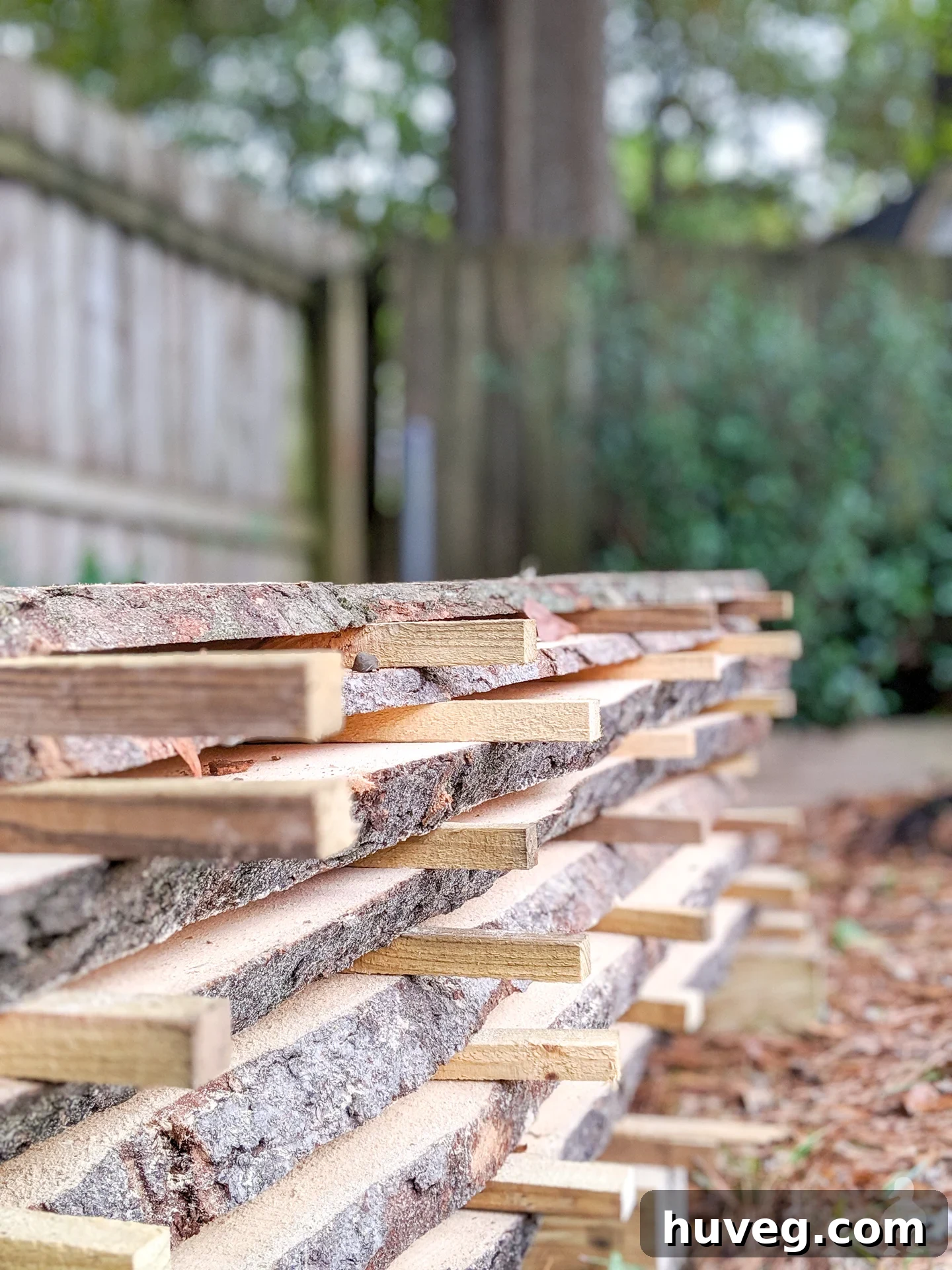
The beauty of a bandsaw mill lies in its thin blade, which minimizes kerf loss (the amount of wood turned into sawdust) as it glides through the log, slicing it into consistent, custom-thickness slabs. As each piece is cut, the previously milled lumber is meticulously stacked. Crucially, “stickers” – thin strips of scrap wood – are placed horizontally between each layer of slabs. These stickers create vital air gaps, allowing for proper airflow around all surfaces of the wood, which is essential for even drying. Once the stack is complete, heavy weights are placed on top to prevent warping, and a tarp covers only the very top to protect from rain and direct sun, while leaving the sides open for maximum air circulation. This careful arrangement allows the wood to air-dry naturally over the next 6-12 months, or even up to a couple of years, depending on the thickness of each slab and local climate conditions.

The Essential Prep Work: Setting the Stage for Slabbing
Before the sawyer could arrive, a few critical preparatory steps were necessary to ensure a smooth and successful milling day.
Moving the Log: A Stroke of Genius
The first major hurdle was getting the massive magnolia log from my neighbor’s yard to mine. This initially seemed like an impossible task for a single person. However, a creative solution presented itself. The company that had cut down my neighbor’s trees was scheduled to return the next day to collect all the logs. I woke up ridiculously early that morning, waiting for their arrival. When they showed up, I politely asked if they would mind using the long hydraulic arm on their truck, typically used for loading, to simply transfer the magnolia log one yard over into my property. They graciously obliged, and within minutes, the log was in place, ready for its transformation, and they were on their way!

Preparing the Stacking Foundation
Next, we needed to create a stable, level foundation for the newly cut slabs to dry on. We cut down a 6×6 pressure-treated post into several shorter chunks, ensuring they were wide enough to support the magnolia slabs. These supports were spaced approximately every 18 inches (I’ll confirm and update this measurement if needed) across the designated area on the lawn. It was absolutely crucial to meticulously level each of these supports. Getting this step right ensures that each cut slab remains flat as it dries, preventing warping, twisting, or bowing. While the inherent weight of each slab helps keep the pieces beneath it pressed down, the very top layer would require additional weight. For this, we gathered a stack of landscaping pavers, which would provide the necessary downward pressure and ensure overall stability, preventing the entire stack from toppling over.
Slabbing Day: The Transformation Begins!
The highly anticipated slabbing day arrived! You might find this amusing, given this is a sponsored post, but when the sawyer needed to trim a few stray, oversized sections of the log that wouldn’t fit onto the portable mill, he instinctively whipped out a Stihl chainsaw. It was a perfect, unscripted moment of brand synergy! 😂
The milling process began with a few narrow “truing” slices, typically about an inch thick, which were taken off the top to create a perfectly flat surface across the entire length of the log. This initial preparation ensures subsequent cuts are even. Once a clean, flat surface was established, the sawyer switched to a cutting depth of 2 inches per slab. We had the option to rotate the log and trim off the bark and irregular edges for a more conventional, squared-off piece of lumber. However, we enthusiastically opted for the “live edge” look, where the natural, untouched bark remains intact on the edges of the slab, adding unique character. We anticipate losing some of this 2-inch thickness when the wood is planed flat after air-drying, as wood can still move slightly despite careful efforts. However, 2 inches was the maximum thickness recommended for slabs of this length due to their immense weight, which makes handling and future processing significantly more challenging.

Once we had milled about halfway through the log, the sawyer carefully flipped it over. This allowed him to repeat the same pattern of thin truing slices followed by thicker 2-inch cuts from the opposite side, ensuring maximum yield and consistent slab quality.

Every random offcut and irregular piece was diligently saved. These smaller pieces are invaluable for future small projects, like coasters or small carving practice, ensuring minimal waste.

An important task during the slabbing process was wiping off the sawdust from each slab before stacking. This simple step helps prevent moisture retention and inhibits the growth of mold or fungi on the wood surfaces during the crucial drying phase. With each pass of the rag, the intricate, beautiful grain pattern of the magnolia wood was revealed, making me fall more and more in love with its unique aesthetic.

While K and Bruce efficiently carried each heavy slab to the designated stacking area, I was tasked with ensuring that every “sticker” (the scrap wood strips placed between layers) was precisely the same thickness. This meticulous attention to detail is paramount for even spacing throughout the stack. Any deviation – a sticker that’s too thick or too thin – can lead to uneven air circulation, which, in turn, can cause specific slabs to warp or bow as they dry, compromising their integrity and usability. This teamwork was crucial for a successful outcome.

It was incredibly satisfying and SO COOL to witness the entire process unfold! And just look at the impressive amount of beautiful wood we managed to get from a single tree!
The Investment: Cost of Portable Sawmilling and Value
How Much Does It Cost?
The total cost for portable wood milling services is typically calculated based on a combination of factors: the total time spent actively cutting the logs, and the mileage or travel fees for the sawyer to get to your property. Our total cost for milling the magnolia log came in at a very reasonable $400. When you consider the price of purchasing live-edge wood slabs of comparable length and species from a supplier, the cost would be astronomically higher – easily thousands of dollars. This makes portable milling an incredibly cost-effective way to acquire premium lumber. We firmly believe that this investment will provide us with an array of fantastic options for future woodworking projects. Furthermore, if we find ourselves with more slabs than we can use, there’s always the potential to sell the surplus to other local woodworkers who appreciate working with unique, live-edge pieces.

What’s Next? The Drying Process and Future Projects
The entire milling operation took place directly in front of the house, with the log resting on the newly laid grass until it was time for processing. Despite our early start on a Sunday morning, our neighbors seemed largely unfazed by the noise. Our neighborhood, it seems, operates on an unspoken “it’s okay to be loud sometimes because we were loud three weeks ago and you didn’t complain” policy. Still, it’s always best practice to give your neighbors a friendly heads-up!

My partner, K, was initially quite concerned about the log and the inevitable sawdust ruining the grassy patch at the front of the yard. This was understandable, especially after all the effort we had poured into reseeding and nurturing the lawn over the summer. The sawdust was indeed deep enough to make a “sawdust angel,” though lying in the street isn’t quite my preferred activity!

We had the wood milled in November, so several months have passed, and we still have many more to go before the slabs are adequately air-dried. As for the grass, I’m happy to report it’s rebounded beautifully and is now lush and healthy! Phew!
Bruce, our sawyer, highly recommended purchasing a moisture meter. This essential tool will allow us to accurately monitor the wood’s moisture content, helping us determine when our custom lumber has reached a suitable air-dried state (typically around 25-30% moisture content, though the exact ideal level can vary). Once air-dried, the next step would be kiln drying to further reduce the moisture level to a stable 6-8%, which is crucial for preventing movement and cracking when the wood is finally turned into finished projects. The general rule of thumb for air-drying wood is roughly “one year per inch of thickness,” but this is a very rough estimate, especially in high-humidity areas like ours. We are clearly still many months away from the final project phase!

(Initially, we mistakenly thought we needed to cover the entire stack with a large tarp, but quickly realized the importance of allowing airflow on the sides for proper drying. We corrected ourselves, covering only the top portion to protect from precipitation while keeping the sides open!)
Once the wood is fully dried and stabilized, we anticipate having enough beautiful magnolia lumber for several exciting projects. I’m incredibly eager to see what we create! My current top ideas include crafting a stunning live-edge headboard for our primary bedroom and/or unique countertop pieces for our Ruby project. We’re also planning to make a special cutting board or serving board as a heartfelt thank-you gift for our incredibly tolerant neighbor. Beyond that, there are possibilities for smaller decorative pieces, perhaps even some wearable art – anyone interested in a custom wood necklace? 😊 (Though slightly off-topic, I’m already envisioning similar art pieces using salvaged wood from the Ruby renovation as well.)

As an exciting bonus, K surprised me with a benchtop lathe for Christmas! This means I’ll soon be able to put those initial magnolia chunks to good use, exploring woodturning and carving. Stay tuned for those projects later this year! If you have any other creative ideas for what we should make with this precious magnolia wood, I would absolutely love to hear them in the comments below!