Domestic Gripes Share Your Home Pet Peeves

In these extraordinary times, where our homes have become more than just living spaces—they are our offices, our schools, our sanctuaries—the seemingly small details within them have taken on new significance. Many of us are spending unprecedented hours within our four walls, and with that increased immersion comes a heightened awareness of every nook, every cranny, and perhaps, every tiny, inexplicable flaw. While the world outside feels perpetually in motion and often overwhelming, the desire for order, efficiency, and comfort within our personal domains has never been stronger. It’s in this spirit that I wanted to share a rather common, yet often unarticulated, observation about home organization and design.
I’m talking about those peculiar household quirks, those minor design choices, or even simple organizational habits that, for some unfathomable reason, just rub us the wrong way. They’re often completely absurd in their triviality, yet they possess an uncanny ability to irk us with disproportionate intensity. Have you ever walked into a room and felt a slight, illogical pang of annoyance over something that, objectively, doesn’t matter much at all? Perhaps it’s a light switch placed just out of reach, a cabinet door that scrapes the ceiling when opened, or even a misplaced decorative item. These aren’t critical failures of architecture; they are the “pet peeves” of home organization and design, and I’m convinced we all have them.
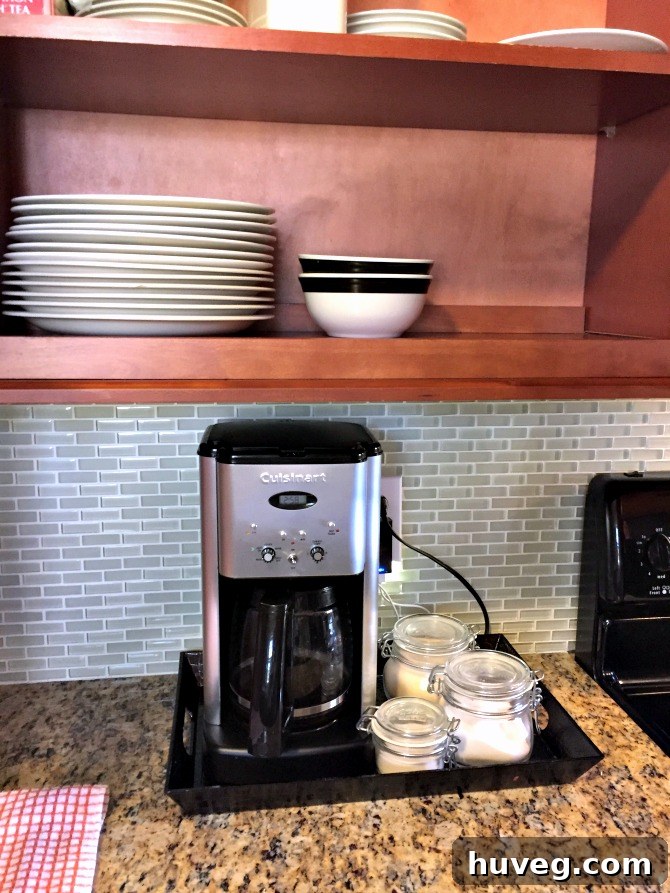
This thought occurred to me recently while making my morning coffee at my parents’ house – a ritual I cherish, but one that always seems to highlight a particular, shall we say, “organizational challenge.” As I stood there, methodically preparing my brew, I couldn’t help but notice it. Do you see it in the image below?
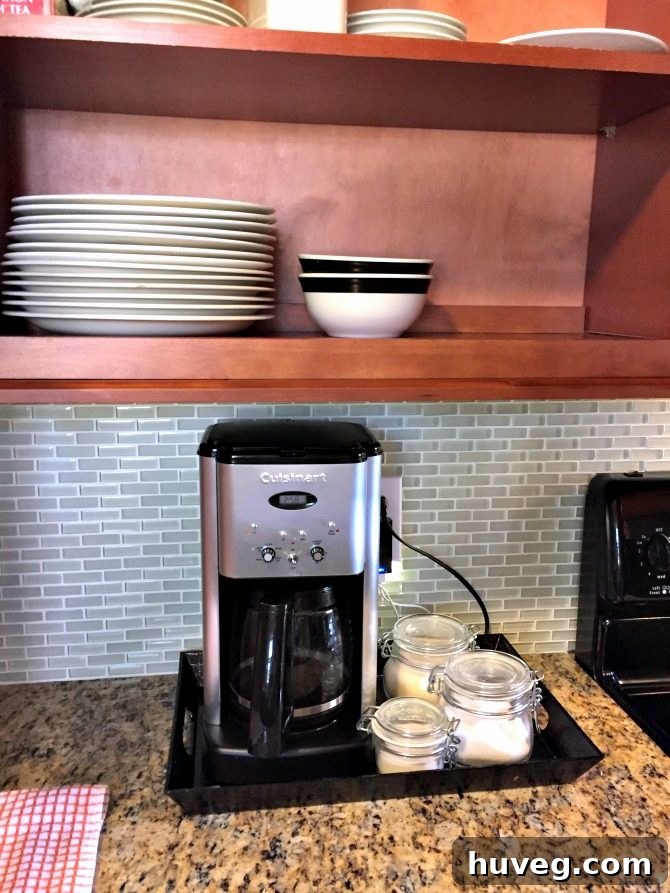
The Curious Case of the Missing Coffee Mugs: A Kitchen Organization Dilemma
It’s undeniably nitpicky, bordering on the ridiculous, yet certain aspects of kitchen layouts and the logic (or lack thereof) in organizing kitchen essentials seem to trigger a deeply rooted, almost irrational desire within me to “fix” things. In this instance, at my mom’s house, the glaring issue was simple: the coffee mugs were not in the cabinet directly above the coffee maker. Sounds trivial, right? But consider the workflow: here I was, coffee filters at hand, coffee grounds measured, water heating – all the components for a perfect cup, neatly gathered. Except for the vessel itself. The mugs? They resided two cabinets over, on the other side of the stove. It’s a minor detour, a few extra steps, but it breaks the fluid motion of a simple task.
Of course, my mom has every right to organize her kitchen exactly as she pleases – and she should! Her home, her rules. Yet, I find myself having to confess this particular pet peeve, fully aware of its disproportionate impact on my peace of mind. This isn’t just about coffee mugs; it’s about the underlying principles of functional kitchen design and efficient home organization. These small inefficiencies, when encountered daily, can accumulate into a subtle layer of frustration. It’s akin to reaching for the silverware drawer only to find it inconveniently located far from the dining table or the dishwasher, or constantly searching for drinking glasses that are never quite near the refrigerator or the water dispenser.
Understanding the Psychology Behind Our Organizational Pet Peeves
Why do these seemingly inconsequential details bother us so much? It boils down to our innate human desire for efficiency, logic, and a seamless flow in our daily routines. When an environment, especially one we interact with multiple times a day like a kitchen, presents a minor obstacle, it disrupts our subconscious expectations of how things “should” work. This friction, however slight, registers as an inefficiency, a minor annoyance that chips away at our sense of control and order. It’s not about perfection; it’s about congruence between expectation and reality.
These are the kinds of things that make us pause and think, “Why is this like this?” When the tools we need for a specific task aren’t readily accessible in the logical proximity of that task’s execution, it creates a break in the natural rhythm. Imagine a baking station where the flour is in one corner, the sugar in another, and the mixing bowls in a third. It adds unnecessary steps and mental load to an otherwise straightforward process. For me, the coffee mug dilemma is a prime example of this kind of cognitive dissonance in home organization.
Common Kitchen Design and Organization Flaws That Irk Us
Beyond the specific coffee mug scenario, there are numerous common kitchen design flaws and organizational missteps that can become significant pet peeves for homeowners. Being aware of these can help in planning a more functional and enjoyable space:
- Poor Workflow Zones: A kitchen should ideally be zoned for different activities: a prep zone, a cooking zone, a cleaning zone, and a storage zone. When these zones overlap or are illogical (e.g., the trash can being far from the prep area), daily tasks become cumbersome.
- Inconvenient Appliance Placement: Microwaves placed too high or too low, dishwashers that block main walkways when open, or ovens that are difficult to access can all lead to daily frustrations.
- Lack of Adequate Counter Space: Especially near the sink or stove, insufficient counter space makes meal preparation a constant struggle, leading to clutter and inefficiency.
- Inaccessible Storage: Deep corner cabinets without pull-out mechanisms, high shelves that require a stool for every use, or pantry layouts where items get lost in the back are common complaints.
- Illogical Drawer and Cabinet Contents: As with the coffee mugs, storing silverware far from the dishwasher or dining area, or glasses not near the refrigerator, defies common sense and adds extra steps to simple actions.
- Insufficient Lighting: Poor task lighting in prep areas or overall dim lighting can make the kitchen feel less inviting and less functional.
- Limited Power Outlets: Not enough outlets, or outlets placed inconveniently (e.g., behind permanent appliances), can limit flexibility and necessitate extension cords, which are often eyesores and trip hazards.
Beyond the Kitchen: Household Design Flaws and Organizational Grievances
While the kitchen often takes center stage for these functional grievances due to its high-traffic nature, similar issues can plague other areas of the home. Think about:
- Light Switches: Placed on the wrong side of an entry door, or multiple switches for one light source causing confusion.
- Power Outlets: Hidden behind fixed furniture, or not enough in a room to accommodate modern electronics, leading to messy power strips.
- Bathroom Storage: A common lack of adequate storage for toiletries, towels, and cleaning supplies, leading to cluttered countertops.
- Door Swings: Doors that open into other doors, or into main traffic paths, creating awkward navigation.
- Entryway Clutter: Lack of a designated spot for keys, mail, shoes, and bags, leading to a perpetually messy entry point.
- Bedroom Closets: Insufficient hanging space, poor shelf configuration, or difficult-to-access areas leading to disorganization.
These seemingly minor “design flaws” or organizational oversights don’t just create momentary annoyance; they can subtly impact our daily comfort and efficiency. They are the tiny, often unspoken, stressors that accumulate over time. And sometimes, like in my mom’s case, the arrangement might even be maintained on purpose *because* of my disproportionate irritation at being minorly inconvenienced. (I’m laughing at myself here, too – fully aware of how this particular quirk bothers me and me alone, and possibly provides Mom with some amusement.)
Strategies for a More Functional and Harmonious Home
Recognizing these pet peeves is the first step toward creating a more functional and harmonious living space. Here are a few strategies to consider for optimizing your home organization:
- Observe Your Habits: Pay attention to your daily routines. Where do you naturally reach for items? What paths do you take? This observation can reveal areas where your home isn’t supporting your natural flow, from the kitchen sink to your bedside table.
- Declutter Systematically: Less is often more. By decluttering, you reduce the number of items vying for space, making organization simpler and revealing opportunities for better placement of essential items. Tackle one area at a time to avoid feeling overwhelmed.
- Create “Zones” of Activity: Group items by function. In the kitchen, a “coffee station” with mugs, filters, and coffee beans together makes sense. A “baking zone” with all ingredients and tools similarly grouped improves efficiency. This principle applies to other rooms too: a reading nook, a charging station, or a designated mail area.
- Utilize Vertical Space: Shelves, wall-mounted organizers, tiered drawers, and stackable containers can maximize storage without expanding your footprint. This is especially useful in smaller kitchens, bathrooms, and closets.
- Prioritize Accessibility: Frequently used items should be at eye-level and easy to reach. Less frequently used items can go higher or lower. Think about the “first-in, first-out” rule for pantry items and ease of access for everyday essentials.
- Embrace Custom Solutions: Every home and every person is unique. What works for one might not work for another. Don’t be afraid to experiment with different arrangements until you find what truly enhances your daily life. Sometimes, a simple drawer divider, a small, dedicated hook, or an adjustable shelf can make all the difference.
- Seek Inspiration: Look at interior design blogs, home organization magazines, and social media for innovative storage solutions and layout ideas. Adapt them to fit your specific needs and space constraints, remembering that functionality should always come before aesthetics.
Ultimately, our homes should be places of comfort and ease, not sources of continuous, albeit minor, irritation. Addressing these small organizational or design flaws can significantly enhance our daily living experience, reducing subtle stressors and promoting a greater sense of calm and efficiency. Taking the time to optimize these small details can lead to a surprisingly significant improvement in your overall well-being and satisfaction with your living environment.
So, I’m just curious: is there anything like this that drives *you* bananas? A light switch that’s always in the wrong spot, a cabinet that’s just a little too high, or an organizational quirk that no one else seems to notice but you? I can’t possibly be the only one who fixates on these things! Share your most illogical, yet utterly frustrating, household pet peeves in the comments below. Let’s commiserate and perhaps even share some clever solutions for better home design and organization!
P.S. Just so you guys know, I didn’t publish this without Mom’s knowledge – she was the one who helped me clear off the counter so I could take the pic. We had a good laugh about it! 😉