Free Plans to Build a DIY Floating Platform Bed

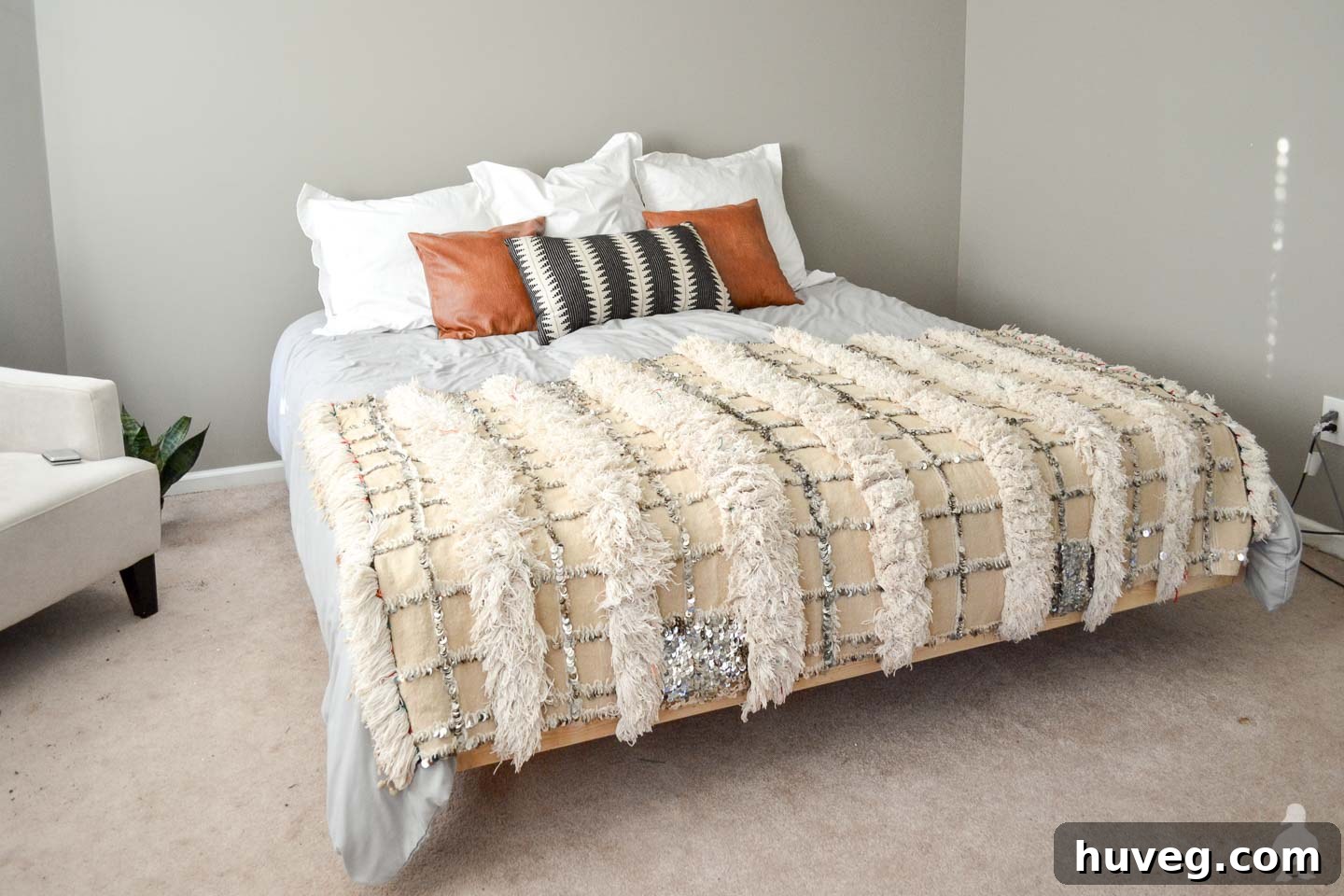
Transform your primary bedroom with a show-stopping feature: a DIY floating platform bed. Designed to create the illusion of levitation, this bed frame adds a touch of modern elegance and unique style to any space. In this detailed guide, we’ll walk you through the entire build process, from selecting your materials to final assembly, and share our free woodworking plans for king, queen, and full sizes. (California king & twin sizes coming soon!).
This project has been a labor of love and a highly anticipated share! For months, we’ve received requests for the king-size floating bed frame plans that K and I meticulously crafted together. Now, with our primary bedroom renovation taking shape—featuring fresh paint, new rugs, updated fabrics, and other exciting updates—it’s the perfect time to unveil these plans. This way, you can follow along with our home improvement journey in a semi-chronological order and build your own custom sanctuary.
Frankly, I’m glad we held onto these plans for a little while. Furniture building, especially sharing detailed plans, is a relatively new frontier for me. For years, our budget was almost exclusively dedicated to essential home repairs, making furniture projects feel like a luxury. Now, with more freedom to explore creative builds, I’ve gained confidence not just in the craft but also in the design’s durability. Having slept on this bed for nearly a year, I can confidently vouch for its fantastic upgrade from our previous, rather crowded, queen-sized bed. It comfortably accommodates two people and two dogs, proving its robust construction. Beyond its functionality, I cherish this bed far more than any mass-produced MDF or particleboard furniture. It’s built from solid wood, customized precisely to our needs, and imbued with the satisfaction of a handmade creation.
While the design may not revolutionize bed aesthetics—a curious thought to ponder—its strength lies in its practicality and the personal touch. In hindsight, I’d consider integrating drawers into the base for much-needed under-bed storage, a modification I might still tackle someday. But what truly makes this project special is the collaborative effort behind it. K and I worked together on the design, the build, and even the accompanying video. In that sense, it stands as our first significant joint woodworking project, an accomplishment we both deeply appreciate. The idea of adding extra storage compartments to maximize the unused space beneath remains a tempting future enhancement.
DIY Floating Platform Bed: A Step-by-Step Guide
Creating a floating platform bed is an immensely rewarding project that combines practical skills with creative design. The illusion of a bed hovering above the floor brings a modern, minimalist aesthetic to your bedroom. Below, you’ll find the comprehensive video tutorial that walks you through each stage of the build, along with a detailed list of materials and essential tools.
Essential Tools and Materials:
Before you begin your floating bed frame project, gather the following tools and materials. Having everything ready will ensure a smooth and efficient build.
- Miter Saw or Circular Saw: Essential for precise, straight cuts on your lumber. A miter saw offers excellent accuracy for repeatable cuts, while a circular saw is versatile for longer boards.
- Drill/Driver: A cordless drill is indispensable for pre-drilling holes and driving screws.
- Self-Tapping Screws: These screws are highly recommended as they eliminate the need for pre-drilling, saving you significant time and effort during assembly. If you use regular screws, remember to pre-drill to prevent wood splitting.
- Wood Glue: Provides extra strength to your joints, ensuring a rock-solid bed frame. Apply a thin, even coat before fastening with screws.
- Tape Measure: For accurate measurements, crucial for ensuring all components fit together perfectly.
- Pencil: For marking cuts and drilling locations.
- Kreg Jig: A pocket hole jig is fantastic for creating strong, concealed joints, giving your bed a professional finish.
- Kreg Jig Screws: Specifically designed for use with a Kreg Jig, ensuring optimal hold.
- Face Clamp (optional): Helpful for holding pieces flush while securing pocket hole screws, ensuring tight joints.
Our floating platform bed is designed in three main sections: the base, the platform, and the bed slats. While you could technically start with the bed slats or the base, we recommend building the base (#2) before the platform (#3) to ensure all components align perfectly during final assembly. This modular approach also simplifies transportation should you ever need to move. The approximate cost for this project was $160, though this figure can potentially decrease if you opt to use plywood and rip it down for the bed slats instead of 1×3 lumber.
UPDATES & FAQ:
- Good news! Full and queen size plans are now readily available. Due to popular demand, we are also diligently working on plans for twin size and California king beds, which will be released soon!
- Many of you have asked about the cut list; rest assured, it’s comprehensive and included IN THE PLANS! Our detailed PDF download contains all the full diagrams, a precise cut list, step-by-step instructions, and additional helpful information, totaling about 11 pages of valuable content. To access these free plans, simply head over to my woodworking plans library and follow the instructions provided there.
1. Constructing the Bed Slats (x2 for larger beds)
Building the bed slats is a straightforward process, and using a Kreg Jig makes it even simpler. Our approach involves creating a basic perimeter frame and then filling it with evenly spaced slats. While you might observe a relaxed approach to precise slat spacing in the video—which, admittedly, hasn’t caused any issues for us over the past year—for optimal mattress support and spinal health, we strongly recommend following the even spacing guidelines detailed in the plans. Consistent spacing prevents mattress sagging and ensures long-term comfort.
A key advantage of this platform bed design is its compatibility with modern mattresses. Our memory foam mattress rests directly on these sturdy bed slats, eliminating the need for a traditional box spring. This not only contributes to the bed’s sleek, low-profile aesthetic but also simplifies your bedding setup and reduces overall costs. The solid support provided by the slats ensures your mattress performs optimally and lasts longer.
2. Assembling the Floating Base
The bed’s floating illusion begins with its concealed base. This section comes together remarkably quickly, and in my initial build, it was assembled so swiftly one evening that I entirely forgot to hit record! While my filming habits have certainly improved since then, this was one of the early projects where the idea of documenting the process for video clicked only halfway through. That said, the simplicity of the base’s construction makes it very approachable. At the time, I was also heavily involved in constructing the Rust-Oleum booth for the first WorkbenchCon, so distractions were plentiful. (WorkbenchCon 2019 is happening this week, and I’m teaching a class this time! Public speaking always makes me nervous, so wish me luck!*)
The base is the unsung hero of the floating bed, providing robust support while remaining out of sight. Its sturdy construction is paramount to the bed’s overall stability and the effectiveness of the floating effect. Ensure all joints are secure and square, as this foundation will bear the entire weight of the platform, mattress, and occupants.
3. Constructing the Main Floating Bed Frame
With the base complete, K and I moved on to constructing the outer frame of the main platform section. This involves building a robust rectangular frame that will eventually house the bed slats and support your mattress. We incorporated two additional supports running down the middle of the frame to ensure comprehensive support across all four sides for the bed slats. After constructing this outer frame, we carefully positioned and began assembling the rest of the platform directly on top of the already-built base. This method allowed us to perfectly align the additional supports that overlap the base, ensuring they were fully and securely supported by the 2×8 lumber underneath.
For securing the frame components, I highly recommend using self-tapping screws, as listed in the materials section. Our initial build involved pre-drilling every hole before applying wood glue and driving regular screws, which essentially doubles the workload. Self-tapping screws significantly streamline this process by drilling their own pilot holes, saving you considerable time and effort without compromising structural integrity.
You might encounter situations where traditional drilling angles are challenging. For some of the middle supports, particularly where the platform used doubled 2x4s and was thicker than our available screws could comfortably penetrate straight on, we opted to screw them in at an angle. This technique provides effective fastening even in tight or thick sections.
If you do choose to pre-drill, as we initially did, remember a crucial tip to prevent drill bit slippage or breakage: start your drill bit at a more perpendicular angle to engage the wood securely, and then gradually move to your desired angle as the bit begins to bite. This method ensures a clean start and reduces the risk of damaging your material or tools.
4. Final Assembly: Connecting the Modular Sections
A thoughtful design feature of this bed is its modular construction, divided into three main sections. This foresight allows for easier disassembly and transport should you ever need to move homes. To securely connect the platform to the base while maintaining this modularity, we utilized scrap wood pieces as connectors. It’s crucial not to glue these scrap pieces so that they can be easily unscrewed later, allowing for convenient disassembly. These connectors primarily prevent the platform from sliding off the base, ensuring stability without permanent attachment. (Note: As these connectors are made from varying scrap wood, they are not specified in the plans or cut list, allowing for flexibility based on your available materials.)
Once the platform bed frame and its base were securely connected using these removable scrap wood pieces, we proceeded to add the bed slats on top, fastening them with additional screws. At this stage, the entire bed forms one solid, robust unit, capable of being moved as a single piece. This stability was evident when we recently updated our primary bedroom rugs, demonstrating the bed’s integrated strength and ease of relocation.
Please bear with us on the “final” styling shot of this bed; it’s still a work in progress! As is often the case when upgrading to a larger bed, the bedding itself requires a complete overhaul. Our existing mattress, sheets, and accessories were remnants from K’s old place—a collection best described as “bachelor-life” style. None of it matched, chosen solely for comfort or convenience, never for aesthetics, and much of it is nearing the end of its life. To inject some style, I’ve incorporated a few of my own smaller pillows and blankets and, at long last, brought out the beautiful handira I’ve cherished for years. A handira, or Moroccan wedding blanket, was an early splurge I ordered from Marrakesh when I first bought my house, and I still love it sooo much. It brings a unique, textural element to the bed while we await a complete bedding refresh.
For an even more appealing “final” shot, our adorable fur-model graciously stepped in to lend a paw. 😉
5-6. The Unfinished Touch: Headboard & Platform Wrap
At this point, our floating bed frame project is nearly complete, but two significant elements remain: the headboard and the decorative wrap for the exposed platform edges. My long-standing dream has been to create a dramatic live-edge headboard that spans the entire wall. Achieving this, however, involves sourcing an exceptionally large and costly slab of wood, and currently, I’m prioritizing saving up for a new table saw.
Last fall, we explored the exciting possibility of sourcing our own wood slab from K’s family property. While that option remains viable, we ultimately ended up milling a tree from a neighbor’s property. The process of learning to use an Alaskan chainsaw mill or finding a portable mill is fascinating, but it also necessitates a considerable amount of drying time for the wood, meaning a lengthy wait before it can be used for a headboard.
This brings me to a temporary, yet potentially permanent, solution: designing an interim headboard. I’m contemplating carving my own headboard using the angle grinder carving skills I honed last year. (In fact, I have many carving projects planned for this year, but those are stories for other posts!) My ideas range from a faux live edge design to a completely custom carving, or even a simple, elegant plywood solution. The possibilities are truly inspiring, and the more I consider them, the more I think I might create something I love too much to ever replace—a wonderfully happy and significantly cheaper outcome!
In addition to the headboard, the still-exposed edges of the bed platform, visible in the GIF assembly above, require a finished wood wrap to elevate its aesthetic. For design mockups, I often gravitate towards walnut, a personal favorite wood species, for this wrap. Ultimately, however, my goal is to select a wood that harmonizes perfectly with the chosen headboard, making the headboard decision primary. There’s a vast array of beautiful wood species I’m eager to work with for this trim, each offering unique grain and color. To delve deeper into our bedroom’s overall design vision and mood board, be sure to check out this comprehensive post.
So, that’s the current status of our primary bedroom transformation. Rest assured, many more photographs of this room angle are on their way, showcasing the new paint (including an exciting feature wall!), recently hung art, and our freshly delivered bedding. It’s always challenging to determine stopping points during a room renovation when nothing feels truly “done.” However, considering we’ve been comfortably sleeping on this “new” bed for nearly a year while the headboard situation remains ongoing, it feels like an opportune moment to share our progress. I genuinely can’t wait for that feature wall to be fully realized and for the entire room to truly come alive! More updates soon.
Frequently Asked Questions About the DIY Floating Platform Bed
This is a common question I receive on the YouTube video! As a DIY homeowner and not a furniture manufacturer, I don’t conduct formal weight or stress tests on items like commercial products. We don’t have a dedicated testing department, offer warranties, or load our furniture with heavy objects to assess breaking points (I get similar questions for my floating shelves and other projects, with the same answer). However, what I can offer is real-world experience: my partner and I, along with two dogs (and now a baby), have been comfortably sleeping on this bed for over 3.5 years without any issues. There’s been no creaking, sagging, or noticeable changes in its structure. While I can’t provide an exact “true” weight limit, I can confidently say that for our needs, this bed is exceptionally sturdy and strong!
Absolutely not! Thanks to the substantial 2x material used throughout its construction, the bed frame itself is quite heavy. Moving it usually requires both of us (unless one of us is feeling particularly ambitious and ready for a backache!). Our 50-lb dog frequently jumps onto the end of the bed without any issues, and I often sit on the edge to put on shoes (my weight, for the record, is not disclosed!). I’ve even climbed onto the end a few times to work on projects around the bed or hang art. The design provides inherent stability, so tipping has never been a concern or something I even considered when posting these plans. While I wouldn’t recommend deliberately jumping on or trying to break any hand-built furniture after all the effort involved in making it, if you have any personal concerns about weight, you can always add more support beams to the base for your complete peace of mind. The robust structure ensures excellent balance and stability.
And one more exciting update since this post first went live several years ago: we’ve since built an entire feature wall around this floating bed, and I honestly love it even more now! This stunning slat wall incorporates a clever bump-out shelf, hidden drawers that pull out beneath the nightstands, and a host of smart home features. These include voice-enabled light fixtures, convenient wireless charging stations, and a backup power surge protector—essential for protecting our laptops and devices during storms. You can explore the full details of that intricate build and watch the complete transformation in our dedicated YouTube video right here!