Picture Frame Moulding Installation Simplified: 5 Clever Shortcuts

Transform Your Walls: An Easy Guide to Installing Picture Frame Moulding (Even on Imperfect Walls)
Are you looking to add a touch of classic elegance or contemporary flair to your home without undertaking a major renovation? Installing custom picture frame moulding, often referred to as “molding” in the US, is a surprisingly simple yet incredibly impactful DIY project. This comprehensive guide will walk you through the process, covering everything from mastering miter cuts to perfecting spacing, and even offering ingenious hacks to tackle common challenges like uneven walls and existing chair rails. Get ready to elevate your interior design with stunning decorative wall trim!
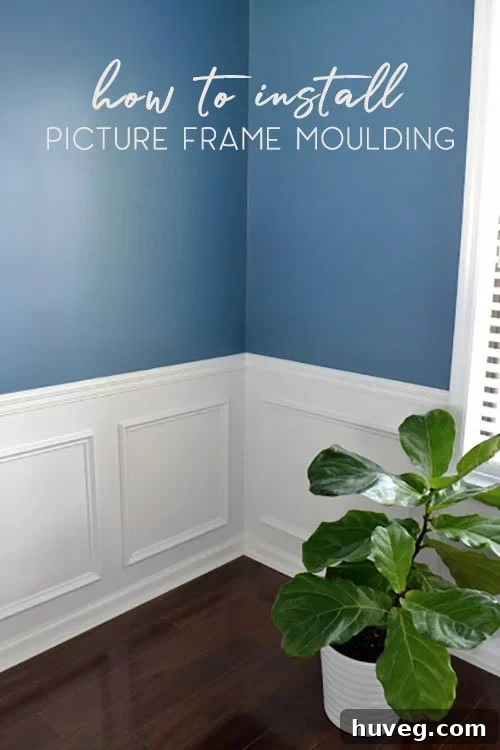
The transformation that decorative wall moulding brings is truly remarkable. It’s like watching a room shed its plain, unassuming skin and emerge as a sophisticated, well-dressed space. My recent dining room project, executed with the invaluable help of my uncle and his brother Timmy, truly brought this vision to life. Beyond organizing my garage, finishing my workbench, and tricking out my kitchen window with new trim, the majority of our efforts were focused on realizing my picture frame molding plans in the dining room. The result is nothing short of spectacular, turning a simple wall into a statement of refined taste.
Why Choose Picture Frame Moulding for Your Home?
Picture frame moulding, also known as box moulding, is a timeless decorative element that offers numerous benefits for your home:
- Enhanced Aesthetics: It adds architectural interest and depth to otherwise plain walls, creating a sense of custom craftsmanship.
- Increased Home Value: Well-executed decorative trim can significantly boost your home’s appeal and market value.
- Defines Space: In open-concept living areas, moulding can subtly define different zones, like a dining room or entryway, without the need for physical barriers.
- Cost-Effective Upgrade: Compared to other renovation projects, installing moulding is relatively inexpensive, offering a high return on investment in terms of visual impact.
- Versatility: It complements various interior design styles, from traditional and classic to modern farmhouse and transitional, depending on the profile and scale of the moulding chosen.
- Covers Imperfections: Strategically placed moulding can mask minor wall blemishes, cracks, or uneven paint lines.
Essential Materials & Tools for Picture Frame Moulding Installation
Before diving into the installation, gather these essential tools and materials to ensure a smooth and efficient process:
- Pencil: For accurate marking and layout.
- Miter Saw: Crucial for precise angle cuts, especially 45-degree cuts for corners.
- Measuring Tape: For all your length and spacing measurements.
- Safety Gear: Always wear safety glasses and hearing protection when operating power tools.
- Paintable Caulk: Your best friend for filling gaps, sealing seams, and even acting as an adhesive. Choose a high-quality, flexible, and paintable acrylic latex caulk.
- Caulk Gun: To apply caulk smoothly and evenly.
- Primer: Essential for preparing both the wall and the moulding for a lasting paint finish.
- Trim Paint: High-quality paint suitable for trim, often semi-gloss or satin for durability and easy cleaning.
- Air Compressor + Brad Nail Gun or a standalone cordless nail gun: For securely fastening the moulding to the wall.
- 18-Gauge Brad Nails: The appropriate fasteners for decorative moulding, long enough to penetrate the wall surface.
- Level: A traditional bubble level for ensuring straight lines.
- Laser Level (Optional but highly recommended): Provides perfectly straight lines over long distances, greatly simplifying layout on uneven walls.
Step-by-Step Guide to Installing Picture Frame Moulding with Ease
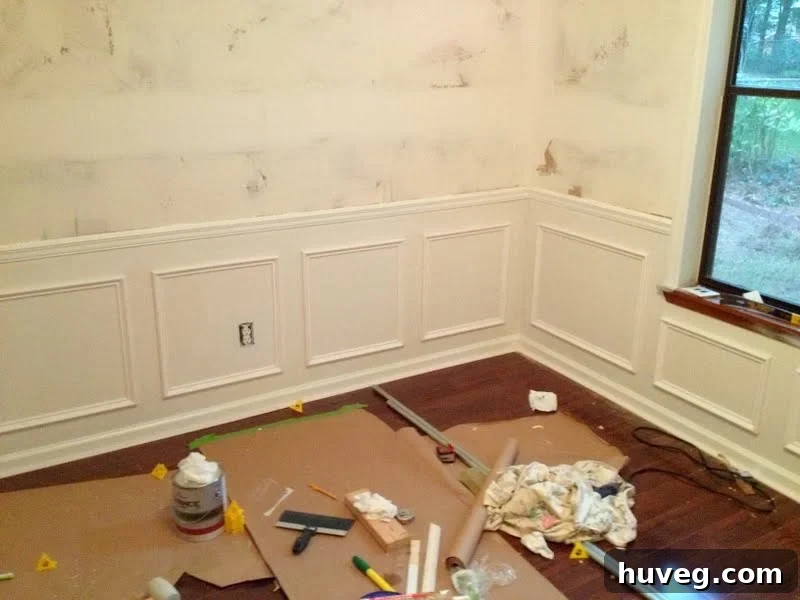
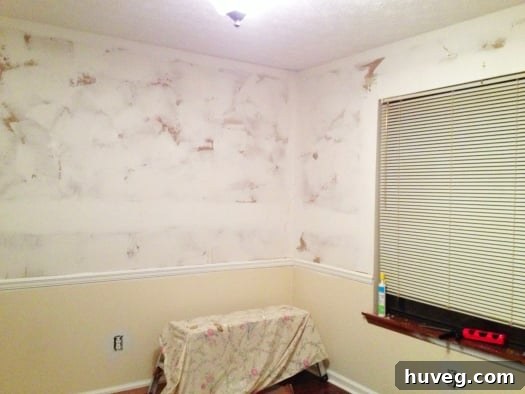
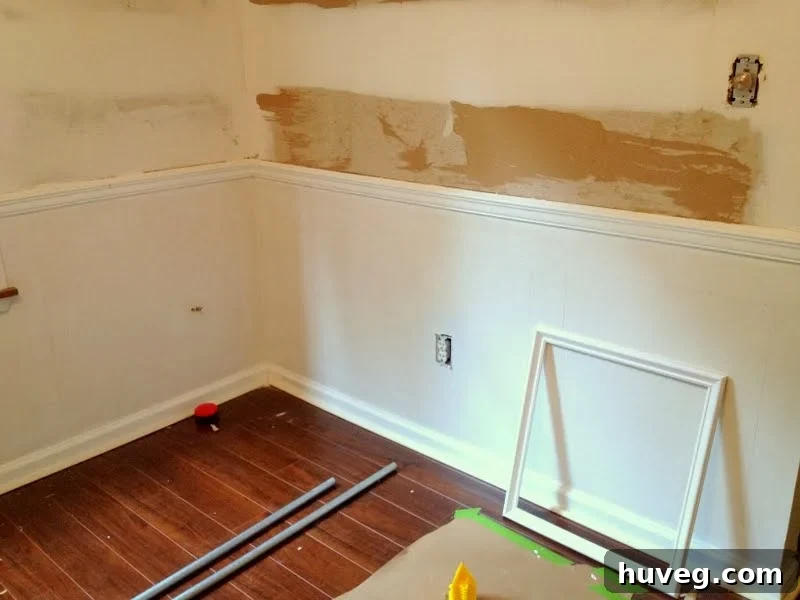
Transforming your space with picture frame moulding begins with careful preparation and a strategic approach. Let’s look at the wall before we started:
Hack #1: Prime Before Installation (A Time-Saving Secret)
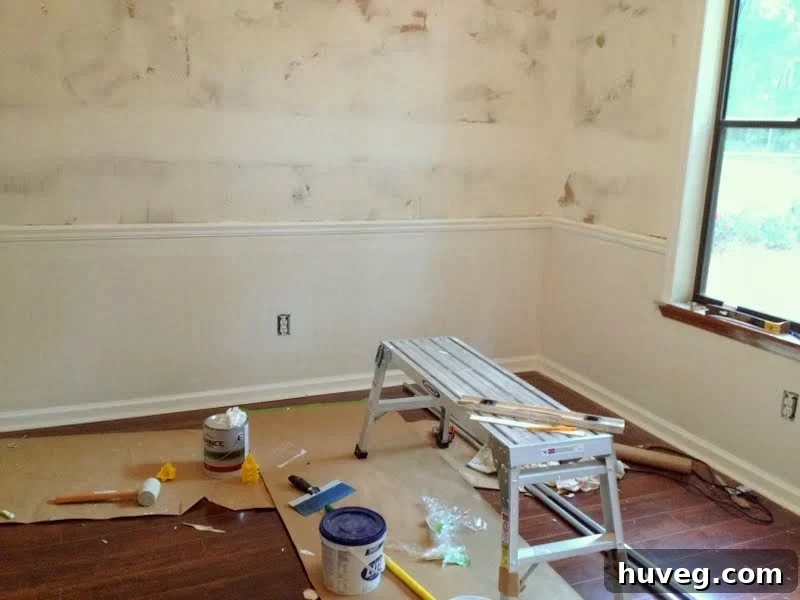
One of the most valuable tricks for a professional finish is to prime your walls before attaching any moulding. For this project, I used the same primer I’d used on my kitchen cabinets, along with the same brush and roller (which were conveniently still wet and wrapped). I applied primer to the lower half of the dining room walls, below the existing chair rail. This step is a game-changer because it allows the new moulding to adhere better, provides a uniform base for the final paint coat, and significantly reduces the amount of touch-up painting required after installation. Even just the primer alone instantly brightened the room, setting the stage for the decorative trim to come. I had picked up the moulding during a late-night Home Depot run, which you might have seen hinted at in yesterday’s foreshadowing photo.
Hack #2: Measure, Mark, and Visualize Your Layout (Before Making a Single Cut!)
While my helpers were outside preparing for a day of cutting, I spent critical time in the dining room meticulously marking and measuring the placement of each picture frame box along the lower wall. This step is paramount for achieving a balanced and aesthetically pleasing result. Initially, I had hoped to complete this layout the previous night, but after classes and two separate trips to procure the moulding (which was too long for my car, requiring a morning pickup by my dad), I was simply too exhausted. However, this delay proved beneficial.
Taking the time to accurately mark the entire wall allows you to truly visualize the finished product and make necessary adjustments before any wood is cut. Achieving the “right” look isn’t always straightforward; boxes of identical size, while appealing on paper, might not suit a wall that doesn’t permit perfectly even spacing. For instance, the wall featuring the window often requires larger boxes on either end and shorter ones beneath the windowsill and trim. This visualization also helps in estimating material quantities, ensuring you don’t purchase too much or too little, especially if dealing with custom or odd-shaped cuts.
The extra time was well spent, as I quickly discovered that the walls were not perfectly plumb, and the existing chair rail wasn’t perfectly level. This meant that simply measuring a consistent distance from the chair rail or baseboard for box dimensions wouldn’t yield the desired even appearance. Through careful adjustments and marking, I eventually mapped out the precise location for each box. Each pencil line indicated the outer edge of a box, allowing me to clearly visualize the spacing and make micro-adjustments for an optically balanced layout.
Hack #3: Implement a Custom Spacer for Uneven or Unlevel Areas
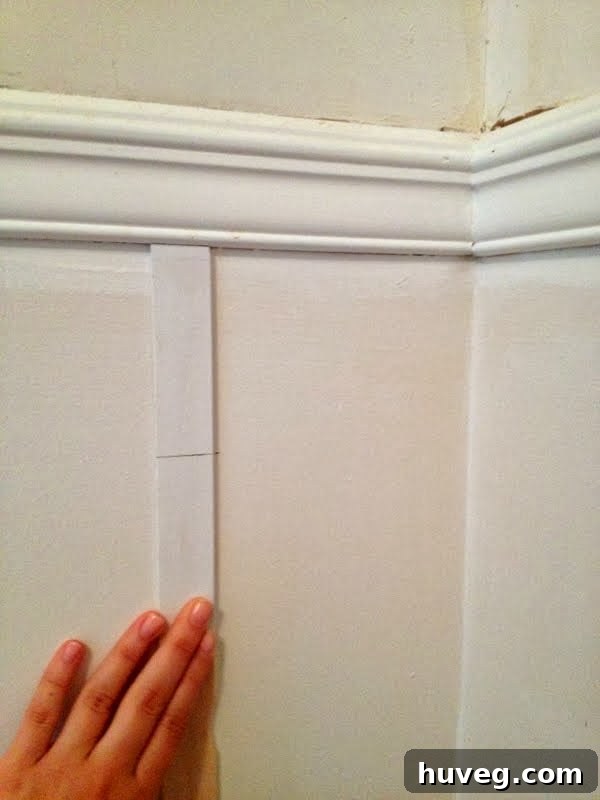
Part of ensuring visual consistency involved making sure that the distance between the top of each picture frame box and the chair rail remained as uniform as possible, despite the wall’s imperfections. To streamline this process, I created a simple 4-inch spacer using a paint stick. While a tape measure could work, a dedicated spacer makes repetitive measurements much quicker and less prone to error. A scrap piece of wood cut to your desired width would serve the same purpose admirably. After initially marking with the spacer, I then used a metal level to ensure all marks were perfectly aligned horizontally, creating crisp, straight lines.
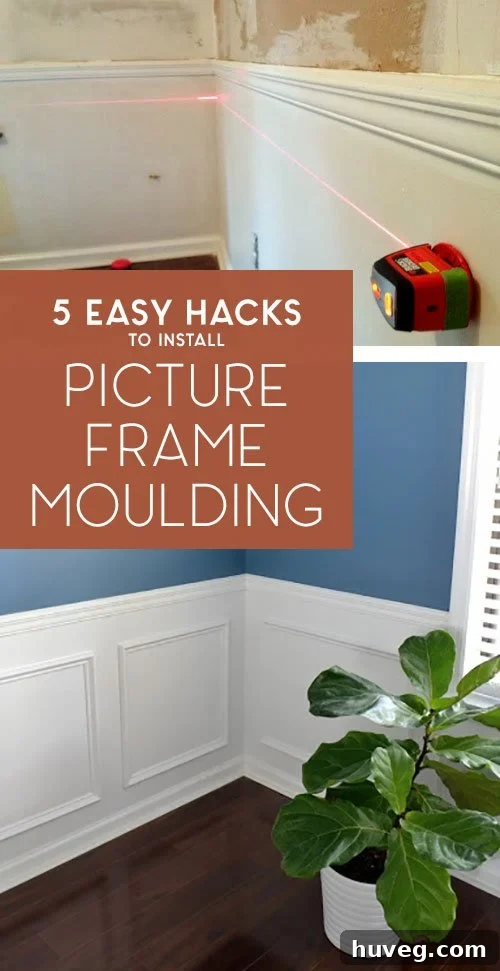
For greater accuracy over longer wall stretches, particularly on the two main walls, I deployed a laser level. This tool casts a perfectly straight line across the wall, allowing for quick and precise verification of my pencil marks. (The painter’s tape on the back of my laser level was a charmingly DIY solution to a finicky battery door, a testament to real-world project challenges!). This combination of a physical spacer for initial marking and a laser level for verification drastically improved the speed and accuracy of our layout, especially when contending with old, less-than-perfect walls.
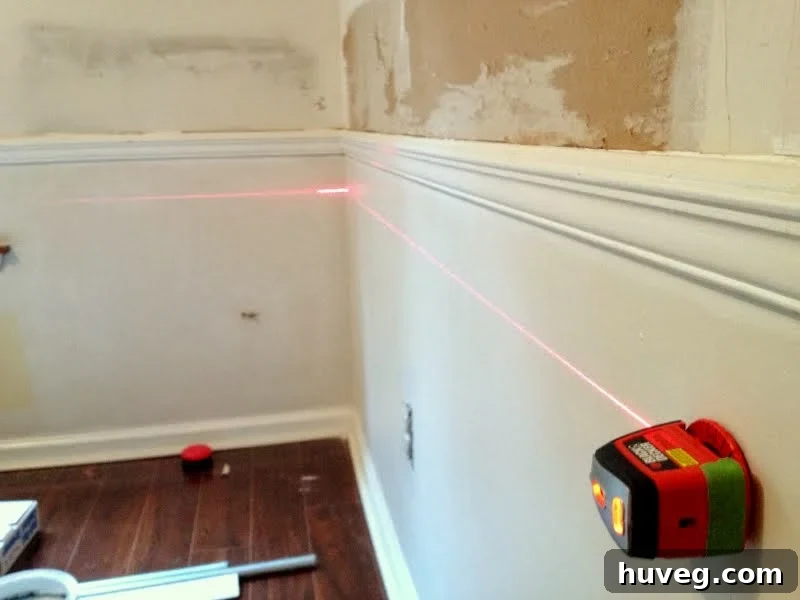
Once all the meticulous measurements and markings were complete – a task that felt like a delightful blend of creativity and fun arithmetic – it was time for the cutting phase. My uncle and his brother moved to my newly completed workbench outside (a joyous moment in itself!) to begin cutting the moulding pieces to their precise lengths, each with perfect 45-degree mitered corners ready for assembly.
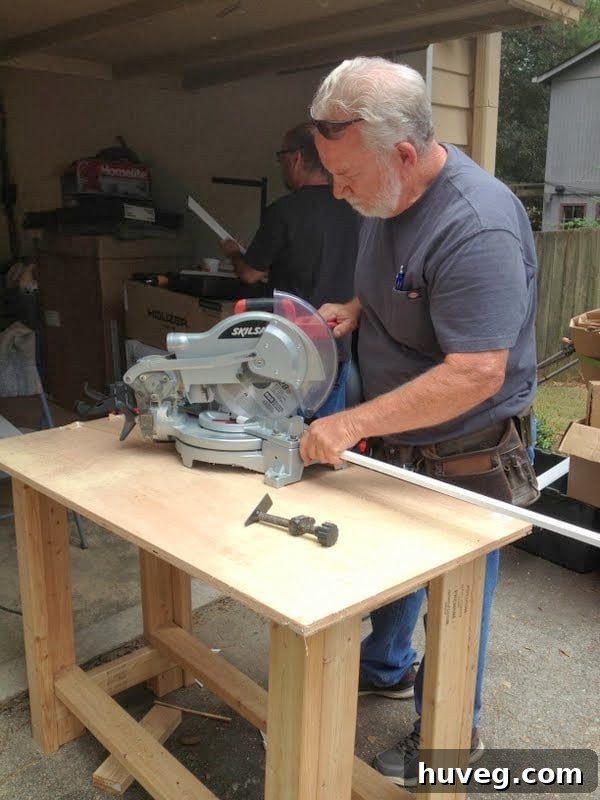
Hack #4: Pre-assemble Your Picture Frame Boxes Before Wall Installation
Instead of the traditional method of attaching each piece of moulding individually to the wall, we opted for a far more efficient and superior approach: pre-building each picture frame box. This involved assembling the four mitered pieces into a complete rectangle on a flat surface, then securing the corners together with small brad nails or wood glue, creating a perfectly flat and square unit. Only after this pre-assembly step were the entire boxes then tacked to the wall with brad nails. This method is sheer genius!
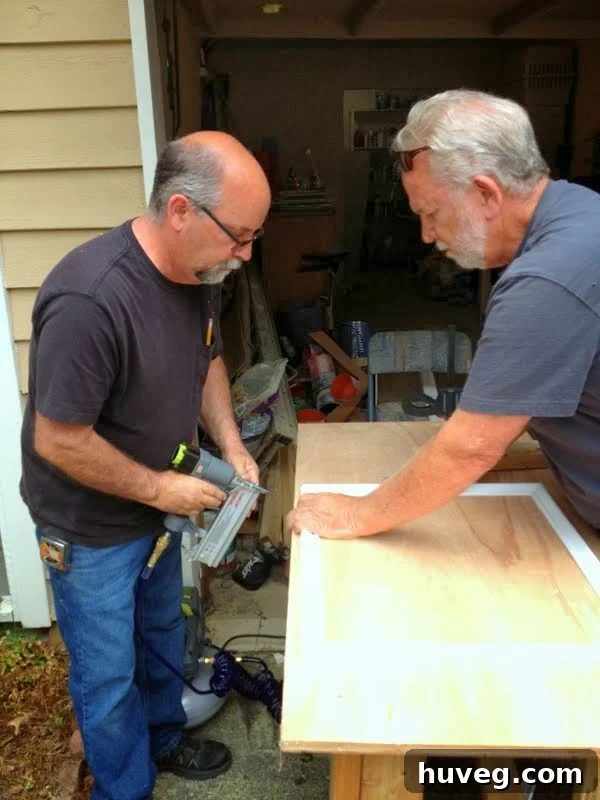
We anticipated that some areas of the wall might be uneven, potentially leading to small gaps between the pre-assembled moulding box and the wall surface. These minor imperfections would ultimately be addressed with caulk. The advantage of pre-building the boxes is that it guarantees perfectly matched and flush corners, which are the most visible and critical elements of the frame. Trying to achieve perfect corners while simultaneously dealing with an uneven wall can be frustrating, leading to shimming and endless adjustments. By building the box flat, you ensure the integrity of the frame itself, then simply focus on attaching that flat, perfect frame to the (potentially imperfect) wall. This prevents the irritating scenario where one piece of moulding seems to protrude stubbornly, no matter how much you try to coax it flat. I much prefer dealing with a solid, flat box and then relying on my trusty caulk gun to flawlessly conceal any wall imperfections.
Hack #5: Leverage Caulk for Both Adhesion and Flawless Sealing
This brings us to another ingenious application of caulk. To provide additional holding power and stability as we nailed the pre-assembled rectangles to the wall, I initially assumed we’d be using an adhesive like Liquid Nails. However, my uncle surprised me by reaching for a tube of caulk instead. At first, this seemed unusual, but its effectiveness quickly became apparent. As we pressed the boxes into place, any excess caulk that squeezed out was easily wiped away, and because it was the same material I planned to use for filling seams anyway, it seamlessly blended into the finishing process.
Using caulk as a temporary adhesive offers several advantages: it’s flexible, paintable, and easy to clean up if any squeezes out. Furthermore, it serves a dual purpose by filling any minor gaps between the moulding and the wall, immediately beginning the process of creating a smooth, built-in look. This eliminates the need for a separate adhesive step and streamlines the overall workflow.
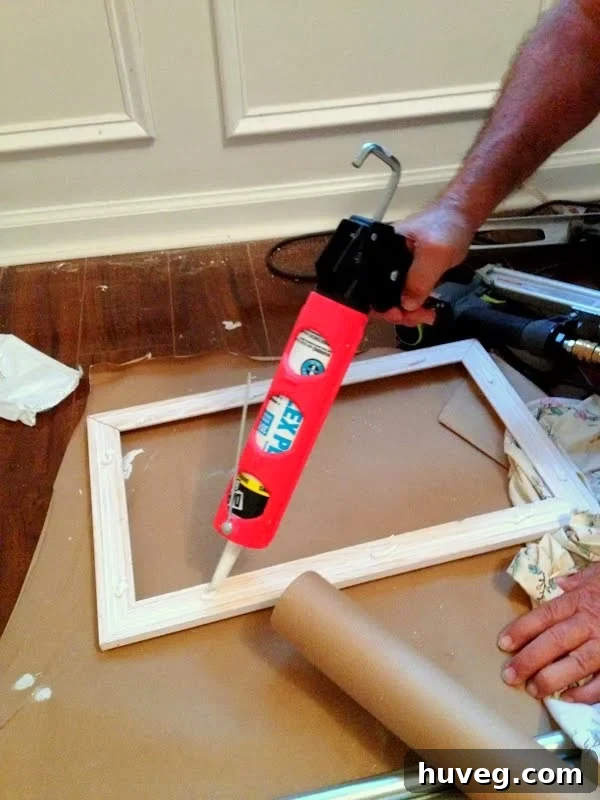
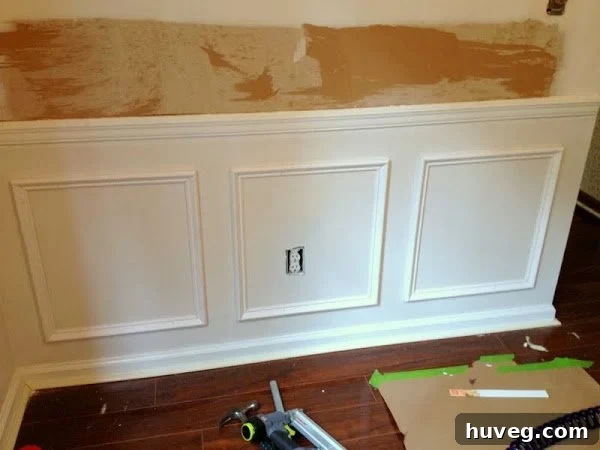
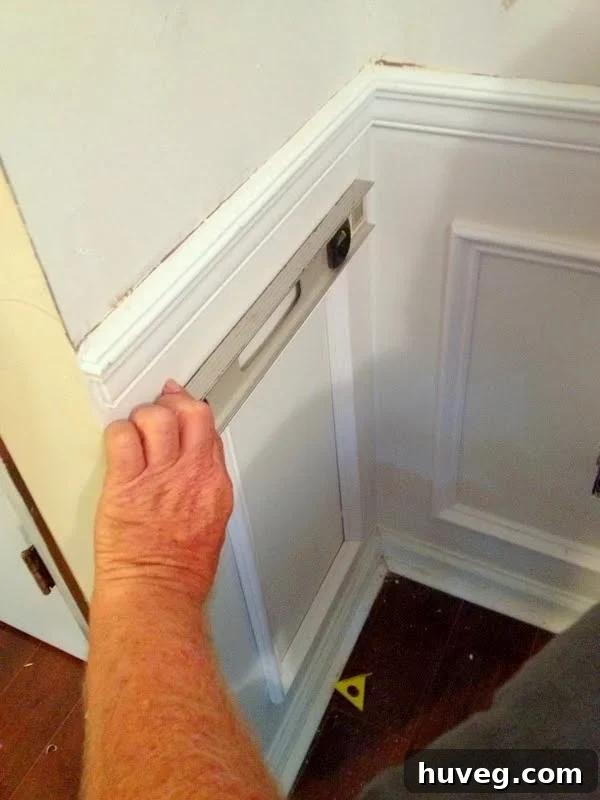
With the caulk applied to the back of the box, we carefully positioned it on the wall, aligning it with our pencil marks. Before fastening, we meticulously checked for level to ensure perfect horizontal and vertical alignment:
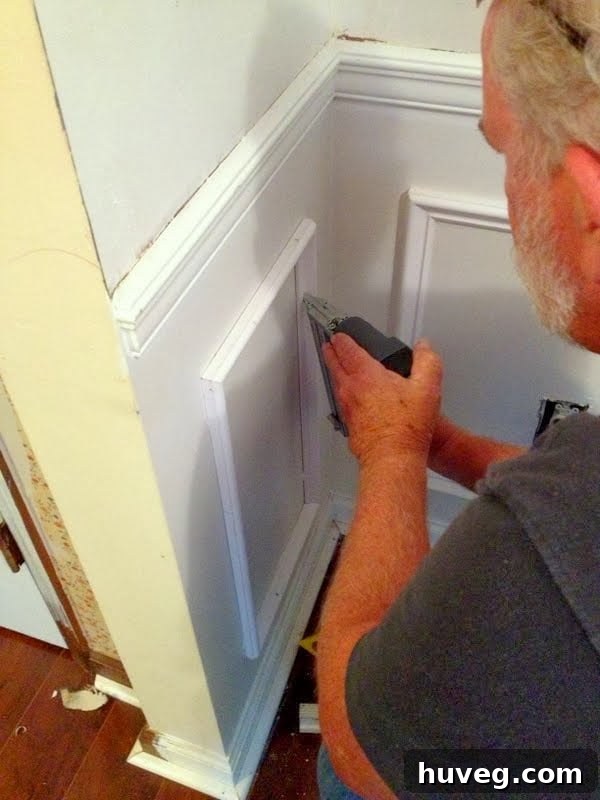
Once perfectly aligned, we secured each box firmly in place using a brad nailer. (Of course, true to DIY form, the nailer conveniently required a hose replacement just before the project commenced – a classic scenario!). The brad nails hold the moulding securely while the caulk cures, creating a strong bond. We typically placed nails every 12-18 inches along the perimeter of the box, and also angled nails at the corners for extra reinforcement.
After all the boxes were installed, I went back over every seam and nail hole with additional caulk. While some professionals advocate for wood putty for nail holes, claiming caulk shrinks (though I use types that promise not to!), I remain a staunch “caulk girl.” Its versatility, ease of application, and ability to seamlessly blend imperfections make it my go-to choice for achieving a smooth, paint-ready finish. The goal is to make the moulding look like an integral part of the wall, not an added-on element, and caulk is essential for this illusion.
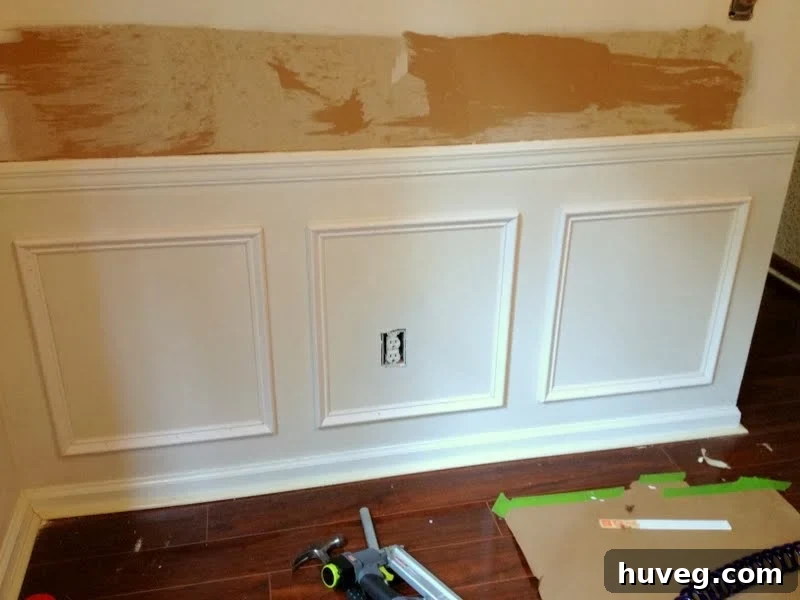
Finishing Touches: Sanding and Painting
Once the caulk has fully dried (check the manufacturer’s recommendations for curing times), a light sanding with fine-grit sandpaper (180-220 grit) will smooth out any caulk lines or minor imperfections. Wipe away any dust with a damp cloth. Finally, it’s time for painting! Apply two thin coats of your chosen trim paint, allowing adequate drying time between coats. The priming step you did earlier will ensure excellent adhesion and a vibrant, long-lasting finish.
Before the Transformation
Here’s a reminder of what the wall looked like before we began:
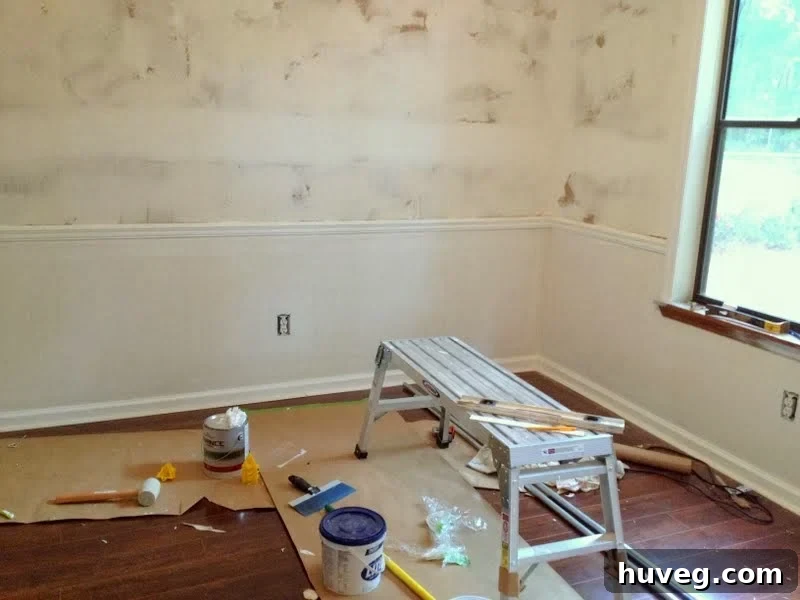
After the Stunning Upgrade
And here is the incredible transformation achieved in just one day:
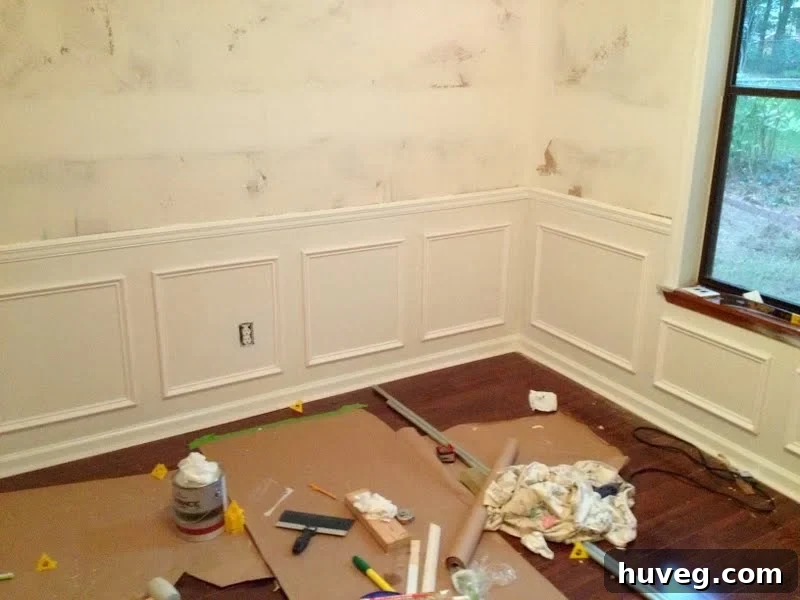
The difference is truly night and day! My superhero duo isn’t done yet, and there’s more work to do and pictures to share. We encountered a few unique challenges with outlets and windows in the dining room, so I’ll be dedicating a separate post to how we skillfully worked around them to integrate the moulding seamlessly. Plus, with a new mini-mester starting sooner than expected, my plate is full! Stay tuned for more DIY adventures and inspiring home transformations!