Dueling DIY: Quickfire Builds

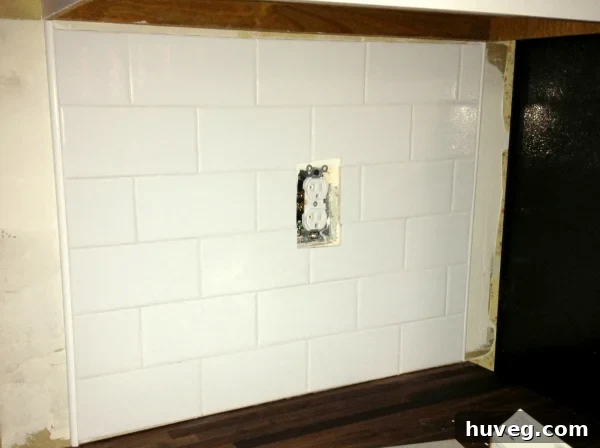
You’d expect that after a brief hiatus from our Dueling DIY updates, I would return with triumphant tales of fully-grouted kitchen walls, showcasing a gleaming, completed backsplash. However, reality, as it often does in the world of DIY home improvement, painted a different picture. While optimism is always appreciated, the truth is, my progress was somewhat more… modest.
The Grouting Grind: Conquering Kitchen Backsplash Challenges with DIY Grit
Instead of a pristine, finished backsplash, all I managed to achieve this past week was captured in this dimly lit, late-night photograph:
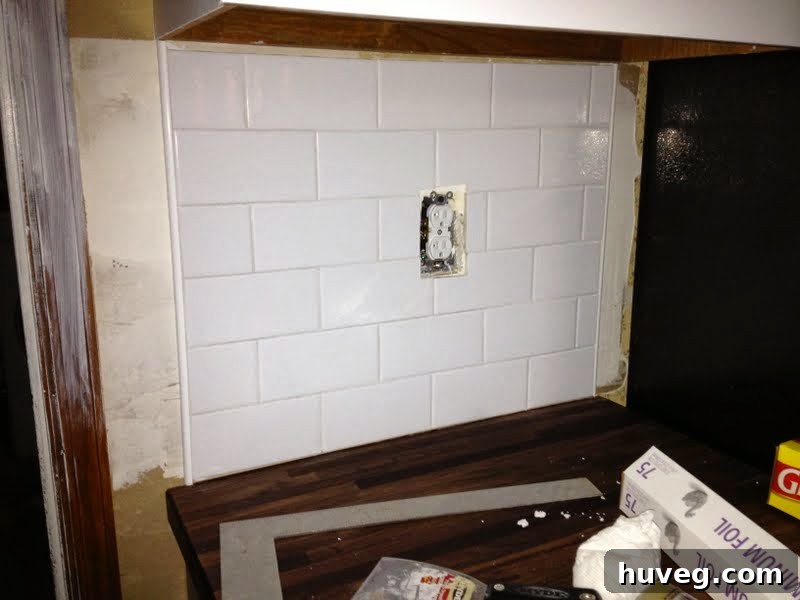
This minimal step forward wouldn’t have even materialized if I hadn’t resorted to my favorite psychological trick: convincing myself to do it “real quick.” This internal negotiation, a promise to myself that a daunting task will be swiftly completed, often becomes the sole catalyst for action when motivation wanes. It’s a powerful, albeit manipulative, tool in the DIYer’s arsenal, especially when the goal is simply to have something to report for our weekly Dueling DIY challenge. In that sense, the underlying premise of this project, even with minuscule progress, seems to be working its magic.
The “Real Quick” Paradox: A DIYer’s Constant Battle with Motivation
The phrase “real quick” is a double-edged sword for many DIY enthusiasts. It’s the whisper that coaxes us into tackling a project we’d rather postpone, assuring us that we’ll be back to our preferred leisure activities in no time. Yet, this innocent phrase often leads down one of two familiar paths:
- The Procrastination Spiral: “I’ll just watch one episode ‘real quick’ before I start… or maybe a whole season, that works too.” This route often delays the actual work indefinitely as the allure of comfort outweighs the push for productivity.
- The All-Night Marathon: “I’ll just put up the first row of tile ‘real quick’… and suddenly, hours have passed, dinner has been skipped, and even social engagements are sacrificed in the relentless pursuit of progress.”
I’ve employed this mental trick so frequently that I oscillate between pride in my cunning ability to con myself into action and disappointment in my own gullibility. It’s a testament to the complex psychology of home improvement, where the desire for a finished product constantly battles against the effort required to achieve it.
Facing the Grouting Gauntlet: Why This Step Often Stalls Progress
A significant portion of my recent lack of motivation can be attributed to my growing aversion to grouting. While it wasn’t always a dreaded task, after completing three tiling projects in this house, grouting has become the nemesis standing between me and a finished backsplash. There’s also caulking, of course, but that step feels almost negligible in comparison – I find caulking to be nearly effortless, a sentiment I invite you to snicker at! Perhaps it’s simply the natural rhythm of any large project: progress comes in waves, with periods of intense productivity followed by lulls. One week, I’m bursting with energy, making significant strides. The next, I find myself delightfully engrossed in the latest season of Archer on Netflix, while the grout bucket remains untouched in the basement.
However, this unexpected delay actually proved beneficial, as I stumbled upon a crucial issue. Encouraged by the ease of using pre-mixed thinset (which, for clarity, is often more akin to mastic and generally not recommended for wet areas, but excellent for less demanding applications), I decided to try pre-mixed grout. Having always mixed my own grout from a dry powder, I was a first-timer with the pre-mixed variety, and this led to a few unanticipated challenges that are vital for any DIYer to consider.
Pre-Mixed Grout: My First-Hand Experience and Unforeseen Issues
Opting for convenience, I chose a pre-mixed grout, assuming it would simplify the process. While it did remove the hassle of measuring and mixing, it introduced new complexities:
1. Sanded vs. Unsanded Grout: The Unspoken Detail
Firstly, this particular pre-mixed grout was sanded, not unsanded, which is what I typically prefer for my 1/16-inch tile gaps. The product label offered very little clarity on this crucial detail, with only a small description tucked away in tiny print on the back of the bucket. While it didn’t significantly impact the ease of installation for my ceramic tiles, and appears perfectly fine for the long term, this is a vital distinction:
- Sanded Grout: Contains fine sand particles, providing strength and preventing shrinkage in wider grout lines (typically 1/8 inch or wider).
- Unsanded Grout: Lacks sand, making it suitable for narrow grout lines (up to 1/8 inch) and delicate surfaces.
For instance, using sanded grout would have been a poor choice if I had opted for glass tiles, as the abrasive sand could easily scratch and dull their surface. For ceramic tiles, however, it’s generally acceptable. For my previous upstairs guest bath project, with 1/16-inch spacing, I correctly used unsanded grout to ensure a smooth finish.
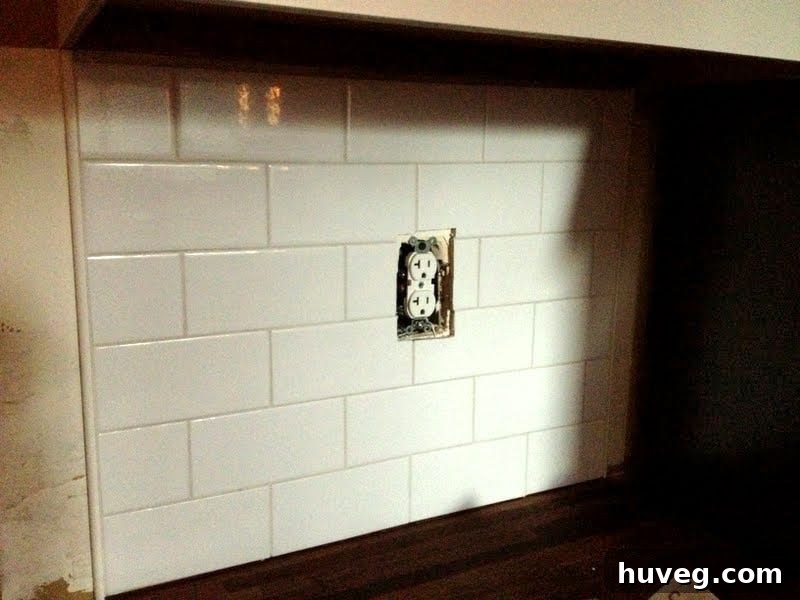
2. The Grout Color Conundrum: When White Isn’t White
Secondly, the grout wasn’t as vibrantly white as I had envisioned. Even though the fuzzy cell phone picture doesn’t fully capture it, the grout’s true color is a subtle grayish hue, not the pure, seamless white I desired to blend with the tiles. The sanded texture likely contributes to this perception, but the reality is a slight deviation from “bright white.” While it’s probably not enough to genuinely bother me (and I had even considered a gray grout at one point), it highlights the common discrepancy between expectation and outcome in DIY. If I were to undertake this project again, the convenience of pre-mixed grout wouldn’t outweigh the importance of achieving the precise color and texture. These aesthetic elements are paramount in the final look of a kitchen backsplash.
Choosing the Right Grout: Beyond Sanded and Unsanded
Understanding grout types is essential for a successful tiling project. Here’s a quick guide to help you make informed decisions:
- Cementitious Grout: The most common type, available in sanded and unsanded varieties. It’s affordable and easy to work with but requires sealing to prevent staining and moisture absorption.
- Epoxy Grout: Highly durable, stain-resistant, and waterproof. Ideal for high-traffic areas and wet environments like showers. It’s more challenging to work with and more expensive but offers superior performance.
- Urethane Grout: A newer option, offering flexibility, stain resistance, and ease of use, similar to epoxy but with a longer working time. It doesn’t require sealing.
When selecting your grout, always consider the tile material, the width of your grout lines, and the environment where the tile is being installed. For fine lines and delicate tiles, unsanded options (or epoxy/urethane if budget allows) are often best. For wider lines and more robust tiles, sanded cementitious grout provides necessary structural integrity.
Tips for Grouting Success (and Avoiding the Dread)
While I might dread the process, I’ve learned a few things over the years that can make grouting less painful:
- Preparation is Key: Ensure your tiles are clean and dry, and remove any spacers. Mask off adjacent surfaces if necessary.
- Work in Sections: Don’t try to grout an entire wall at once. Work in manageable sections (e.g., 2×2 feet) to ensure you can wipe away excess grout before it dries too much.
- Proper Tools: A good rubber float, grout sponge, and two buckets of clean water are indispensable. Change water frequently.
- Angle Matters: Hold your float at a 45-degree angle to force grout into the joints.
- Timely Cleanup: This is critical! Wipe off excess grout with a damp sponge, rinsing often. Don’t let it dry on the tile surface.
- Consider Sealing: For most cementitious grouts, applying a good quality sealer after the grout has fully cured (usually 48-72 hours) will protect it from stains and moisture.
Looking Ahead: Two More Walls and a Renewed Perspective
The upside to this whole experience? I can now technically declare that one out of three kitchen backsplash walls is officially grouted. Only two more to go! And yes, I’ll still tell myself it’ll be “real quick” to get them done. See? The con artist in me never truly rests.
This journey, with its triumphs and setbacks, is a constant reminder that DIY is as much about mental resilience as it is about practical skills. Each challenge presents an opportunity to learn, adapt, and refine our approach to home improvement.
Join the DIY Community: Share Your Progress!
Alright, fellow DIYers! It’s time to celebrate your hard work and progress. My friend Carrie has been diligently sending me updates all week, perhaps to subtly make me feel less productive (or simply because she’s genuinely thrilled to be nearing her countertop templating!). Head over to her blog to see her fantastic achievements and let her bask in the glory of winning this week’s progress race. And if you recall, she was quite a contender last week too!
We’re looking forward to seeing what you’ve all been up to in your own DIY adventures. Share your stories, lessons learned, and progress shots. Every small step is a victory!