Cross Stitch for Newbies: Your Easy Starter Guide

Embarking on a new creative journey can feel both exhilarating and a little daunting, but with cross stitch, you’re choosing a craft that is incredibly rewarding, meditative, and surprisingly easy to learn. For years, I’ve dreamed of creating a comprehensive guide, complete with an in-depth video series, to help aspiring stitchers build a solid foundation. While that larger project is still in the works, I’m thrilled to offer you this quick-start guide – an essential resource designed to get anyone stitching with confidence right away! Whether you’re a complete novice picking up a needle for the very first time or a seasoned stitcher looking for a refreshing take on the basics, this guide is crafted with you in mind. We’ll cover the most crucial tips and techniques to help you successfully complete your very first pattern. Use the interactive table of contents below to navigate through each section and dive into the wonderful world of cross stitching. Get ready to create something beautiful!
Discover a preview of some of my popular cross stitch patterns in the video below:
The Ultimate Beginner’s Guide to How to Cross Stitch
In This Post
- What is cross stitch? Unveiling the Craft
- Essential Cross Stitch Supplies
- Mastering Your Cross Stitch Pattern
- Preparing Your Fabric for Stitching
- Preparing Your Needle and Thread
- Starting Your First Cross Stitch
- Seamlessly Changing Thread Colors
- Finishing and Displaying Your Project
- Advanced Tips & Expert Tricks for Cross Stitchers
Before we delve into the stitches and supplies, I want to share a little perspective. As a long-time blogger and a passionate advocate for creativity, I understand that there are countless ways to approach any craft. This guide presents the techniques and methods that have served me well throughout my cross stitching journey, many of which were lovingly passed down from my grandmother. She was an extraordinary artist whose cross-stitched creations – intricate pieces featuring beads, metallic threads, and complex designs – were even showcased in art exhibits and are cherished heirlooms in our home today. Her legacy inspires my approach.
Therefore, this tutorial is based on my personal stitching method and the techniques I find most effective for creating beautiful, consistent results. It’s important to remember that the world of cross stitch is vast, and you might encounter other techniques that promise to save time or offer a different aesthetic. And that’s perfectly fine! Creativity thrives on personal preference and exploration. If you have a helpful tip or trick that you believe would genuinely benefit fellow beginners, please feel free to share it respectfully in the comments. However, I kindly request that we maintain a positive and encouraging environment. Condescending remarks or any attempts to gatekeep by insisting on a “right” or “wrong” way to stitch will be removed. This space is dedicated to welcoming and supporting beginners as they discover the joy of cross stitching.
What is Cross Stitch? Unveiling the Craft
At its heart, cross stitch is a delightful form of counted thread embroidery, renowned as one of the most accessible and enjoyable entry points into the world of needlework. Imagine a canvas made of tiny, perfectly spaced squares, much like a grid. On this grid, you create charming X-shaped stitches using various colored threads, bringing designs to life one meticulous stitch at a time. This art form typically uses specialized fabrics with an even and open weave, such as Aida cloth or linen, which naturally guide your stitches and make counting effortless.
While this beginner’s guide primarily focuses on the fundamental X-shaped stitch (often referred to as a “full cross stitch”), it’s worth noting that more advanced stitches exist, offering endless possibilities for texture and detail as you progress. Cross stitch designs can span the entire creative spectrum, from classic, intricate samplers that harken back to centuries-old traditions to vibrant, modern patterns featuring pop culture references or minimalist art. This craft boasts a truly fascinating history, weaving through cultures and generations, and I even had the pleasure of discussing it as a guest on the Tinkering Belles podcast!
For those eager to dive in, beginner cross stitch projects are readily available as convenient kits, which often include everything you need to start. Alternatively, you can purchase the basic supplies (detailed in the next section) and choose from a vast array of standalone patterns, including many free and beginner-friendly options available in my library, or explore exclusive designs through my membership site. Regardless of your starting point, this guide will equip you with the fundamental skills to master the art of cross stitch.
Essential Cross Stitch Supplies
Just like any creative endeavor, cross stitching requires a handful of essential tools to bring your visions to life. Some items are indispensable for almost every project, ensuring a smooth and enjoyable stitching experience, while others are “nice-to-have” additions that can enhance comfort and precision. Here’s a comprehensive breakdown of what you’ll need:
Always Necessary: Your Core Cross Stitch Toolkit
- Cross Stitch Pattern or Chart — This is your blueprint, a detailed graph that illustrates the design, specifies the colors to use, provides stitch instructions, and often estimates thread usage. A good pattern clearly plots out every ‘X’ on a grid. You can find beautiful patterns in my pattern library, many of which are perfect for beginners and available for free. For exclusive designs and a thriving community, consider joining my membership site. We’ll delve deeper into how to read these charts further down.
- Embroidery Hoop or Frame — Keeping your fabric taut is crucial for even, neat stitches and to prevent puckering. An embroidery hoop is the most common choice; it consists of two concentric rings that sandwich the fabric securely. I personally use a hoop for almost all my projects. Other popular options include a quilting frame for larger pieces or a lap stand that holds your work, freeing both hands. The goal for all these tools is the same: maintain consistent tension.
- Tapestry Needles — Unlike sharp sewing needles, cross stitch primarily utilizes blunt-ended needles, often called tapestry needles. These needles feature a rounded tip that glides easily through the pre-made holes in your fabric’s weave without piercing threads or your fingers. They also typically have a larger “eye” to accommodate multiple strands of embroidery floss. While I’ve occasionally used sharp sewing needles in a pinch, blunt tapestry needles are ideal. A mixed assortment like this set allows you to experiment and find your preferred size, which often depends on your fabric count.
- Cross Stitch Fabric — The foundation of your project! The most popular choice for cross stitch is Aida cloth, specifically designed with a clear, square-weave grid that makes counting stitches straightforward. Other options include linen or evenweave fabric, which offer a finer, more traditional look, though they can be more challenging for absolute beginners due to their tighter weave. Fabric “count” refers to the number of stitches per inch. A 14-count Aida, meaning 14 stitches fit into one inch, is highly recommended for beginners as it offers a clear view of the holes and creates a project of a manageable size. Higher counts (16, 18, 20+) mean smaller stitches and a more detailed, compact finished piece. Conversely, a pattern designed for 14-count will result in a smaller piece if stitched on 18-count fabric. Fabrics come in an exciting array of colors, allowing you to choose a background that complements your design.
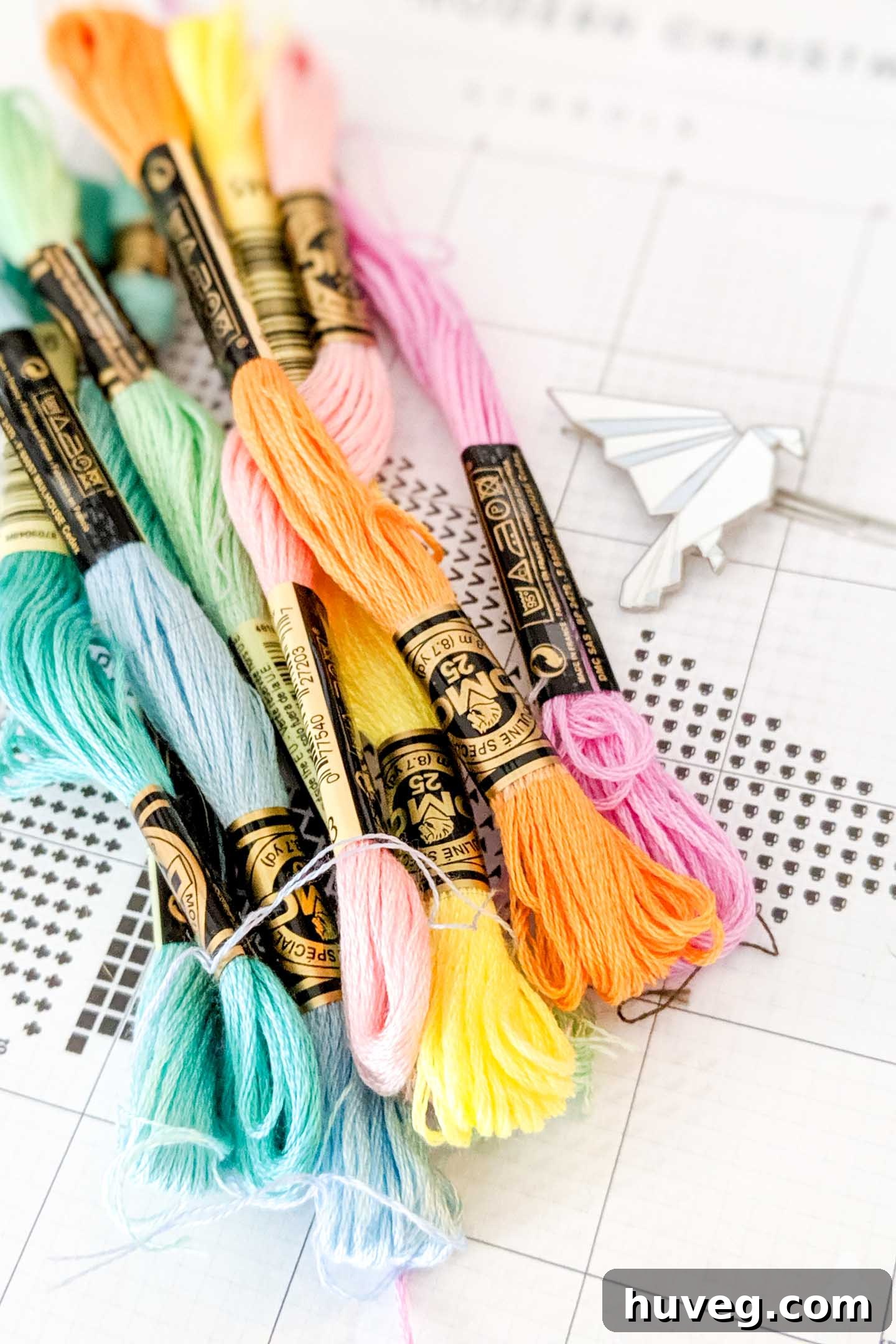
- Embroidery Floss — This is the thread you’ll use to create your stitches. DMC embroidery floss is the industry standard, known for its extensive color range, consistent quality, and vibrant, fade-resistant hues. Each skein of floss typically consists of six individual strands, which you will separate to use the number of strands specified in your pattern (most often two for cross stitch).
Nice to Have: Enhancing Your Stitching Experience
- Needle Minder — A magnetic accessory that keeps your needle safely attached to your fabric when you take a break, preventing it from getting lost or falling. You can even DIY your own!
- Needle Threader — A small, handy tool that helps you quickly and easily thread your needle, especially useful for those with vision challenges or simply to save time.
- Thimble — Worn on your finger, a thimble protects it from repeated pushes of the needle, particularly helpful when working with stiffer fabrics or if you’re prone to pricking your finger.
- Magnifying Glass — For intricate patterns or higher count fabrics, a magnifying glass can reduce eye strain and help you see your stitches more clearly.
- Clip-on Light — Good lighting is essential for comfortable and accurate stitching. A portable clip-on light ensures your workspace is always well-illuminated, day or night.
- Stitch Scissors — Small, sharp scissors designed for precise thread snipping. Keeping a dedicated pair for your cross stitch ensures a clean cut every time and prevents dulling from other uses.
Many beginners opt for cross stitch kits, which conveniently bundle most, if not all, of the “necessary” items and sometimes include a few “nice-to-have” accessories. If you’re starting from scratch, many online retailers offer a wide selection of these items. Simply browse and add to your cart to gather everything you need.
Mastering Your Cross Stitch Pattern or Chart
A cross stitch pattern, often referred to as a chart, is your visual guide to creating the design. It’s essentially a detailed graph (sometimes spread across several pages for larger projects) that meticulously maps out every single stitch. Understanding how to read it is fundamental to successful stitching. Here’s what you can expect to find and how to interpret it:
- The Grid: Your Stitching Map: The pattern features a grid, where each square on the chart represents one cross stitch on your fabric. For easier counting and navigation, these grids are typically marked with bold lines every 10 squares, both horizontally and vertically. This systematic numbering helps you quickly locate specific areas and count the number of stitches required, which is why it’s called “counted cross stitch.”
- The Color Key (Legend): Unlocking the Design: Crucial to every pattern is the “color key” or legend. This section provides a list of symbols, each corresponding to a specific thread color. It will tell you the exact DMC (or other brand) number and name for each color, ensuring you use the correct shade. Additionally, it often indicates the estimated yardage or number of skeins needed for each color, helping you plan your thread purchases.
- Center Markers: Finding Your Starting Point: Most patterns include an arrow at the top and side of the chart indicating the exact center of the design. Many stitchers, both beginners and experienced, prefer to start stitching from the center and work outwards. This method helps ensure your design is perfectly centered on your fabric and provides ample margin around the edges for framing.
- Black and White vs. Color Charts: While traditional patterns often use black and white symbols, many modern patterns (including my updated patterns) now offer color charts. Color charts can be incredibly helpful for visualizing the finished piece and making it easier to track your progress, especially when working with many similar shades.
By carefully studying your pattern and familiarizing yourself with these elements, you’ll be well-equipped to translate the symbols on paper into beautiful stitches on your fabric.
Preparing Your Fabric for Stitching
Proper fabric preparation is a small but crucial step that can significantly impact the quality and enjoyment of your cross stitch project. Taking a few moments to prepare your fabric ensures a smooth, frustration-free stitching experience and a professional-looking finished piece.
- Ironing for a Smooth Start: Aida fabric, often sold in rolls, can easily develop wrinkles and creases. Before you begin, gently iron your fabric to remove any folds or lines. This creates a flat, even surface, making it much easier to count stitches accurately and achieve consistent tension. When storing your work-in-progress, try to avoid folding it to prevent new creases from forming.
- Preventing Fraying Edges: Woven fabrics, especially Aida, are prone to fraying along the cut edges. This can lead to loose threads that get caught in your stitches or reduce the overall size of your usable fabric. To prevent fraying, you have several effective options:
- Masking Tape: A simple solution is to apply masking tape (or painter’s tape) around all four raw edges of your fabric. Be selective with your tape choice, as some tapes can leave a sticky residue.
- Zigzag Stitch: If you have a sewing machine, you can use a zigzag stitch to sew a neat border around the fabric’s perimeter.
- Serger Stitch: For the most professional finish, a serger can create a durable, overcast edge that completely prevents fraying.
- Mounting Your Fabric in a Hoop or Frame: Once your fabric is smooth and its edges are secured, the next step is to mount it. An embroidery hoop is wonderfully simple to use:
- Loosen the Clasp: Untwist the metal screw on the outer hoop until the two hoops can be easily separated.
- Position the Fabric: Place your fabric over the inner hoop, centering the area you plan to stitch first.
- Secure the Outer Hoop: Gently push the outer hoop down over the inner hoop, sandwiching the fabric firmly in between.
- Tighten and Adjust: Begin to tighten the metal clasp, pulling the fabric taut as you go. Rotate the hoop, gently pulling on the edges of the fabric (not the weave itself) to remove any slack. Your goal is a drum-tight surface that doesn’t sag or give when you press on it, but avoid stretching the fabric excessively, which could distort your stitches.
I often find myself re-tightening my hoop as I stitch, as the fabric can loosen with prolonged use. This quick adjustment ensures continuous, optimal tension throughout your project.
Preparing the Thread and Needle
Getting your thread and needle ready is a straightforward process, but a few key steps will ensure your stitches are neat, your thread doesn’t tangle, and your needle glides smoothly through the fabric. For the majority of my patterns, and indeed many cross stitch designs, two strands of floss are recommended per stitch.
- Cutting and Separating Floss:
- Cut a Manageable Length: A common guideline for cutting floss is to measure a length from your elbow to your fingertips – this is typically around 18-24 inches (45-60 cm). This length is ideal because it’s long enough to stitch for a while without running out too quickly, but not so long that it becomes prone to tangling and knotting.
- Separate the Strands: A skein of embroidery floss is made up of six individual strands twisted together. To prepare your two strands, hold the cut length of floss firmly at one end. With your other hand, gently pull one or two strands upwards and away from the remaining strands. They will separate with a slight ‘zip’ sound. Repeat this until you have the desired number of strands (usually two) together. The other four strands can be put aside for later use. Separating them one by one, even if you need two, helps prevent tangling.
- Threading Your Needle:
- Choose the Right Needle Size: The size of your needle should complement the count of your fabric. Generally, a larger eye and blunt tip are preferred. You don’t want a needle that’s too thick, as it could stretch the holes in your fabric, leading to a distorted look. For 14-count Aida, a size 24 or 26 tapestry needle is often a good choice.
- Slip Through the Eye: Take the prepared end of your floss (the two separated strands held together) and carefully slip it through the eye of your needle. You can moisten the end slightly or pinch it tightly to make this easier.
- Even Lengths (Optional Loop Method): Pull the thread through until one end is longer than the other. If you’re using two strands and want to employ the “loop method” for a knotless start (highly recommended for beginners!), pull the thread through until the two ends are even, and the needle sits in the middle of the folded floss. This creates a loop at the very end of your thread.
With your thread and needle prepped, you’re now ready for the exciting part: making your very first stitches!
Starting Your First Cross Stitch Row
For most beginner projects and patterns, you’ll primarily be working with full cross stitches. Mastering the technique for starting your thread knot-free is a fundamental skill that contributes to a clean and professional-looking finished piece. Here’s how to begin your first row, focusing on a method that avoids knots and secures your thread beautifully.
- The “Tail” Method for a Knotless Start:
- Identify Your Starting Point: Refer to your pattern and choose a row or a series of contiguous stitches of the same color. This makes securing your thread much easier.
- Bring Needle Up: From the back of your fabric, bring your needle up through the first hole of your chosen stitch.
- Leave a Tail: Pull the thread through, but leave a small “tail” of about two inches (5 cm) dangling on the back of your fabric. This tail will be secured by your subsequent stitches.
- Secure the Tail: As you make your first few stitches, gently lay this tail along the path of the stitches on the back of the fabric. Your needle will pass over this tail with each new stitch, effectively trapping and securing it underneath. This method ensures your thread is anchored without creating a bulky knot on the back, which can otherwise show through to the front of your finished work.
While you *can* make a knot to start, it’s generally advised against for several reasons: 1) A knot might pull through the fabric hole if tension is too strong, 2) it can excessively widen the fabric hole, and 3) most importantly, it can create a noticeable lump or shadow on the front of your finished piece, detracting from its smooth appearance.
Now, let’s form the iconic ‘X’ stitch: Think of each square on your grid as a box, with four distinct holes at its corners. You’ll be stitching diagonally, forming the two legs of the ‘X’.
- The Two-Pass Method for Even Stitches: For the neatest and most consistent results, it’s highly recommended to complete your stitches in two passes across a row.
- First Pass (Half Stitches): Begin by making a row of half stitches. If you typically stitch from the lower-left to the upper-right, your first pass will look like a series of forward slashes: / / / / / / /. Work your way across the desired number of stitches in your row, always bringing the needle up from the bottom-left hole and going down into the upper-right hole for each stitch.
Once you’ve completed your row of half stitches, you’ll turn around and make the second pass.
-
- Second Pass (Completing the X’s): Now, return along the same row, completing each ‘X’. Stitch back in the opposite diagonal direction, going from the lower-right hole to the upper-left hole for each stitch, creating a series of backward slashes: \ \ \ \ \ \ \.
When you’re finished, you’ll have a perfectly neat row of XXXXXXX! Each fully formed ‘X’ is considered a “full cross stitch.” Maintaining consistency in the direction of your first leg (e.g., always lower-left to upper-right) across your entire project will ensure a uniform and polished appearance.
Can I make complete stitches one by one instead?
Absolutely, you can. Some stitchers prefer to complete each individual ‘X’ stitch fully before moving to the next. This can be particularly useful in areas where a color is scattered across the pattern rather than forming a solid row or block. However, I personally find that the “two-pass” method, stitching in rows of half stitches and then completing them, generally results in a cleaner, more consistent finish, with all the top legs of the ‘X’ stitches lying in the same direction.
Seamlessly Changing Thread Colors
As your cross stitch project progresses, you’ll undoubtedly need to switch between different thread colors to bring your design to life. There are various strategies for tackling color changes, and your preferred method might evolve as you gain more experience. Some stitchers meticulously complete one color entirely within a specific area before moving to the next color. Others prefer to work row by row, which often necessitates more frequent color changes. Personally, I tend to be a bit more organic in my approach, often finishing an entire cut length of a specific color before transitioning, or completing a significant block of color.
When you’re ready to switch colors, the goal is to securely end your current thread without creating knots or bumps that could show through to the front of your fabric. Here’s my go-to method:
- Securing the Old Thread:
- Flip Your Work: Turn your piece over to the back.
- Weave Through Existing Stitches: Gently run your threaded needle underneath 3-4 existing stitches of a similar or matching color. The idea is to weave the tail of your thread through these stitches, effectively “locking” it into place. This method is akin to how you secure your starting tail, ensuring no bulky knots.
- Trim Excess: Once secured, carefully snip off any remaining excess thread close to the fabric, being careful not to cut any of your actual stitches.
Important Tip for Hiding Tails: Always try to run your finishing thread through stitches of a similar color. For instance, avoid threading a dark black floss tail through the back of a light white or cream-colored area, as it might create a shadow that peeks through to the front, compromising the clean appearance of your work.
When starting your new color, simply follow the “tail” method described earlier for starting your first row. This ensures a clean, knotless beginning for every new section of color, maintaining the overall neatness of your project.
Finishing and Displaying Your Cross Stitch Project
Once you’ve lovingly placed your last stitch, the exciting moment arrives: finishing your project! Proper finishing ensures your hard work is preserved and beautifully displayed. There are several popular methods, each offering a distinct aesthetic.
- Cleaning and Blocking Your Piece (Highly Recommended): Before any display method, it’s advisable to gently wash and block your finished cross stitch. Washing helps remove any natural oils from your hands or light smudges that may have accumulated during stitching, restoring the floss to its full vibrancy. Use a mild soap (like a gentle laundry detergent or even baby shampoo) in lukewarm water, rinse thoroughly, and gently squeeze out excess water. To “block” your piece, carefully pin it to a foam board or thick towel, ensuring it’s squared and stretched evenly. Let it air dry completely in this position. This step helps correct any slight distortion from stitching tension and gives your piece a perfectly even shape.
- Displaying in an Embroidery Hoop (Modern & Popular):
- Re-hoop and Adjust: Once your piece is clean and dry, place it back into a clean embroidery hoop. Center your design and pull the fabric taut, just as you did when stitching, ensuring it’s perfectly straight and wrinkle-free.
- Trim Excess Fabric: On the back side of the hoop, carefully trim the excess fabric, leaving about an inch (2.5 cm) border around the edge of the hoop.
- Secure the Edges: To keep the fabric pulled tight and prevent fraying, you have a few options: you can gather the raw edge with a running stitch and pull it tight like a drawstring, or you can use fabric glue to adhere the edge to the back of the inner hoop.
- Hang and Enjoy: Your beautifully finished piece is now ready to be hung on a wall, adding a personal touch to your decor. The only ‘downside’ is you’ll be constantly looking for new hoops!
- Traditional Framing (Classic & Protective): Framing your cross stitch provides a more classic and protective display. You can opt for professional framing, which offers expertise in mounting and selecting complementary mats and frames, or you can undertake a DIY framing project. This typically involves mounting your piece onto acid-free foam core and then placing it in a picture frame, often with a mat to provide space between the stitching and the glass. I’ve shared more detailed insights into framing finished pieces in a dedicated blog post right here.
- Other Creative Finishes: Beyond hoops and frames, cross stitch pieces can be transformed into cushions, ornaments, bookmarks, or incorporated into quilts and clothing. Your imagination is the only limit!
No matter how you choose to finish your project, the act of completing and displaying your handmade creation brings immense satisfaction. It’s a tangible representation of your patience, skill, and creativity.
More Tips & Expert Tricks for Cross Stitchers
As you delve deeper into the world of cross stitch, you’ll naturally develop your own rhythms and preferences. However, these additional tips and tricks, gathered from years of experience, can help you refine your technique and make your stitching journey even more enjoyable and rewarding. This section will continue to grow over time, but here are a few to get you started on the right foot!
- Maintain Hand Hygiene: Always wash your hands thoroughly before you begin stitching. Lotions, creams, and even the natural oils from your skin can transfer to your fabric and floss, potentially leaving permanent stains or discoloration over time. Keeping your hands clean ensures your fabric remains pristine.
- Consistency is Key to a Polished Look: One of the hallmarks of a professional-looking cross stitch piece is consistency. This applies primarily to two aspects:
- Stitch Direction: Decide on a consistent direction for the bottom leg of your cross stitches (e.g., always going from lower-left to upper-right) and stick to it for every single stitch across your entire project. This ensures that all the top legs lie in the same direction, creating a uniform texture and a smooth, appealing finish.
- Tension: Aim for a happy medium with your thread tension. You don’t want to pull the thread so tightly that it puckers or distorts the fabric, creating an uneven surface. Conversely, stitches that are too loose will look sloppy and lack definition. Practice will help you find that sweet spot where every stitch lies flat and even, contributing to a beautifully uniform piece.
- Optimal Lighting Matters: Good lighting is paramount for comfortable and accurate stitching, especially when working on intricate patterns or higher count fabrics. Stitch in a well-lit area, preferably with natural light. If natural light isn’t available, invest in a good quality task lamp with a daylight-balanced bulb to reduce eye strain and help you see your fabric and floss colors accurately.
- Take Regular Breaks: Cross stitching can be incredibly absorbing, but it’s important to take regular breaks. Step away from your work for a few minutes every hour to rest your eyes, stretch your neck and shoulders, and prevent fatigue. This helps maintain focus and prevents discomfort.
- Smart Storage for Works-in-Progress: When you’re not stitching, store your project flat or rolled gently (never folded for extended periods) to avoid introducing stubborn creases into your fabric. Keeping it in a clean project bag or box will also protect it from dust, pet hair, and accidental spills.
- Embrace (and Correct) Mistakes Gracefully: Everyone makes mistakes! Don’t be afraid to gently unpick a few stitches if they’re not quite right. A small pair of sharp embroidery scissors or a seam ripper can be invaluable for this. It’s always better to correct a mistake early than to regret it later.
Cross stitching is a journey of learning, patience, and creative expression. By applying these tips and continuously practicing, you’ll not only improve your technical skills but also find a deeper enjoyment in this timeless craft.
Don’t forget to pin this guide for future reference and share it with fellow aspiring stitchers!