Home Depot: Empower Her Build

Mastering DIY: My Home Depot Do-It-Herself Tile Installation Workshop Experience
The best-laid plans often fall victim to Mother Nature’s whims. This morning was a prime example. I had every intention of capturing some fresh, sun-drenched exterior shots of my home, eager to share a long-overdue update on my latest home improvement ventures. Unfortunately, the persistent rain clouds and gloomy skies had other ideas, rendering any hope of that perfect sunny photograph completely futile. As any DIY blogger knows, compelling visuals are key to conveying progress and inspiring others, so a grey morning can indeed throw a wrench into content creation plans.
Instead of battling the weather, I pivoted my focus to an equally valuable experience: attending my first-ever “Do-It-Herself” (DIH) workshop at Home Depot. This particular class immediately caught my attention because it focused on tile installation – a skill I was keen to refine, especially with a bathroom renovation looming. Even as someone who frequently tackles home projects, I believe in continuous learning. I figured there might be invaluable tips or techniques I hadn’t yet encountered, or perhaps a fresh perspective that could streamline future projects. It was a perfect opportunity to enhance my DIY toolkit and connect with fellow enthusiasts.
Unveiling the “Do-It-Herself” Workshop: A Refreshing Approach to DIY
And you know what? It was absolutely worth every moment. From the outset, the atmosphere was welcoming and encouraging, clearly designed to empower attendees, particularly women, in what can often feel like a male-dominated arena. While I did find myself sharing a knowing smirk at some of the more “feminized” instructional cues – like the memorable advice to “not get grout in your hair” or to mix it to “the consistency of cornmeal” (a charmingly Southern-centric analogy for us DIY gals) – it was clear these efforts were genuinely aimed at making everyone feel comfortable and engaged. Despite these playful touches, the core instruction was remarkably informative and practical, exceeding my expectations for a free community workshop.
The workshop struck an excellent balance between foundational knowledge and advanced tricks. Much of the basic tiling process, such as subfloor preparation and tile layout, I was already familiar with, thanks in large part to the phenomenal guidance from fellow DIY bloggers like the incredibly talented DIYdiva, whose detailed tutorials have often been my go-to resources. However, the true value of the Home Depot workshop lay in the subtle, yet crucial, pieces of information that often get overlooked in online guides. These were the “aha!” moments that only hands-on instruction from an experienced professional can provide.
Key Takeaways: Practical Tips for Flawless Tile Installation
Two specific tips stood out immediately. Firstly, when installing cement backer board over a plywood subfloor, the instructor emphasized the importance of screwing the backer board down perpendicular to the direction the plywood sheets were installed. This seemingly minor detail is crucial for enhancing the structural integrity of the subfloor, minimizing movement, and significantly reducing the risk of future tile cracking – a common pitfall for DIYers. Understanding the “why” behind such techniques truly elevates a project from simply following instructions to truly mastering the craft.
The second revelation was a brilliant hack for snapping chalk lines without creating a cloud of dust that settles everywhere. The instructor advised spraying a light mist of hairspray along your chalk line before snapping it. This simple trick effectively “fixes” the chalk dust, preventing it from becoming airborne and ensuring a crisp, clean line without the mess. It’s these kinds of ingenious, low-cost solutions that make workshops so incredibly valuable, providing real-world applications that save time and frustration on the job site.
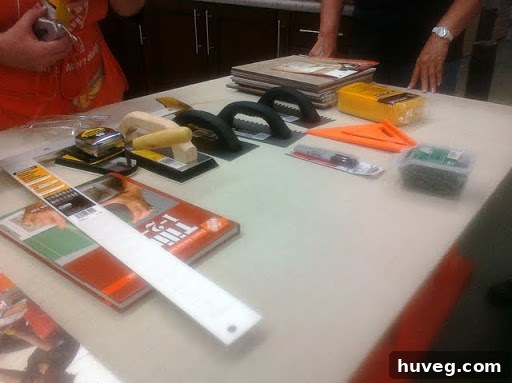
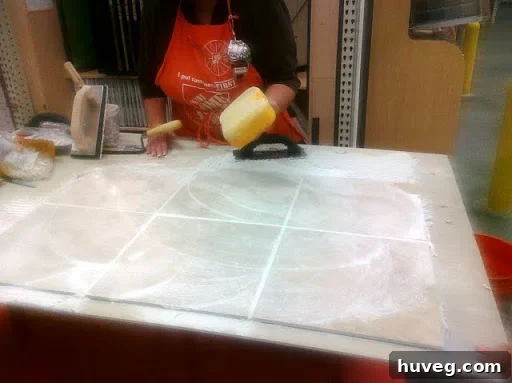
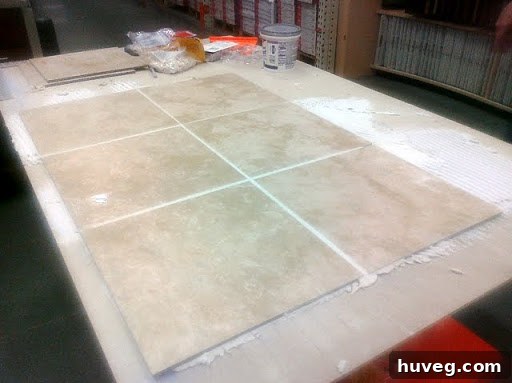
Please forgive the slight cloudiness in some of my phone pictures; it was raining last night, and I suspect some moisture infiltrated the lens. Despite the photographic imperfections, these images capture the essence of the hands-on learning environment, illustrating the various tools and materials discussed during the session. It’s a reminder that even when weather foils one plan, a quick pivot can lead to equally enriching experiences and content.
Navigating the Aisles: Smart Tool Choices and Material Insights
One of the most engaging and practical segments of the workshop was when the instructor led us on a guided tour through the Home Depot supply aisles. As a visual and spatial learner, I deeply appreciate seeing where specific tools and materials are located within the store. This contextual understanding makes future shopping trips infinitely more efficient and less intimidating. More importantly, the instructor provided invaluable guidance on distinguishing between truly essential tools and those that are often marketed as necessary but are, in reality, superfluous for most DIY projects. This focus on cost-effectiveness and practicality is a huge benefit for anyone undertaking home renovations on a budget.
For instance, the instructor pointed out that while a specialized backer board scoring knife exists, a general-purpose utility knife can achieve the same results with a bit of practice. This single piece of advice alone could save a beginner DIYer unnecessary expense, allowing them to allocate funds to more critical items. We also discussed different types of thin-set mortar suitable for various tile materials and substrates, the appropriate trowel notch sizes for different tile dimensions, and the importance of using quality spacers for consistent grout lines. Understanding these nuances helps prevent common tiling errors and ensures a professional-looking finish. This practical walk-through reinforced the idea that smart shopping is as crucial as proper technique in any successful DIY endeavor.
The Power of a Supportive Learning Environment: Why “Do-It-Herself” Shines
The “female-friendly” environment cultivated by the Home Depot DIH workshops is truly commendable, especially for beginners who might feel overwhelmed or intimidated by the prospect of tackling a major home improvement project. The classes are deliberately informal, fostering an atmosphere where participants feel comfortable asking any question, no matter how basic it may seem. There’s ample time dedicated to Q&A sessions, and crucially, no one in attendance—neither the instructor nor other participants—ever made anyone feel silly for their inquiries. This non-judgmental space is incredibly empowering.
I recall a specific moment where someone asked, “So, do I need to sponge the grout off the tile surface immediately, or do I need to let it dry first?” This is a classic beginner’s question, and it was met with a patient, thorough explanation of grout curing times, the importance of haze removal, and the consequences of waiting too long or wiping too soon. This level of supportive instruction, combined with the camaraderie among the women present, truly made the experience beneficial. It highlights the value of creating spaces where women can gain confidence, share experiences, and learn practical skills without feeling self-conscious or out of their depth. The friendly demeanor of both the instructor and my fellow DIY enthusiasts made the entire experience not just educational but also genuinely enjoyable.
Beyond Gender-Specific: Seeking a Broader DIY Community
While I deeply appreciate the intent behind workshops specifically designed for women to feel less intimidated – and Home Depot truly has a commendable program here for its target audience – I personally find myself at a different stage in my DIY journey. I don’t necessarily identify as a “Lady DIYer” in the sense that I require a class specifically tailored to women, in addition to being a class for beginners. There’s just something about the gender-specific branding that, for me, creates a slight sense of intentional isolation when it’s not strictly necessary for my learning style or comfort level. While I celebrate the empowerment these workshops offer, my personal preference leans towards a more inclusive, skill-based learning environment.
For those starting out or who prefer a more nurturing, women-focused environment, these DIH workshops are an invaluable resource. They break down barriers and build confidence, which is vital for diversifying the DIY community. However, as I continue to hone my skills and explore more complex projects, I find myself drawn to workshops where the primary focus is purely on the technique and application, regardless of the gender demographic. My goal is to continually expand my knowledge and proficiency, and I believe this can be achieved in a broader setting that brings together all enthusiasts passionate about home improvement, irrespective of gender.
Looking Ahead: Exploring More General Workshops and Your DIY Journey
In the future, I anticipate gravitating towards Home Depot’s more gender-nonspecific workshops, which are frequently offered each weekend. This approach aligns more closely with my personal learning objectives and my desire to engage with the wider DIY community. For instance, the upcoming “Winter Weatherization” and “Fall Planning” workshops have already piqued my interest. These topics offer practical, seasonal advice that can significantly impact a home’s efficiency and aesthetic, and I’m eager to delve into advanced techniques and material selection for these projects. As always, if I end up attending, you can count on me to share a detailed recap of my experiences and any new insights gained.
This brings me to you, my fellow DIY enthusiasts! Have you ever participated in a workshop at a home improvement store like Home Depot or Lowe’s? What was your experience like? Did you find it helpful and informative? And for those who have attended one, what are your thoughts on classes specifically tailored for women? Did you appreciate the focused environment, or do you, like me, prefer a more general approach to skill acquisition? Your perspectives are invaluable, and I’d love to hear about your DIY learning journeys and any tips you might have gleaned from these sessions.
A Quick Update on My Tiling Predicament and Future Plans
P.S. In parallel with my workshop attendance, I also made a crucial call to The Tile Shop this morning to confirm the suitability of the beautiful tile I had previously selected during a visit. Unfortunately, I received the disappointing news that it is not suitable for flooring applications. Wop wop. It’s a classic DIY blunder – falling in love with a tile before checking its specifications. However, this setback won’t deter me. This coming weekend, I plan to visit Floor & Decor Outlets, a reliable resource where I previously sourced my durable laminate floors. I’m optimistic about finding an equally stunning yet floor-appropriate alternative there to bring my master bath vision to life!
P.P.S. Just as I finished writing this, the sun decided to make a dramatic appearance. Typical! The irony of the initial rain preventing exterior photos is not lost on me. Oh, and a crucial disclaimer: Home Depot did not sponsor this post or compensate me in any way for sharing my experience. I simply wondered whether these workshops were truly helpful or not, and after attending, I felt compelled to share my honest insights with you, hoping it might assist others in their DIY endeavors.

Did you find this deep dive into DIY workshops insightful? If so, please subscribe to receive the latest home improvement tips, project updates, and honest reviews directly to your reader or inbox for free! Your support helps us continue to share valuable DIY content.