DIY Fireplace Transformation Under 100 Dollars

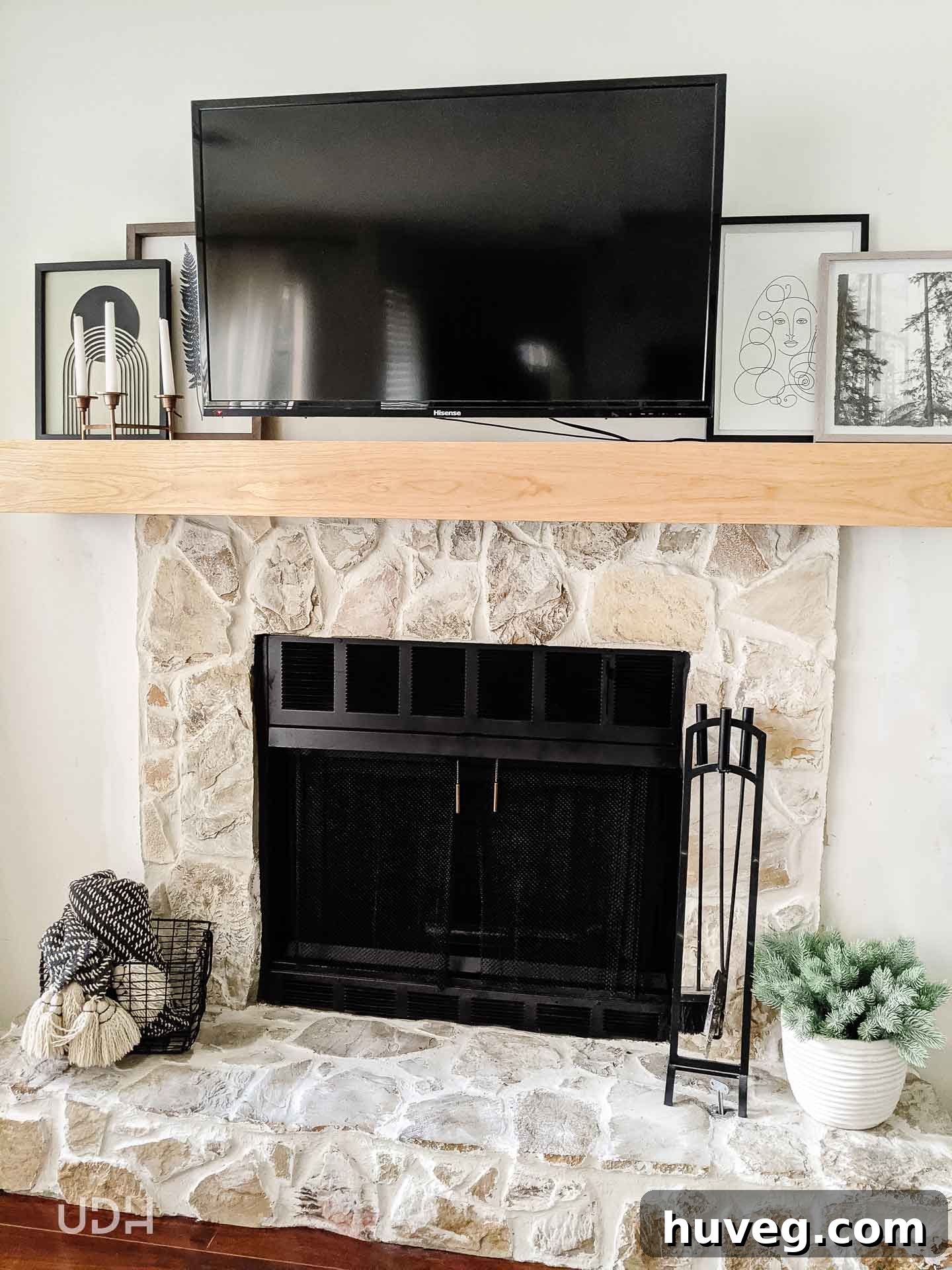
Hello, fellow home renovators and DIY enthusiasts! Today, I am beyond excited to share a project that has completely transformed the heart of my living room: a long-overdue fireplace remodel. This wasn’t just any makeover; I tackled the entire process, including designing and building a brand-new mantel, all on a budget so modest it cost me less than our average trip to the grocery store. If you’ve been dreaming of a significant home update without a hefty price tag, this is the inspiration you’ve been waiting for.
Have you ever found yourself in a perpetual state of indecision regarding a major remodeling project? Perhaps the apprehension of making a mistake or the fear of disliking the final results held you captive? That was precisely my predicament with our old, imposing fieldstone fireplace. I distinctly remember when I first launched this blog, optimistically declaring that I would “live with it for just a little while” before embarking on its fabulous transformation. Little did I know, that “little while” would stretch into an entire decade. Ha. Hahahahaha.
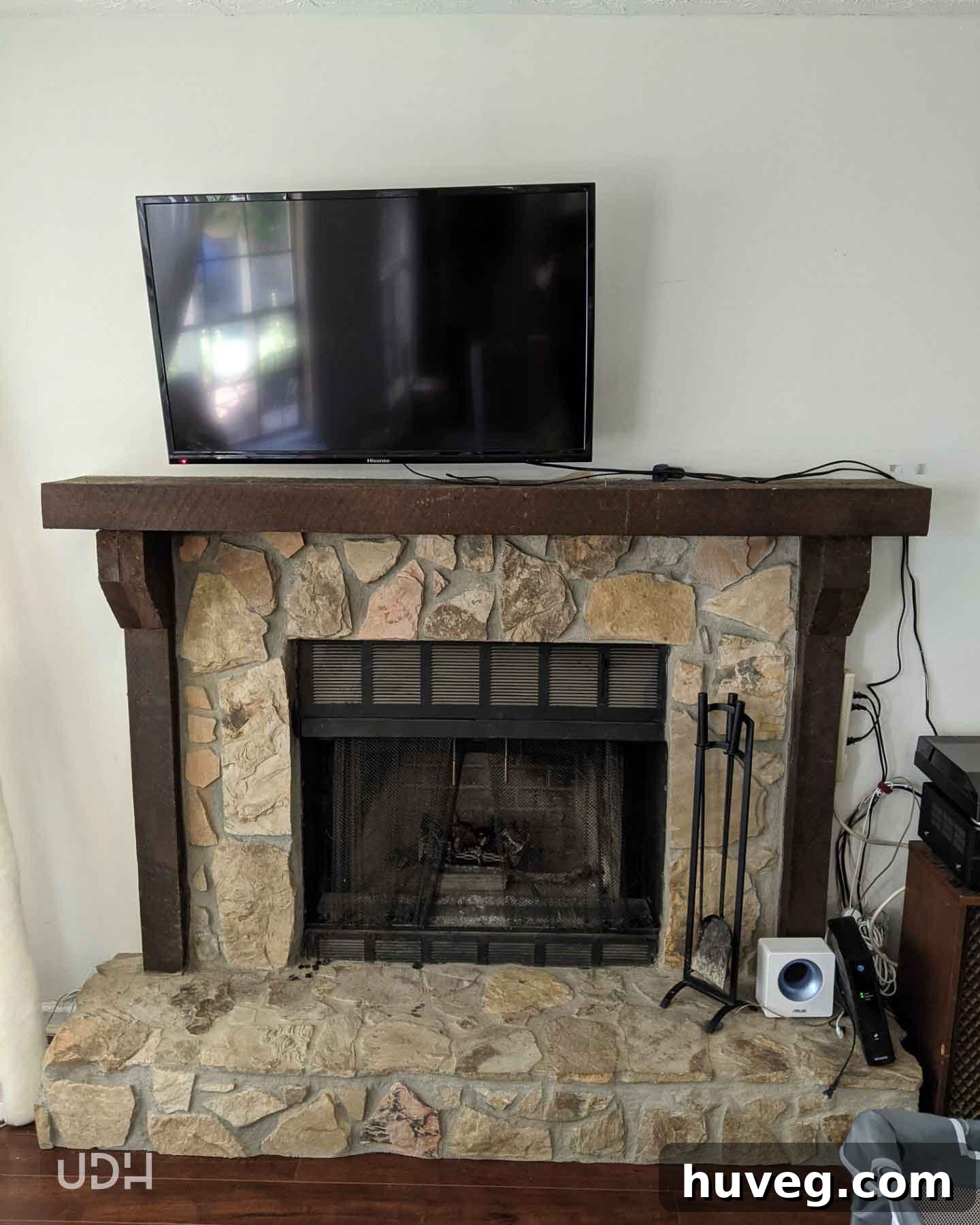
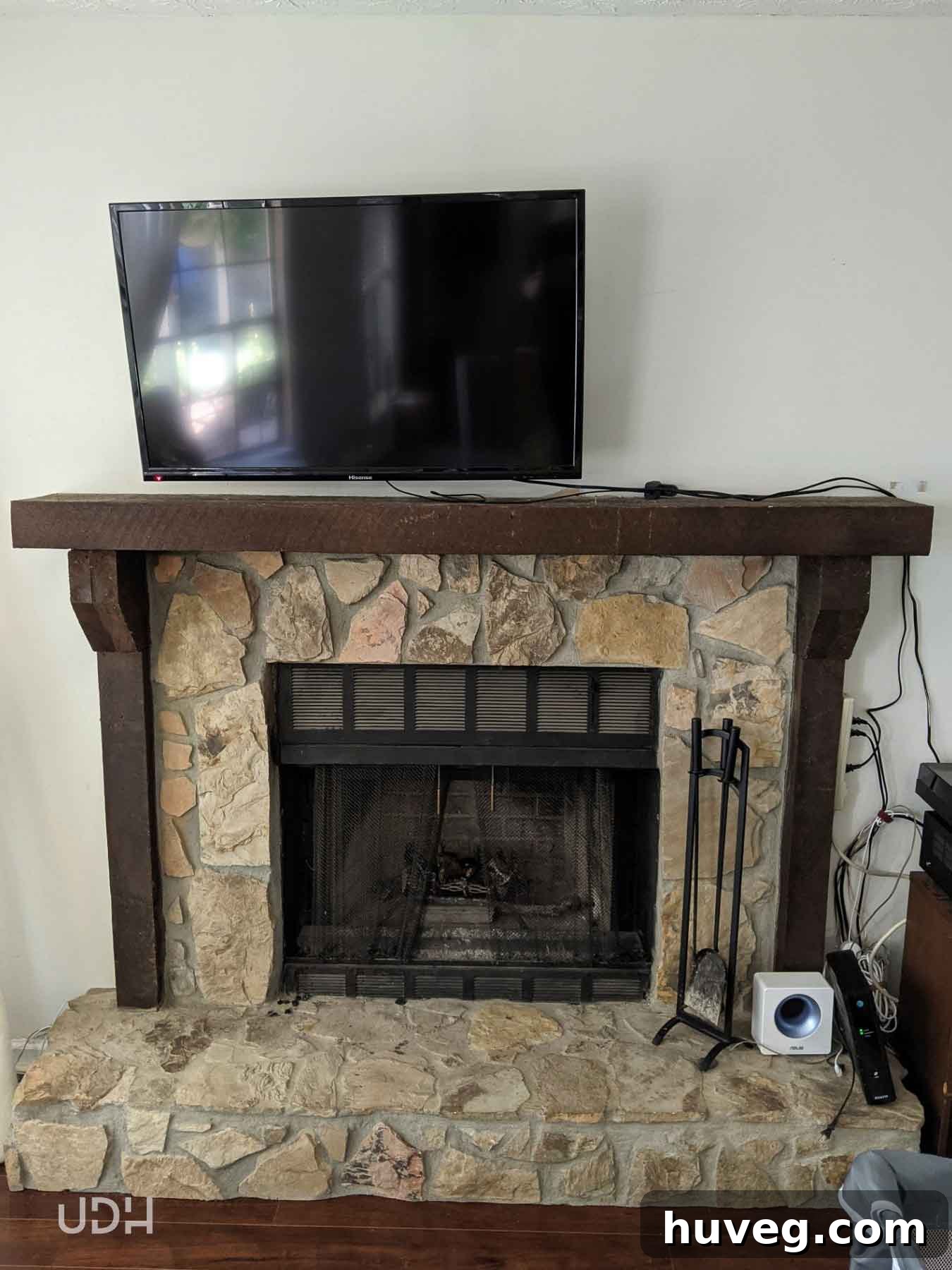
Ten years flew by. I graduated from grad school, met my wonderful partner, welcomed our beautiful baby into the world, and still, that old fireplace remained untouched. Its dark, chunky mantel, supported by heavy, antiquated brackets, cast a shadow that made the entire structure appear disproportionately massive and cumbersome. The gray and orange fieldstone, though a prominent focal point in the room, was an aesthetic I never truly embraced. While I understand that such a rustic look appeals to some (as many opinionated folks on Facebook were quick to remind me), for me, it was an undeniable eyesore. Our homes should be reflections of our personal style, spaces that evoke comfort and joy. This fireplace did NOT align with that vision. The most bothersome aspect, I think, was the pronounced orange hue within the stone. While photographs tend to mute its intensity, in person, it was strikingly polarizing and dominated the room in an unwelcome way.
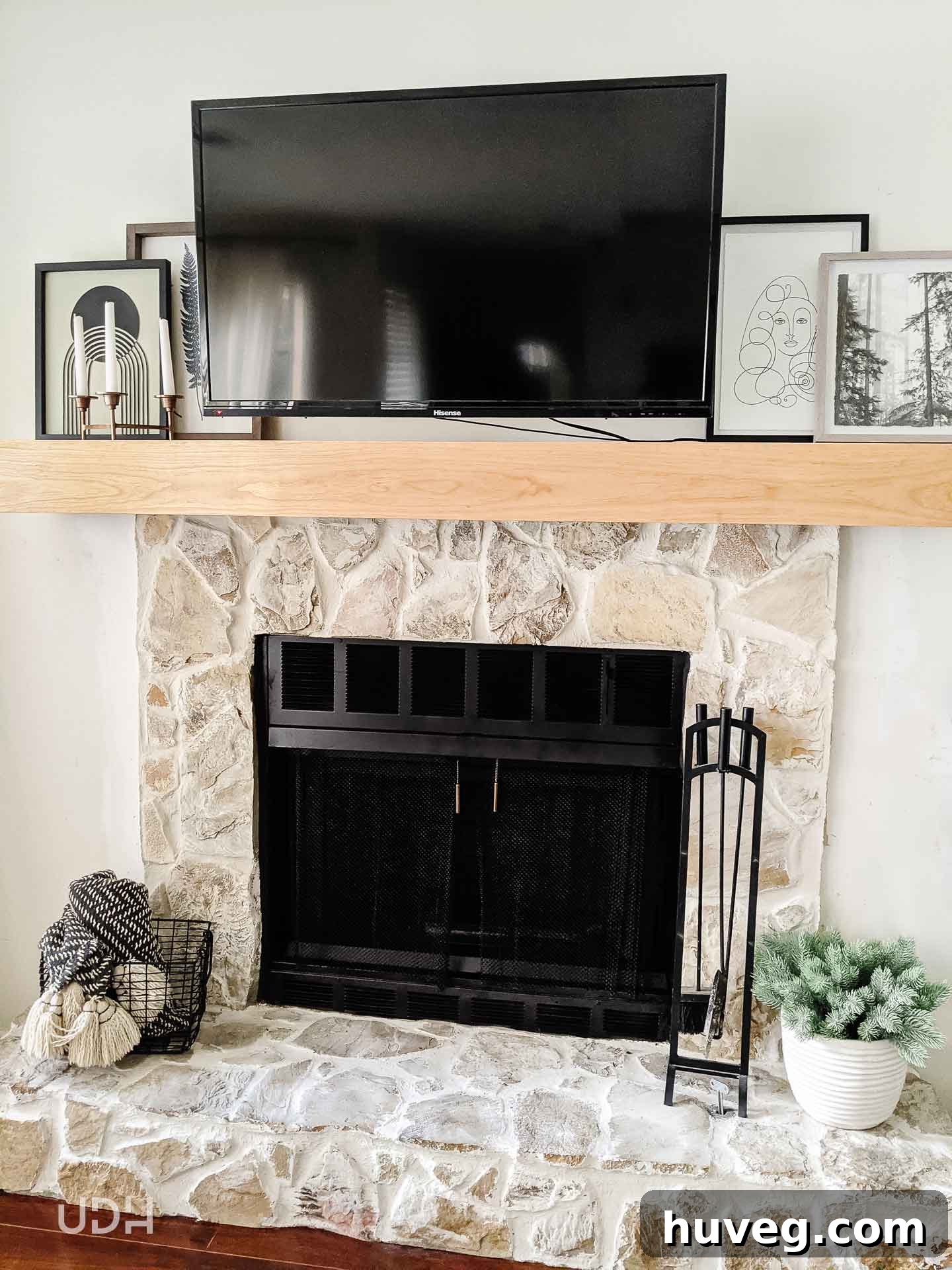
But I’ve got fantastic news (as you might have already inferred from the title of this post): I finally conquered my procrastination and executed the transformation! My living space now boasts a contemporary, inviting focal point that truly reflects our home’s updated aesthetic.
Ready for the breathtaking “after” reveal?
BOOM:
To provide an even clearer understanding of the entire process, I also created a quick video. This visual guide walks you through each step of the renovation, from the initial demolition to the satisfying final touches, allowing you to see firsthand how this dramatic change unfolded.
How I Transformed My Outdated Fireplace: A Step-by-Step Guide
My biggest hurdle in this decade-long contemplation was the elusive nature of “the right inspiration.” Every Pinterest tutorial I encountered for natural stone fireplace makeovers sparked little more than a “meh” response, and none of them seemed truly effortless. Some appeared simple enough in execution but involved permanent changes, and I struggled for a considerable time to recognize any of them as my ideal vision. It felt like a gut instinct; I believed I would intrinsically know the right aesthetic when I finally saw it. Ironically, most of my research primarily provided clarity on what I absolutely didn’t want: not a farmhouse style, not a stark brick facade, nothing excessively modern, and definitely no marble. A recurring theme in many of my house renovations has been the integration of white walls to brighten rooms that felt perpetually dim, and my old fireplace seemed to actively counteract that effort, sucking all the light back out.
This prolonged period of indecision eventually led to immense frustration. Perhaps painting the entire house — another multi-year project I kept postponing but finally completed earlier this year — provided the necessary impetus. It pushed me to dedicate more concerted effort into defining the best way to achieve a contemporary look for the fireplace and, finally, to commit. I spent countless hours scrolling through Pinterest, and this extensive visual research helped me realize a key goal: I wanted to cover the natural stones (somewhat, but not entirely) to achieve a softer, more modern fireplace aesthetic. With this direction established, I researched and meticulously considered various options, each presenting its unique set of pros and cons:
German Smear vs. Limewash vs. Whitewash: Unpacking the Options
- German Smear (or Schmear) with Tile Mortar or Grout: This venerable technique, centuries old, involves partially covering a stone or brick fireplace with white, wet mortar. It excels at softening the irregular appearance of natural stones and imparts a beautiful, rough texture. I was drawn to the look but harbored anxieties about accidentally applying too much coverage or failing to achieve the precise tint (fearing a too-stark white) and subsequently regretting those permanent choices. The window for making changes with traditional mortar is slim, and I knew it would require a large, dedicated block of time, which is challenging with a little one at home. I learned through Emily Henderson’s insightful post that “German smear” is perhaps more of a technique than a specific material, with some variations even incorporating plaster into the mortar. Although Chris Loves Julia referred to their project as an “over-grouted fireplace,” it appeared to be a similar application, and I gained many excellent tips from their experience.
- Limewash: Limewash is a textured product crafted from lime and sandstone, renowned for imparting an “old world” aesthetic to stone and brick. Its historical use immediately associates it with a classic, time-worn appeal. Crucially, it doesn’t completely obscure the surface, allowing the underlying stone or brick to subtly peek through, and it develops a beautiful patina over time. Products like those from Romabio are often removable and changeable for a brief period (their website states it can be applied and removed within two days for testing), but eventually becomes permanent. I found the look acceptable, but I wasn’t 100% sold because my vision specifically included creating a new, thicker texture, much like an over-grouted or German schmear finish would provide. While I actually love the limewash look a lot on old brick, I wasn’t convinced it would translate perfectly to my particular stone. I even considered a combination of German smear followed by limewash, but wanted to assess the smear effect first.
- Whitewash or Graywash: This option could be achieved by simply thinning down a gray or white latex paint and washing it over the stone, similar to the limewash technique. Among all the choices, this was arguably the most budget-friendly way to refresh the look, as I already had plenty of paint lying around, making the material cost virtually free. However, like limewash, it would not provide the significant texture change I desperately desired.
So, my ideal solution needed to be flexible, affordable, achievable in manageable segments over several days (fitting around a busy schedule), significantly brighten the overall appearance, and crucially, impact the fireplace’s texture. Then, a rather unconventional thought occurred to me: what if I could accomplish this with plain old joint compound? I know, it sounds a little crazy, but please, hear me out:
- Color Customization: I could easily add tint to it using latex paint (and I assumed other types of tints like powdered pigment would also work), allowing for precise color matching.
- Forgiving Application: It can be applied in layers, and if I applied too much, it could be scrubbed off with water. While not every speck could be removed (the mud would inevitably get down into the stone’s texture), enough could be removed to make a visible difference and correct mistakes.
- Zero Cost: I had an abundance of joint compound already in my garage from a previous drywall project. My only investment would be my time!
The concept sounded entirely plausible. At the very least, it seemed worth discussing with a professional. As with any project involving a fireplace (and this one involves literal fire), I felt much more at ease checking with a home inspector to ensure I wasn’t compromising the function or safety of my gas fireplace. They basically confirmed that since the stone was merely decorative veneer and not structural, I could proceed safely. Given that our house was built in the 1980s and the back of the fireplace was solid brick (not stone), we both agreed that the existing stone served little more than a rustic, aesthetic purpose. While this approach wouldn’t be ideal for a historical restoration, my project was far from that!
I also thoughtfully developed two backup plans, just in case my joint compound experiment didn’t pan out as hoped:
- Concrete Overlay: Fully cover the “German-smeared” stone with a layer of concrete, pushing the aesthetic towards a truly modern, industrial look.
- Complete Demolition and Rebuild: Fully demo the entire fireplace structure, reframe it with new supports, install cement board, and completely redesign a new look from scratch (perhaps new tile, etc.). This ambitious option, of course, would likely snowball into adding built-in storage and more, becoming a free-for-all construction project.
With a solid plan and contingencies in place, I divided the entire renovation into four fundamental parts:
1. Demolition: Clearing the Path for a New Vision
Materials needed: hammer | small sledgehammer | scrap 2 x 4s | screws | ear and eye protection
For me, demolition is, by far, the most satisfying and empowering part of any DIY project. It’s brimming with potential and makes me feel incredibly capable, even when I’m running on fumes from being up all night with a toddler (ahem). I began by closely examining each piece of the old mantel surrounding the stone, noticing they appeared to be held in place by just a few nails. I figured that by maintaining tight control over my hammer swings, the easiest approach would be to remove things piece by piece, allowing me to understand the underlying structure as I progressed.
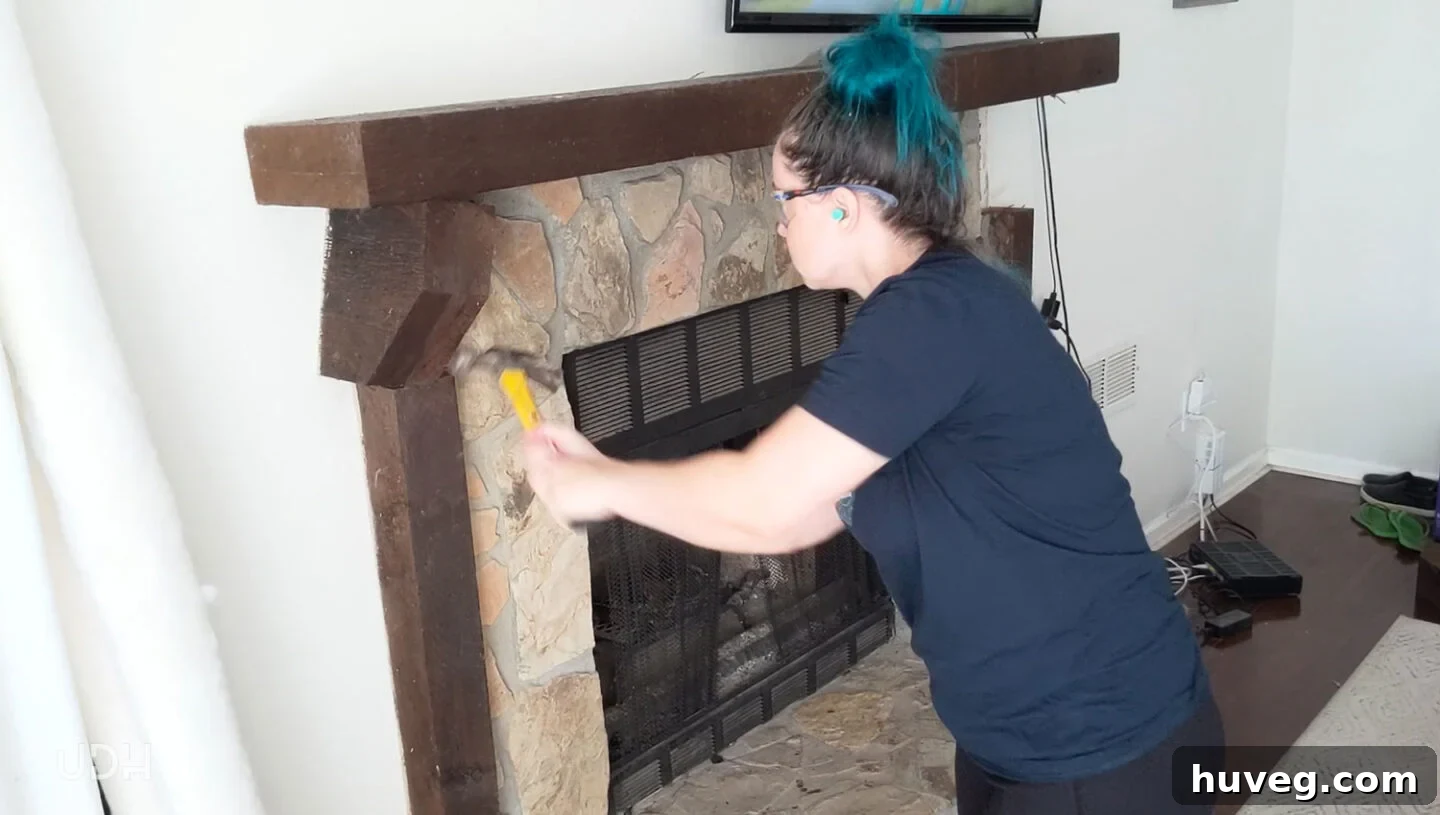
The initial two pieces located directly beneath the upper mantel came off with surprising ease after just a few hammer swings. I was initially unsure if the upper mantel was independently connected to the wall (it was!), so I took extra care to confirm this before proceeding with the demolition of the second side. Removing that first piece also provided invaluable confirmation that I was indeed dealing with stone veneer—you can clearly spot the mesh backing peeking out from underneath the stone. This insight was crucial for my subsequent plans.
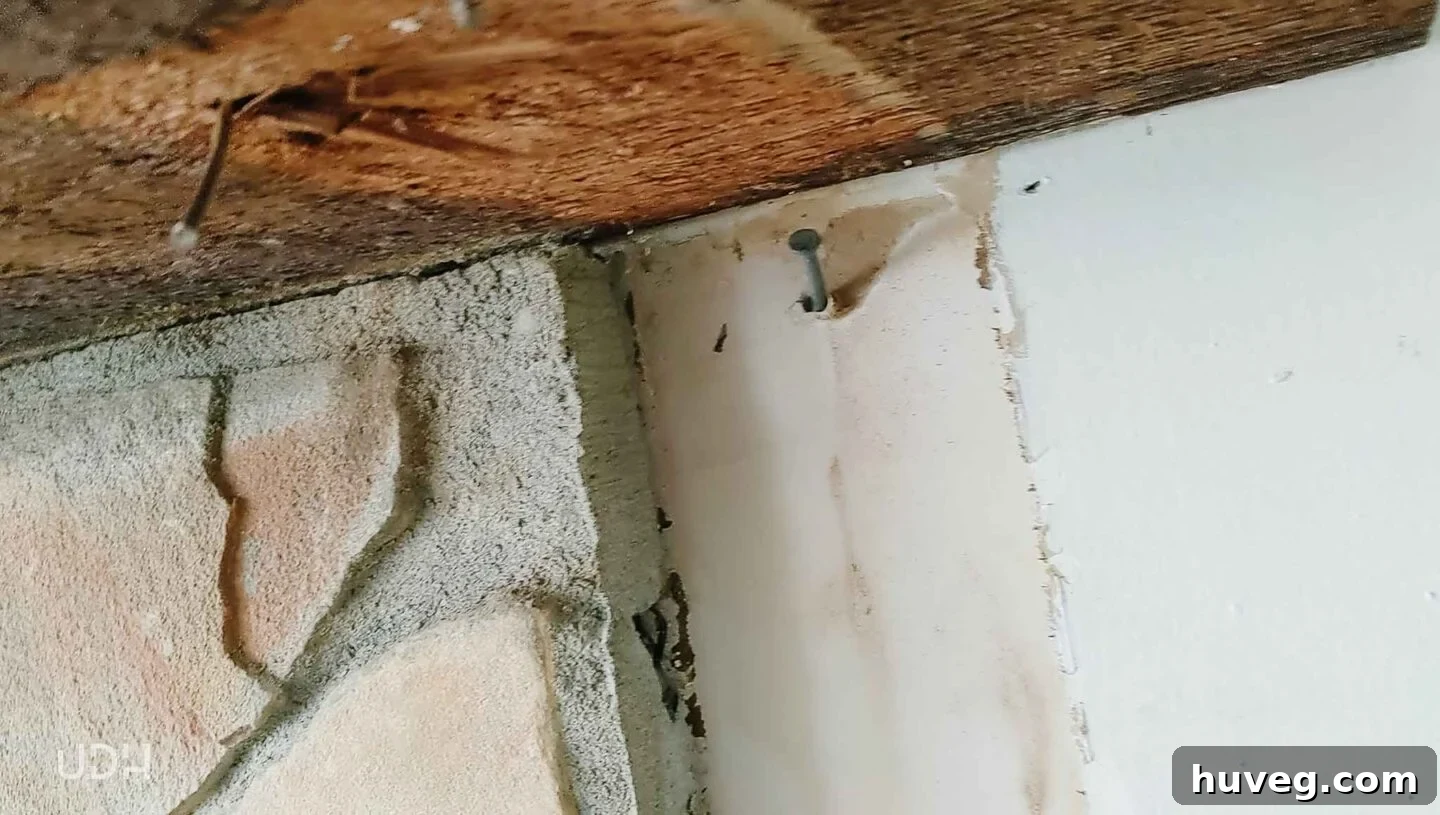
The vertical posts, however, proved a bit tougher. I initially suspected they might have been embedded slightly below the stone on the hearth. My first attempt involved hammering the post sideways, which managed to loosen it significantly, but I lacked sufficient leverage to lift the bottom out. After a brief brainstorming session, I devised a clever solution: I created a triangular brace using scrap 2x4s and securely screwed it into each post. This ingenious setup allowed me to hammer upwards instead of outwards, providing the necessary lift. I was utterly surprised when the first one finally came out—I had no idea it extended down that far! The second post came out significantly easier, a testament to how quickly experience can be gained and applied. Be sure to check out the accompanying video to witness this entire process in action.
After sharing my demolition progress on Instagram, I received a few messages from followers wondering why I hadn’t used a car jack to lift up the posts. The short answer is simply that the idea didn’t occur to me at the time. However, I’m also not entirely sure I would have chosen that method even if it had. My primary concern was to avoid causing any major cracks or damage to the existing stone (which, despite its aesthetic shortcomings, was in good structural shape). I believe a car jack, particularly with my limited experience in such applications, would have significantly increased the likelihood of something breaking, which I desperately wanted to avoid.
2. Fireplace Surround Makeover: Achieving the German Smear Look with Joint Compound
Materials needed: joint compound | stiff brush | rags | latex paints or pigment | mud pan | spreading tools
To achieve a look similar to a traditional German smear, I anticipated a bit of trial and error, but thankfully, joint compound proved to be an incredibly flexible material for this application! I initially tried rubbing the joint compound onto the stone with a rag. I quickly realized that a little goes a very long way, and I was achieving far too much coverage, obscuring too much of the stone. So, I swiftly changed tactics, opting to use a paint stick (my “Very Professional Tool,” indeed!) to apply the mud more precisely into the crevices and between the stones. It looked quite sloppy during the initial application, but I gently smoothed things out more as it began to dry and firm up. I left these two distinct test patches to dry overnight, eager to evaluate which I preferred in natural daylight.
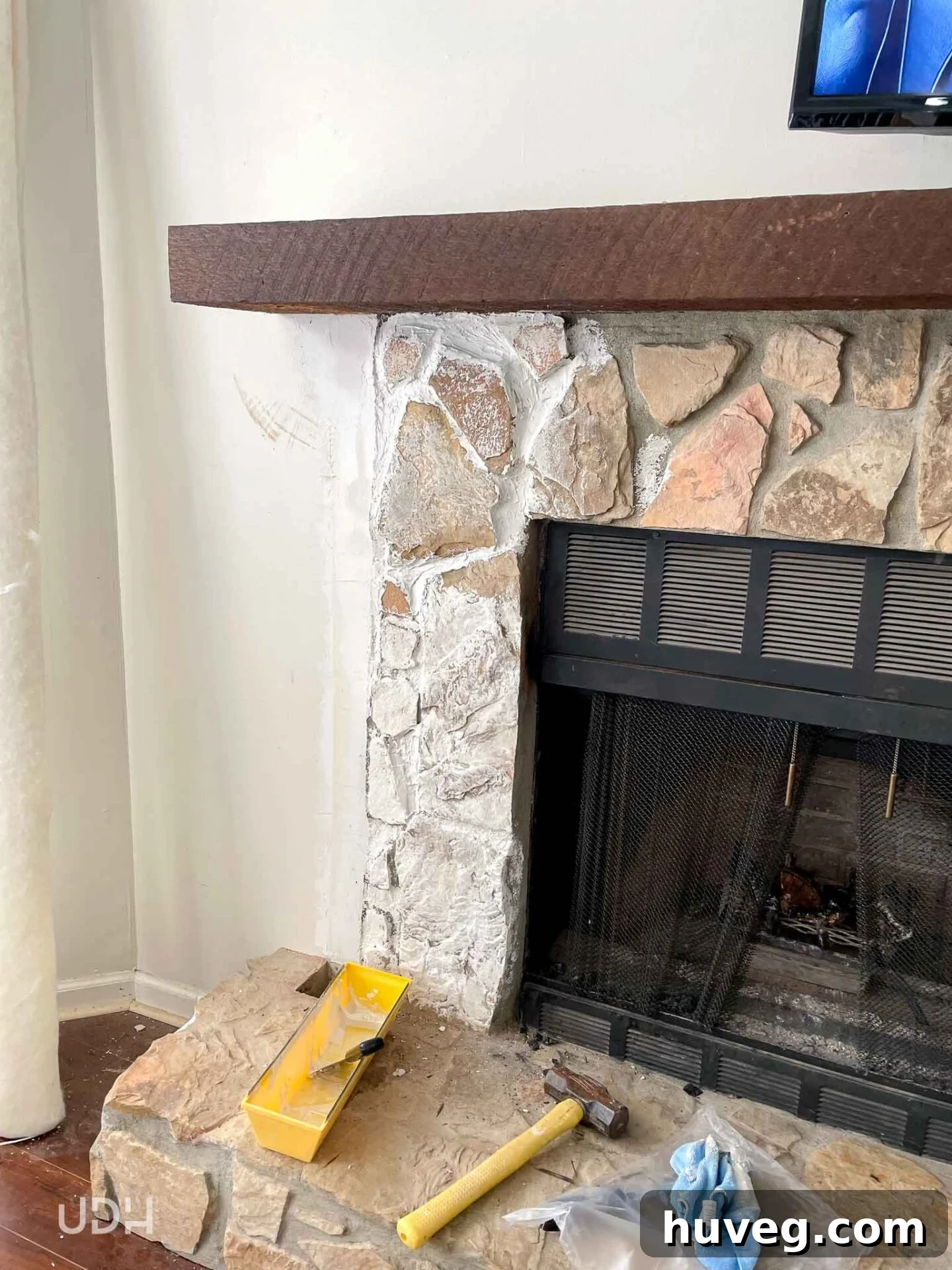
The following day, after observing the dried test patches, I made two crucial determinations: first, I needed to refine the coverage even further – desiring more coverage than the upper test area but less than the lower, thicker section. Second, the pure white joint compound was simply too bright for the room’s aesthetic. So, I pivoted yet again. I gathered a few latex paint samples I had on hand from a different project and mixed them into the joint compound. This created a beautiful, warm off-white color that was a few shades lighter than the surrounding wall color, and serendipitously, it also managed to incorporate and harmonize with the subtle different tones present in the original stone. Even though the color adjustment might not appear super dramatic in the video at first glance, it made an enormous, impactful difference to the overall feel of the fireplace!
As the drywall mud began to dry, I took a stiff brush and meticulously smoothed out all of the marks left by the paint stick. This crucial step helped to blend the application and create the soft, textured, aged appearance characteristic of a true German smear, allowing the natural contours of the stone to subtly show through.
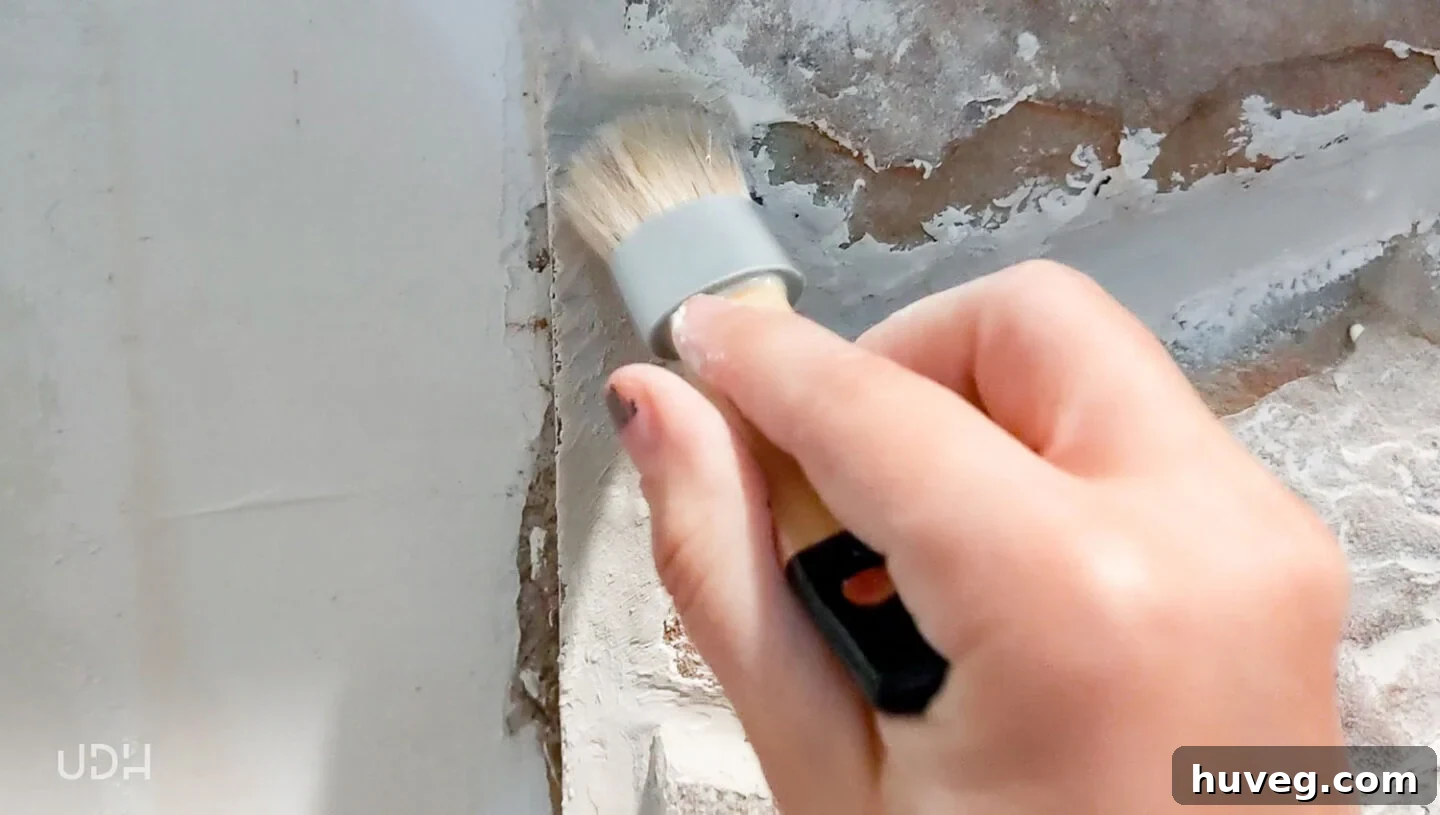
One of the most gratifying aspects of using joint compound was its inherent flexibility. If there was ever a spot where I felt I had applied too much, it was surprisingly easy to scrub it down with a damp rag and remove enough mud to reveal more of the underlying stone. Initially, I also inadvertently globbed on the compound too thickly in certain areas, which predictably led to cracking as it dried. For these sections, I simply used a chiseling tool to carefully remove the cracked mud and reapplied it. While it wouldn’t, of course, be possible to remove all the mud after it had fully cured (it effectively settles deep into the texture of the stone—perhaps a pressure washer might work, but that would be far more trouble than it’s worth), the ability to continuously tweak and adjust over the course of a few nights, after the baby was asleep, adding or removing as needed to achieve the perfect balance, brought immense satisfaction. Even days later, after the compound had completely dried, I could still make subtle changes, a remarkable advantage not afforded by traditional mortar or grout applications.
3. Designing and Installing a Stylish New Wood Mantel
Materials needed: 1×6 pine boards | clamps | miter saw | circular saw | safety gear | wood glue | pin nailer and nails | wood filler | pre-stain conditioner | stain | polycrilic
The new wood mantel was the pivotal design element that truly brought my vision of a completely modern fireplace to fruition. This was essentially the only part of the project that incurred a significant material cost, as I needed to purchase fresh lumber. While I could have potentially sanded down and re-stained the old wood, that approach would have been exceptionally messy and far more time-consuming than I had available. Therefore, I opted for a cleaner and more efficient solution: covering the existing mantel with new wood. After I had safely demolished the original, bulky decorative legs and supports, I confirmed that the mantel itself was still securely fastened to the wall. This made the decision to simply wrap it in new wood a much easier alternative to a full demolition, especially since I desired a similar, yet significantly lighter and sleeker, aesthetic.
During my trip to the hardware store, I discovered that wider pine boards were unfortunately out of stock, and the nearest full-service lumber yard was a good 40 minutes away. To stick to my budget and timeline, I chose several simple 1×6 pine boards. These proved to be just wide enough to completely cover the thickness of the old mantel’s top and bottom pieces, allowing me to wrap the entire front and sides together seamlessly. This created a clean, updated profile without the need for complex joinery.

Beyond the front where the corners are visibly joined, I wasn’t overly concerned about minor seams (such as where the new top piece meets the front). Since I don’t own a table saw, I consciously chose not to attempt to rip down mitered edges for the top or bottom. This decision made for a much simpler glue-up process, saving significant time and effort while still achieving a remarkably clean and modern appearance.
Choosing the Perfect Mantel Stain
For the mantel’s finish, I first applied a pre-conditioner. This crucial step helps to prevent blotchy application, especially when working with pine, ensuring the stain absorbs evenly. Following this, I applied two coats of “Fruitwood” stain to achieve the desired warm, inviting color. I can proudly say I’ve never used an entire can of stain before—until now! This color has become one of my absolute favorites, having graced enough projects in my home to earn its top spot. I’m actually planning a dedicated post soon on my go-to stains, complete with a comprehensive guide, as choosing the right color can be daunting, and some can look quite different depending on the wood species. To provide durable protection and complete the look, I finished the mantel with a Polycrilic topcoat, specifically selecting a flat sheen to maintain a natural, muted appearance rather than a glossy one.
4. Refreshing the Firebox: A Clean, Dark Finish
Materials needed: drop cloth | painter’s tape | recycled plastic bags or plastic sheeting | spray shield | eye protection | breathing mask | box fans
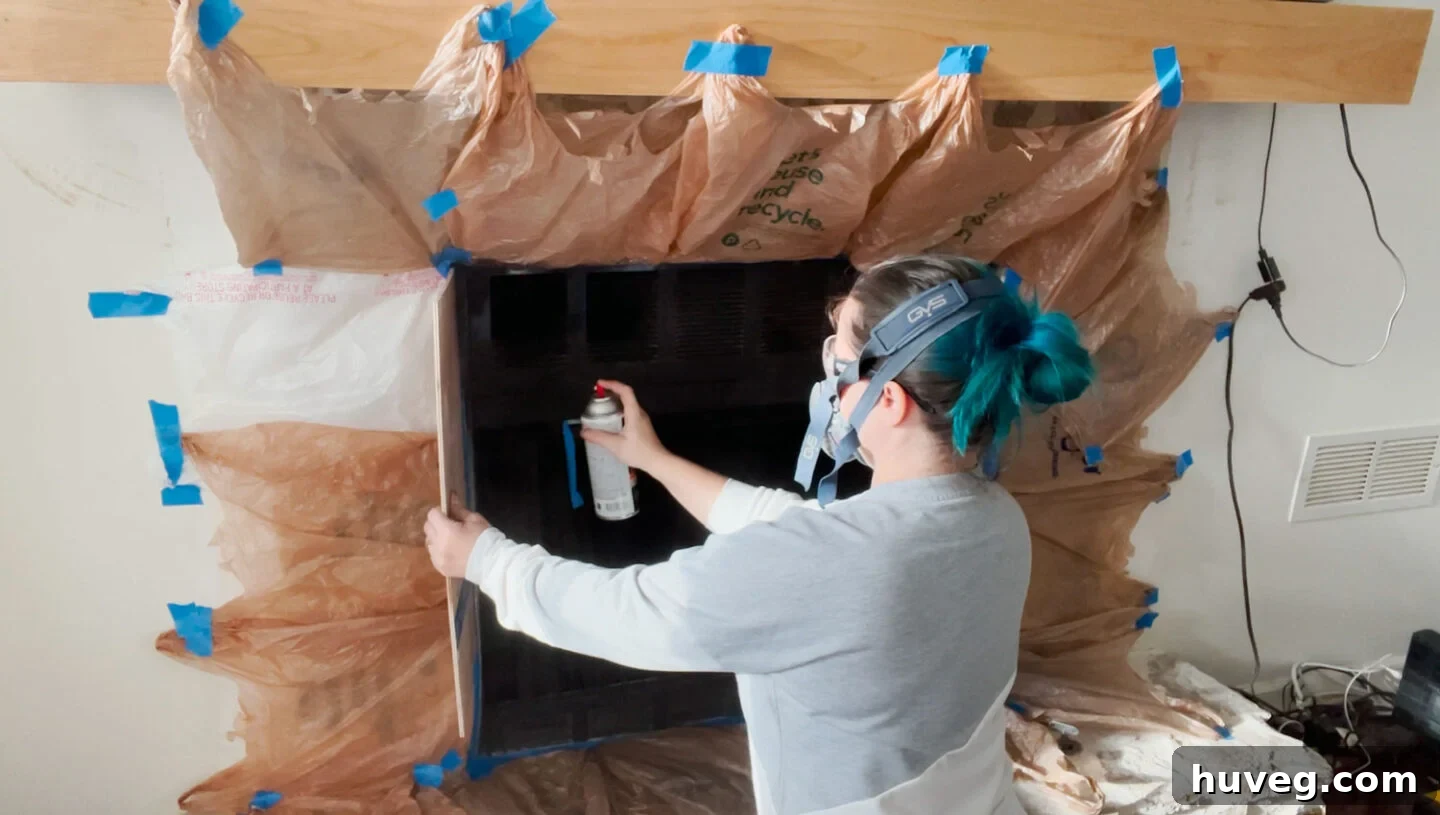
Between years of regular use and the natural effects of age, the firebox itself showed clear signs of wear and tear, primarily in the form of scratches and discoloration from countless fireplace burns. I had already had it professionally serviced, confirming that both the chimney and the gas unit were in excellent condition. My goal, therefore, was purely aesthetic: to refresh the appearance of the interior brick, the metal face, and the curtain screen. For this task, I chose a high-heat resistant black spray paint. I specifically opted for the highest temperature resistance I could find, which conveniently boasted a rapid 10-minute drying time. The process involved meticulously masking off every area I didn’t want painted, applying the spray, and then patiently waiting for the strong fumes to fully dissipate.
To help prevent overspray from settling on the surrounding walls, I used a piece of scrap plywood as a handheld shield as I worked. In hindsight, I would absolutely recommend laying a full drop cloth on the floor; while my cleanup was relatively easy because I worked quickly, there was still some slight overspray. It is EXTREMELY important to wear a proper breathing mask and utilize powerful box fans for robust ventilation during this step, as the paint fumes can become very heavy and concentrated in such a tight space. I’m also contemplating going over just the front metal face with a flat black paint, as the 1200-degree high-heat paint I used has a slightly higher gloss finish than I ideally prefer. The 600-degree temperature resistant paint often comes in a flat sheen and a roll-on form, but I couldn’t find it in stock near me at the time of purchase.
And there you have it! The complete, budget-friendly transformation of my living room fireplace. I sincerely hope you love the new look as much as I do. Because, holy hannah*, I absolutely adore it now! It has undeniably brightened the entire room, infusing it with a vibrant new life and energy. We’ve already enjoyed a toasty fire or two, celebrating this stunning refresh. As with most DIY projects that take me a while to accomplish (and especially in rooms where we spend a significant amount of time), I am so incredibly glad I finally overcame my inner voice that kept convincing me to procrastinate. It was SO WORTH IT!
-

Before the makeover. -
After the dramatic transformation!
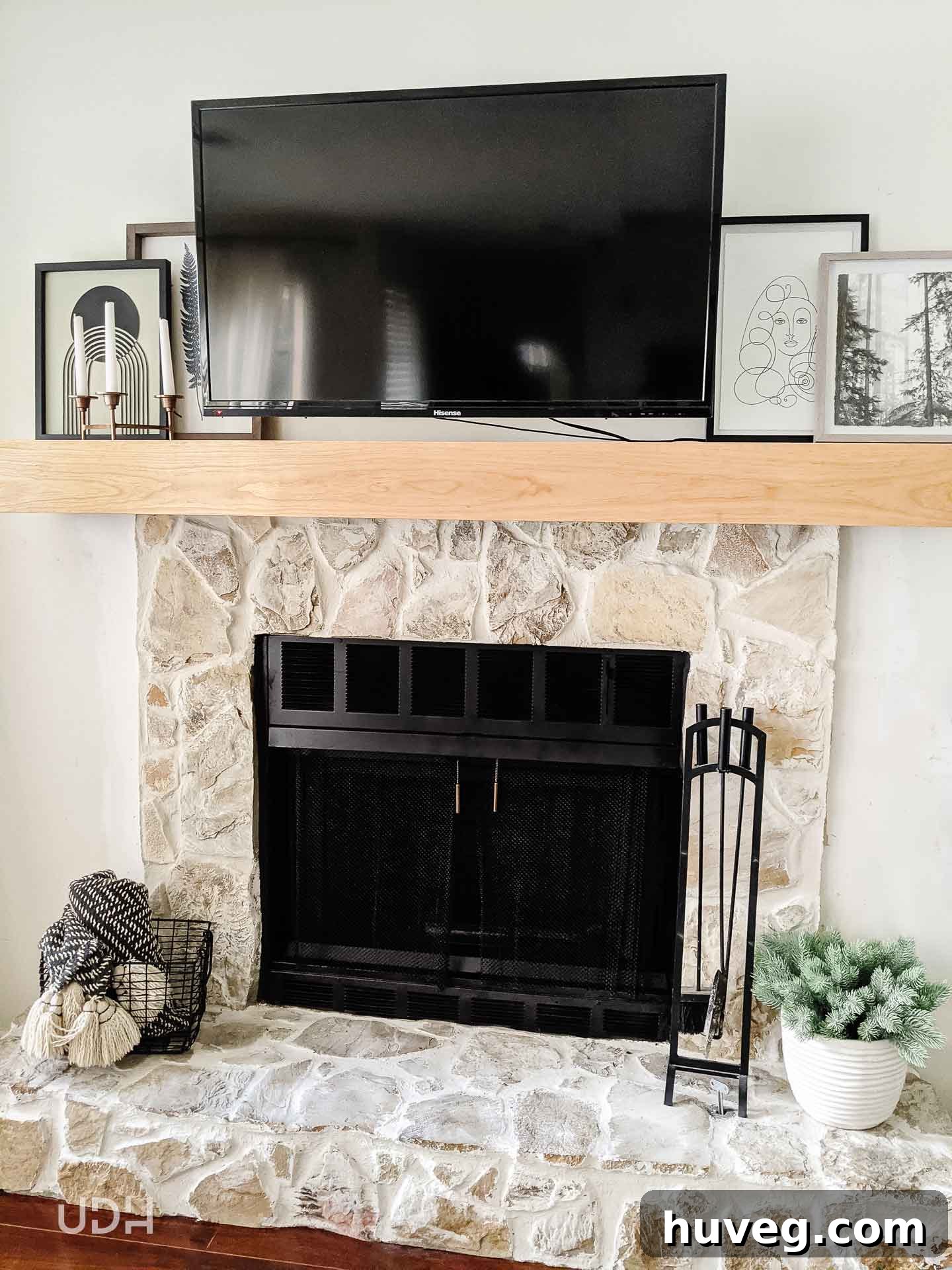
My enjoyment of a completely unobstructed view, however, was rather short-lived! Just a few hours after meticulously arranging the decor and snapping those “after” pictures, I had to promptly install a baby gate to keep little Ellis safely away and protect his precious tiny head from that raised hearth. Still, though. My love for my beautiful new fireplace remains undiminished!

I haven’t yet applied a final sealer to the fireplace, as I’m still making a few more minor tweaks and plan to add some additional elements in the near future (a significant one will be finding an elegant way to hide the television wires on the fireplace wall). I also feel the sides of the fireplace are still missing a little something, but I am undeniably glad the bulky wood surround of the posts is gone. But rest assured, I have a plan! Once I’m confident no further changes will be made, I’ll diligently search for a high-quality sealer that preserves the beautiful matte finish of the stone and joint compound, crucially without altering its carefully chosen color. I’ll be sure to update this post with all the details when that happens! So, what do you think of my refreshed fireplace?
*(I read a blog post once using this delightful phrase, and it still tickles me to use it!)
UPDATE: An Unexpected New Chapter! In an unexpected twist, our family decided we needed more space and chose to move! Consequently, I didn’t get the chance to finish any further enhancements on the fireplace wall as planned. However, I genuinely hope the new owners are enjoying the refreshed fireplace. Our house sold in record time, and I strongly believe that the bright, clean aesthetic of the living room, significantly enhanced by the updated fireplace, played a major role in its quick sale. I remain incredibly satisfied that I finally addressed this long-standing design decision, making the space work better for me during the years we enjoyed it. You can see the final photos of the house before we moved here, and details about our new home will be coming soon!