DIY Floating Deck Part 4 Perfecting Your Deck Board Edges

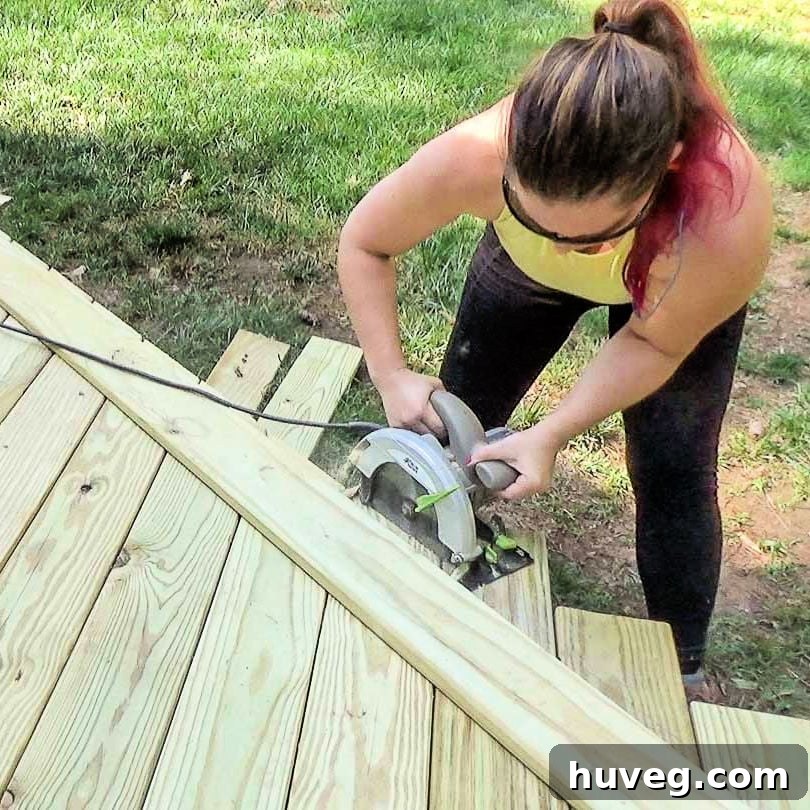
Welcome back to the ongoing saga of my DIY backyard floating deck project! You can follow the entire journey, from initial concept to the final flourish, right here. In this particular installment, we’re diving into the crucial finishing touches: precisely trimming all the deck board ends and meticulously rounding off those freshly cut edges to achieve a professional, polished look.
- Part 1: Planning & Layout – Discover the foundational steps of plotting out your dream deck.
- Part 2: Frame & Waterproofing – Learn how to build a sturdy, long-lasting frame protected against the elements.
- Part 3: Decking – See how to install deck boards, including a unique diagonal pattern.
- Part 4: The Finishing Edge – That’s what you’re reading now!
- Part 5: Landscaping – Transforming the area around your new deck into a beautiful oasis.
- Part 6: Light Pole Planters – Add ambiance and style with custom outdoor lighting.
- Part 7: The Grand Reveal (Mom’s Surprise Party) – Witness the completed project in all its glory!
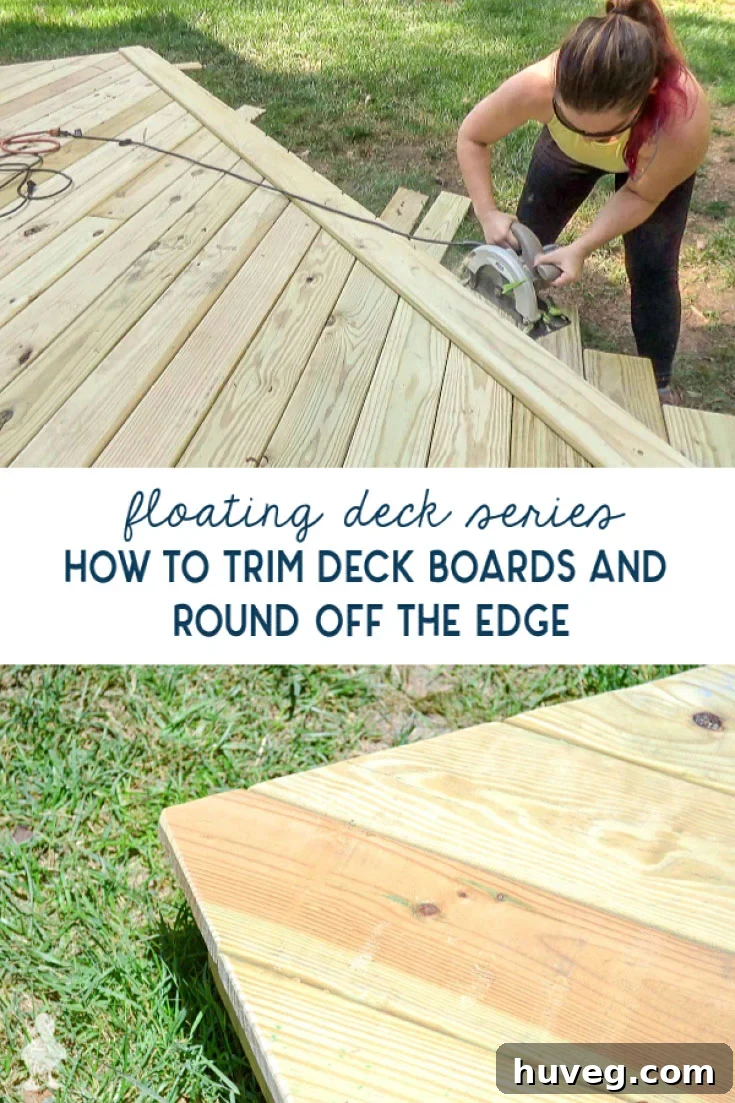
I’m back today, brimming with excitement to share more intricate details of my substantial deck project! This past week has been dedicated to putting those crucial final touches into place, setting the stage for the upcoming furniture builds and overall design aesthetic. Before we delve into the exciting design phase, it’s essential to complete the structural aspects of the deck and address any lingering questions you might have. This installment, complete with an accompanying video, provides all the DIY specifics you’ll need. If you happened to miss the earlier stages, such as constructing the robust frame or installing the decking boards at a striking diagonal, I encourage you to catch up on those parts before proceeding!
(Video detailing the trimming and rounding process is available here for visual learners.)
Help me reach 25k subscribers!
Achieving a Perfect Edge: How to Trim Deck Board Ends
The edges of your deck boards play a significant role in the overall aesthetic and safety of your outdoor space. A clean, uniform trim elevates the entire project, moving it from a “DIY project” to a “professionally finished masterpiece.” This section will guide you through the process of achieving that crisp, straight edge.
Essential Tools and Materials Needed
Before you begin, gathering the right tools is paramount for efficiency and precision. Here’s what you’ll need:
- Chalk Snap Line: Indispensable for creating perfectly straight lines across multiple boards. A good quality chalk line ensures your cuts are consistently aligned.
- Circular Saw: This is your primary cutting tool. I currently rely on this model, which offers excellent performance. If you’re working with a tighter budget, this option comes in under $50 and is a great starting point for many DIY tasks. Remember, a sharp blade is key for clean cuts.
- Spare Piece of 2×4 (or other straight board): This will serve as your saw guide. Its straightness is critical, so choose the best piece you have available. Even slight imperfections can lead to wavy cuts.
- Screws: To firmly secure your guide board, preventing any movement during the cutting process.
- Wood Putty: For patching up any screw holes left by your guide board, ensuring a flawless finish.
- Safety Gear: Never skip this step! Always wear eye protection, hearing protection, and appropriate gloves when operating power tools.
Initially, I hesitated, waiting a few days after the main decking installation to build up my confidence for these critical cuts. The truth is, with this particular step, you typically get only one shot at a clean, straight edge. While procrastination born from fear of failure isn’t productive, thorough preparation certainly is! Focusing on meticulous planning and setup will significantly boost your readiness and the quality of your results.
My initial design consideration included a subtle overhang for the deck boards, extending approximately one inch beyond the support structure. This decision was deliberate; it provides a more finished aesthetic and offers the flexibility to add contrasting trim underneath later, should I choose to. Since I incorporated this overhang into my plans from the outset, two of the six angled deck edges already had this desired extension from their initial installation. These pre-existing overhangs served as excellent reference points and starting lines for trimming the remaining sides.
Precision Setup: Setting Your Cut Line and Circular Saw for Success
Achieving a perfectly straight cut with a circular saw often feels daunting, but with the right technique, it becomes much simpler. My preferred method involves guiding the saw along a straight board. Here’s how to set it up correctly:
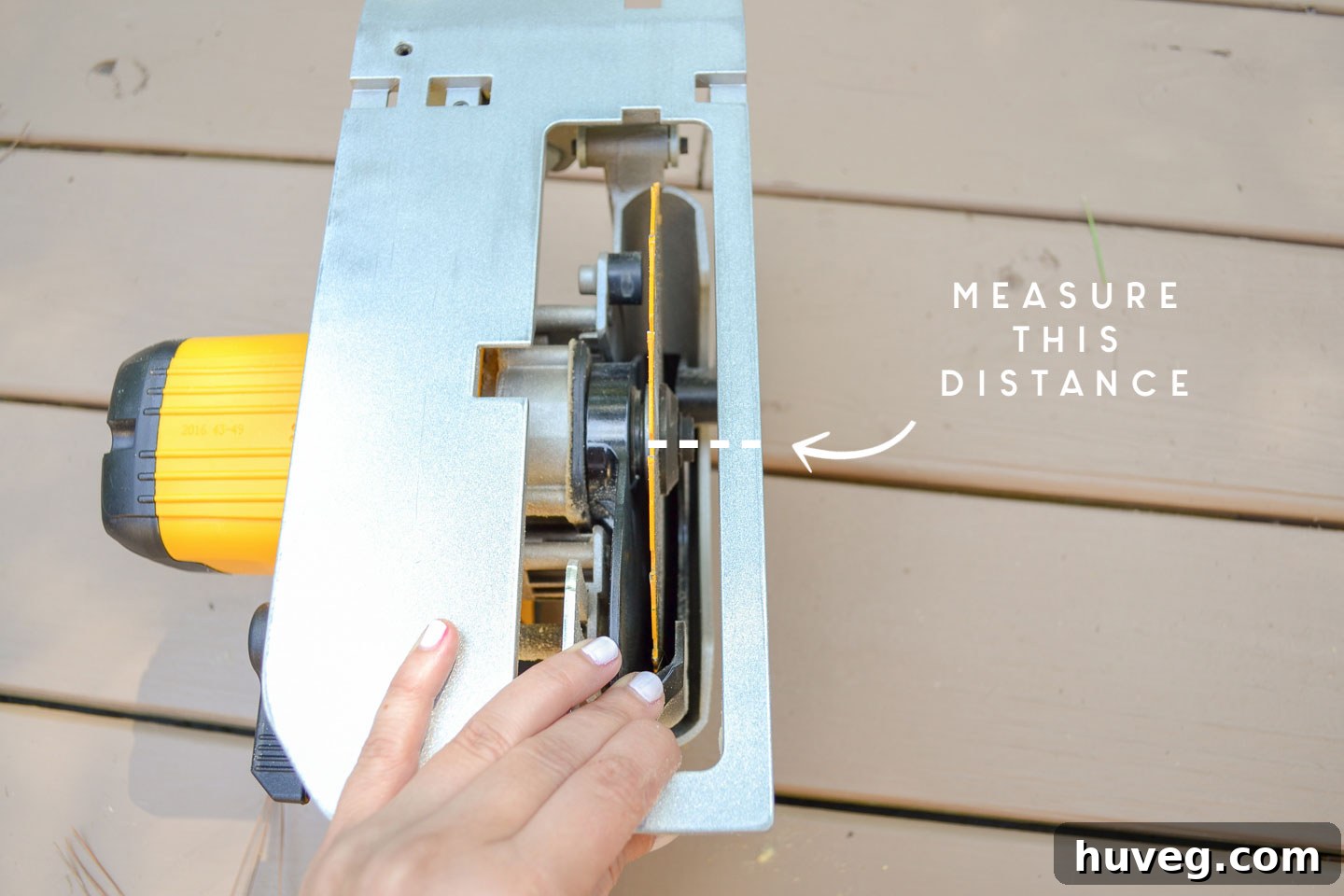
- Offsetting the Guide Board: This is where many DIYers make a common mistake. You cannot simply align your guide board directly with your marked cut line. Instead, you must offset it by a precise distance: the measurement from the edge of your circular saw’s shoe (base plate) to the cutting edge of the blade. On older saws, or those without clear markings, you might need to use a ruler to measure this distance accurately from the underside of the saw. My newer circular saw, however, features convenient line markings that make this measurement unnecessary, simplifying the setup process considerably. Always double-check this offset to ensure your guide board is placed exactly where it needs to be for the blade to follow your intended cut line.
- Adjusting Blade Depth for Optimal Cuts: Another crucial adjustment is the depth of your circular saw blade. The blade should only extend slightly past the material you are cutting – ideally, about 1/4 inch. Setting the blade too deep significantly increases the risk of “tear-out” (splintering on the underside of the wood), which compromises the cleanliness of your cut. Additionally, an overly deep blade could strike obstructions underneath your deck boards, such as dirt, gravel, or even hidden utilities, potentially damaging the blade or causing a dangerous kickback.
- Cord Management (for corded saws): If you’re using a corded circular saw, as I did initially in the video, always be mindful of the power cord. Keep it clear of the cutting path and ensure it doesn’t get tangled or snagged on anything, which could pull the saw off course or create a safety hazard. This is one of the reasons I later invested in a battery-powered circular saw, which offered greater freedom and convenience, especially for larger projects like my upcoming pub shed build.
Step 1: Measure Accurately and Snap a Chalk Line
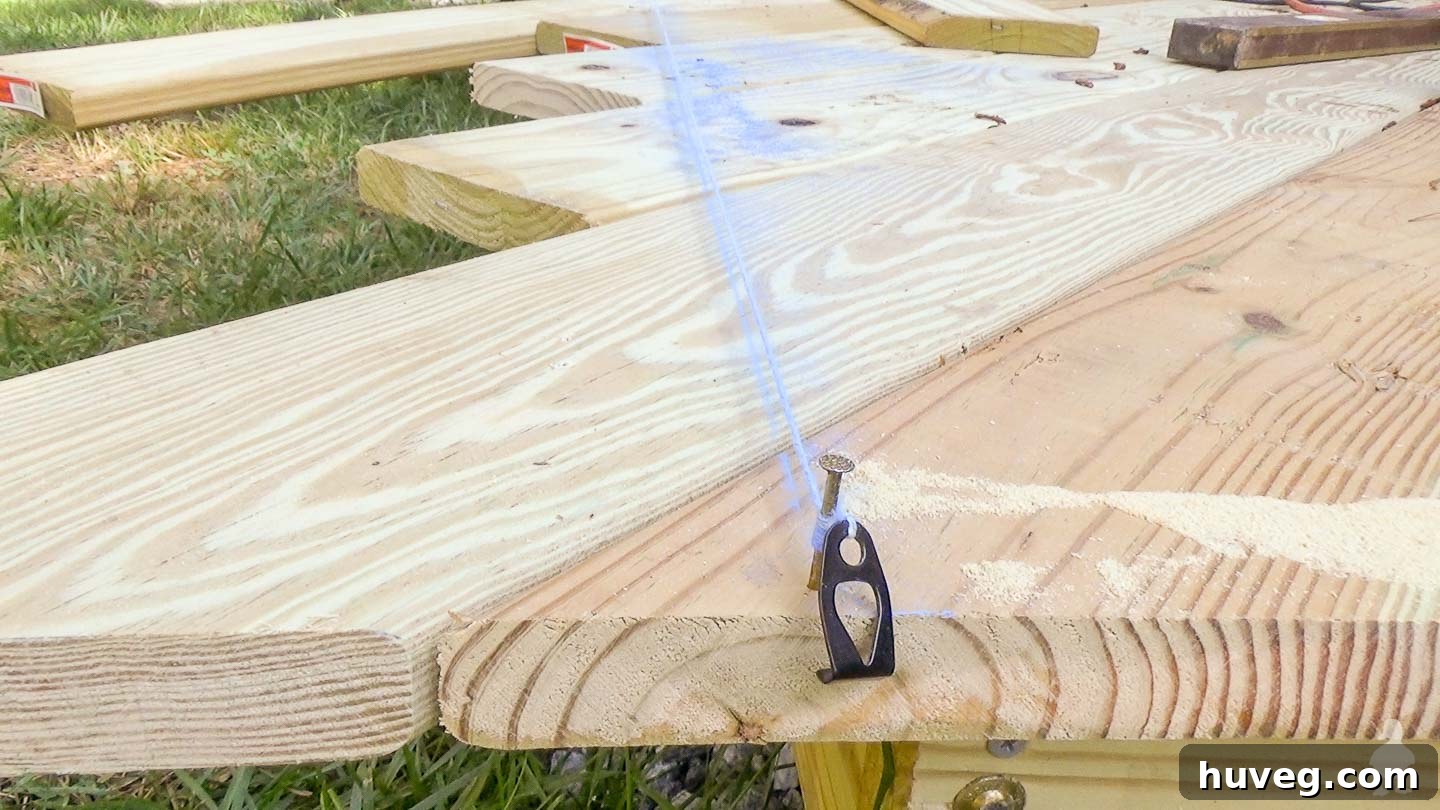
Once I overcame my initial apprehension and properly set up my tools, the process proved to be far more manageable than I had anticipated. The first practical step involves precise measurement. Starting from one end, measure out your desired trim line, ensuring it’s consistent across the entire length of the deck. Once your measurement points are established, stretch your chalk line tightly between them and snap it firmly. This creates a highly visible, perfectly straight guide for your subsequent steps. This chalk line is paramount; it’s the visual blueprint for your cut, so take your time and ensure it’s accurate and clearly marked on all the deck board ends.
Step 2: Secure Your Straight Board as a Cutting Guide
Given that many of my construction materials had endured the elements, specifically a very rainy summer, during the installation phase, selecting the straightest possible piece of wood for my guide board was crucial. Even a slight warp could compromise the straightness of the final cut, so take extra time to find a truly flat and straight 2×4 or similar board.
With the ideal board chosen, carefully measure and mark the blade offset (the distance from the saw’s shoe edge to the blade) onto the deck surface, aligning it perfectly with your chalk line. Then, position your guide board along this offset line. To ensure absolute stability and prevent any unwanted flexing or shifting during the cut, screw the guide board down securely. I recommend using screws at both ends and at least one in the middle for longer runs. While clamps can be an option, especially for projects with easy access, my floating deck sits very low to the ground, making clamping awkward. I found it far more practical and stable to use a few temporary screw holes, which could easily be filled with wood putty later, providing a much more reliable guide for my saw.
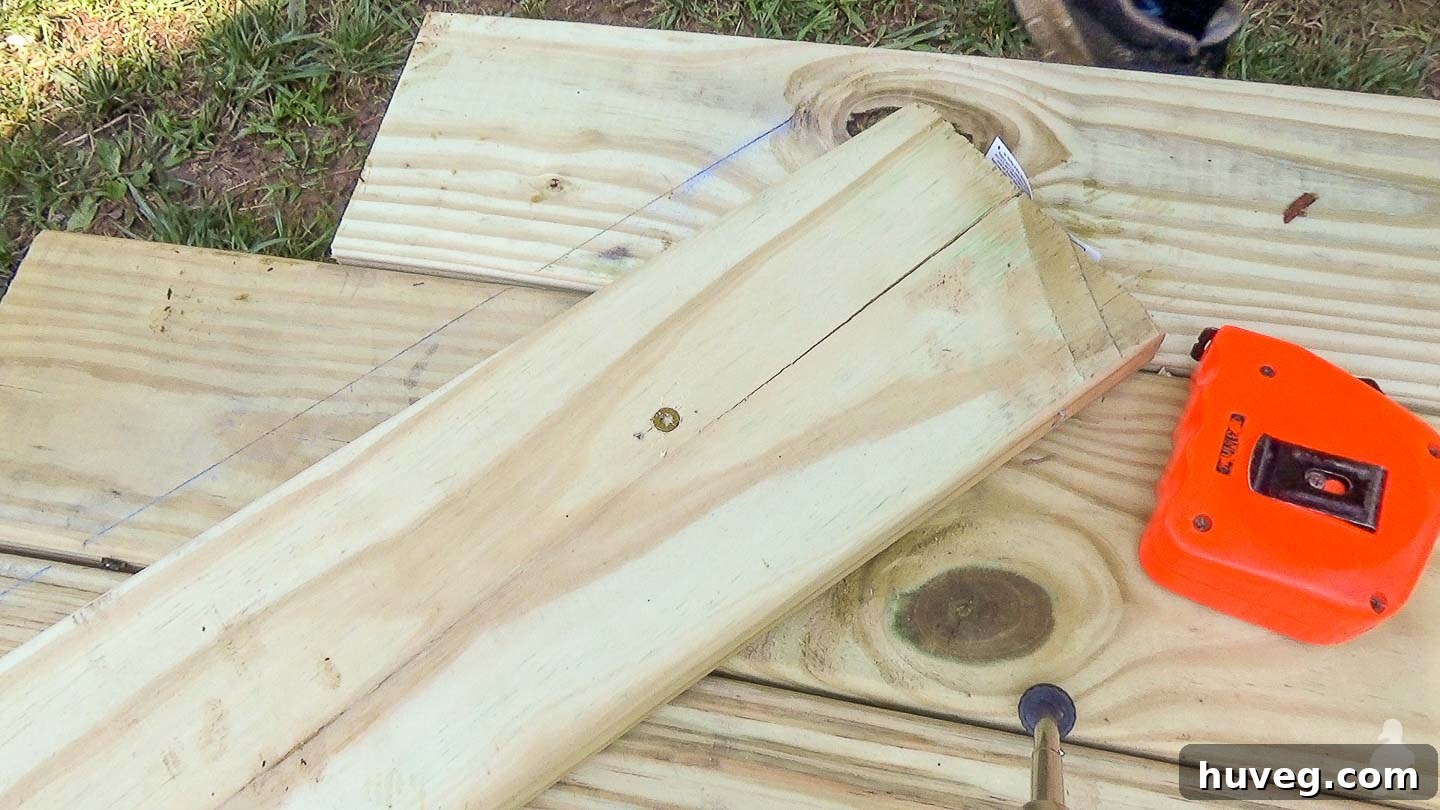
Step 3: Make Your First Precision Cut
Now, with all the meticulous preparation complete, it’s time for the moment of truth. Take a deep breath to steady yourself, ensure your safety gear is in place, and confidently engage your circular saw. Guide the saw smoothly and consistently along your secured straight edge. Maintain a steady hand and a uniform pace, allowing the saw to do the work. Don’t force it, as this can lead to uneven cuts or kickback. Despite my initial nerves about making a mistake, the careful setup paid off, and the first cut was remarkably clean and straight. Trust your preparation, and you’ll find the actual cutting process surprisingly straightforward and satisfying.
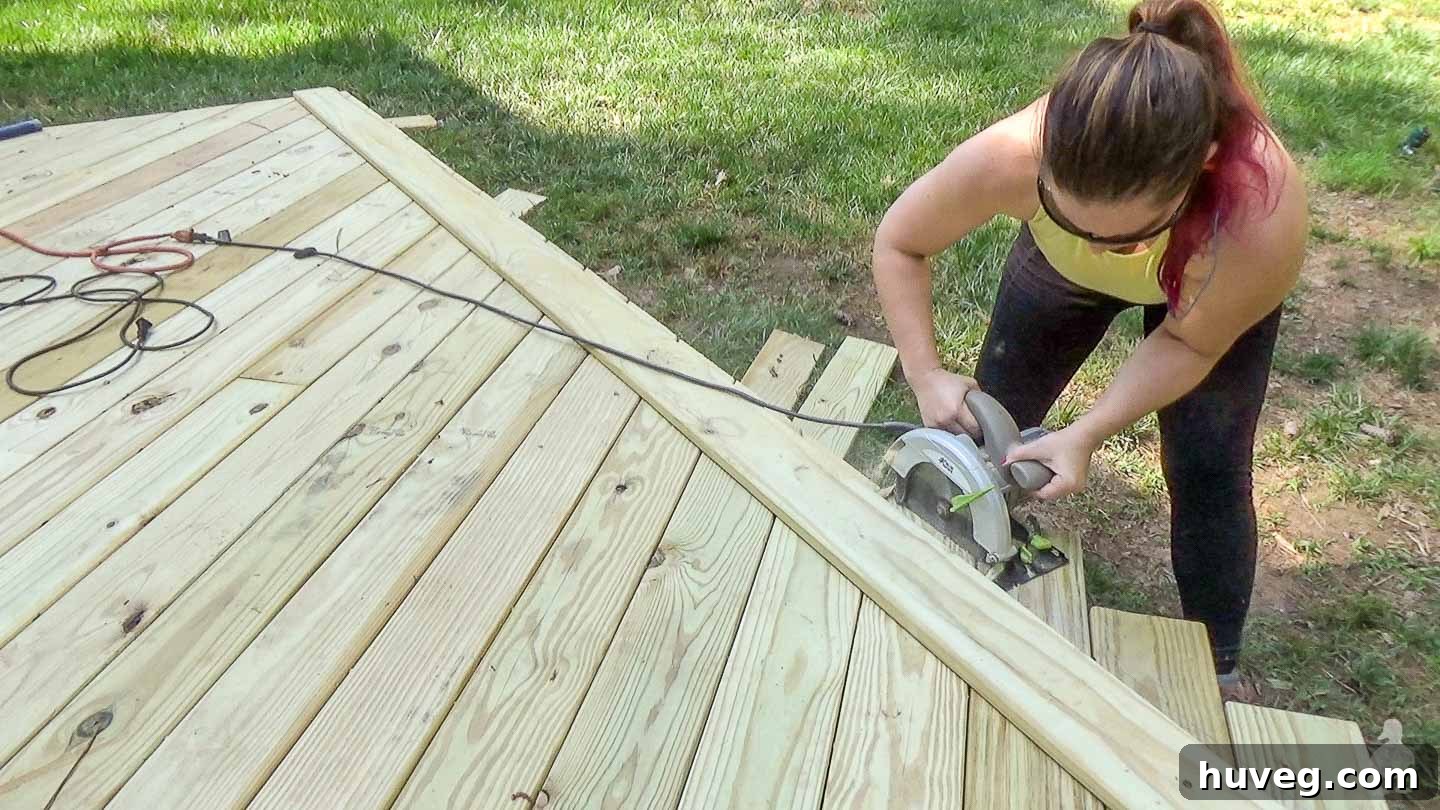
Step 4: Repeat for All Remaining Sides
Once you’ve successfully completed the first cut, it’s a matter of repeating the process for each subsequent side of the deck. Carefully remove your guide board, reposition it for the next section following the same offset and chalk line method, and make your cut. I systematically worked my way around the deck, tackling each side in turn. I intentionally saved the side closest to the house for last. This particular edge presented a unique challenge as there was no option for adding trim; it abuts directly against the decorative edging stones of my hydrangea garden, resulting in a slightly shallower clearance to the base. This required extra care and precision. After a few minor adjustments, including trimming back the corner hydrangea bush to improve visibility and access, all the edges were perfectly aligned and trimmed.
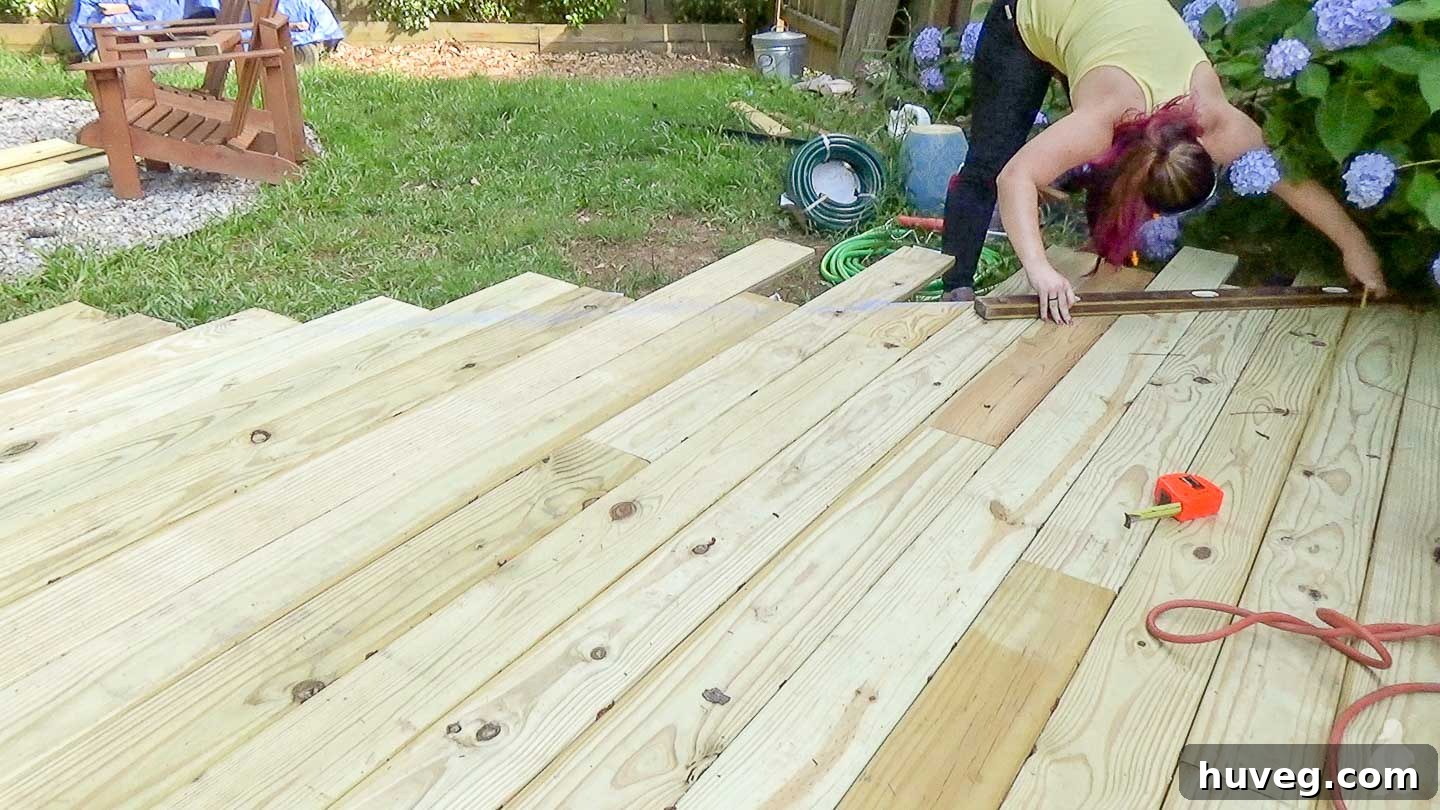
The Final Polish: How to Round Off Deck Board Edges After Trimming
With the deck boards meticulously trimmed to a straight, uniform edge, I quickly noticed a new detail: the freshly cut edges felt quite sharp and looked distinctly different from the factory-rounded sides of the rest of the deck boards. This disparity prompted an additional step to ensure both safety and aesthetic consistency.
The Importance of Rounding the Edges: Aesthetics and Safety
To be entirely transparent, rounding the edges wasn’t an original part of my grand plan. I initially questioned whether attempting to “fix” something that perhaps only I would notice was even worth the effort. (Am I the only one who battles these internal perfectionist thoughts during a DIY project?) However, practical considerations soon shifted my perspective. A sharp, unforgiving edge poses a minor safety risk, particularly for bare feet, small children, or playful pets. Rounding the edges would not only ensure the deck felt more comfortable and safe for everyday use by my dogs and family but also help prevent splintering over time. It would also seamlessly blend the newly cut ends with the existing rounded edges of the factory-finished deck boards, creating a more cohesive and professional overall appearance. With these practical benefits in mind, I headed to the garage to explore quick and easy solutions for this final, crucial detail.
Choosing the Right Tool: Router vs. Angle Grinder for Edge Shaping
My first thought, and undoubtedly the recommendation of many woodworking aficionados, was to reach for my palm router. A router, equipped with a rounding-over bit, is specifically designed for creating perfectly uniform, rounded edges. It offers unparalleled precision and a consistently smooth finish, making it the go-to tool for this task in many professional settings.
However, as I rummaged through my garage, I stumbled upon my angle grinder. Coincidentally, it still had a high-grit flap disk attached from a previous wood carving project. Given the summer heat and my inherent desire for efficiency (or perhaps, a touch of laziness!), the angle grinder presented itself as an immediate, less setup-intensive alternative. Recognizing that “done” is often better than “perfect” for many DIY tasks, and confident in my existing experience with the tool, I decided to go with the angle grinder. I plugged it in and carefully, yet decisively, began shaping the cut edge around the entire perimeter of the deck.
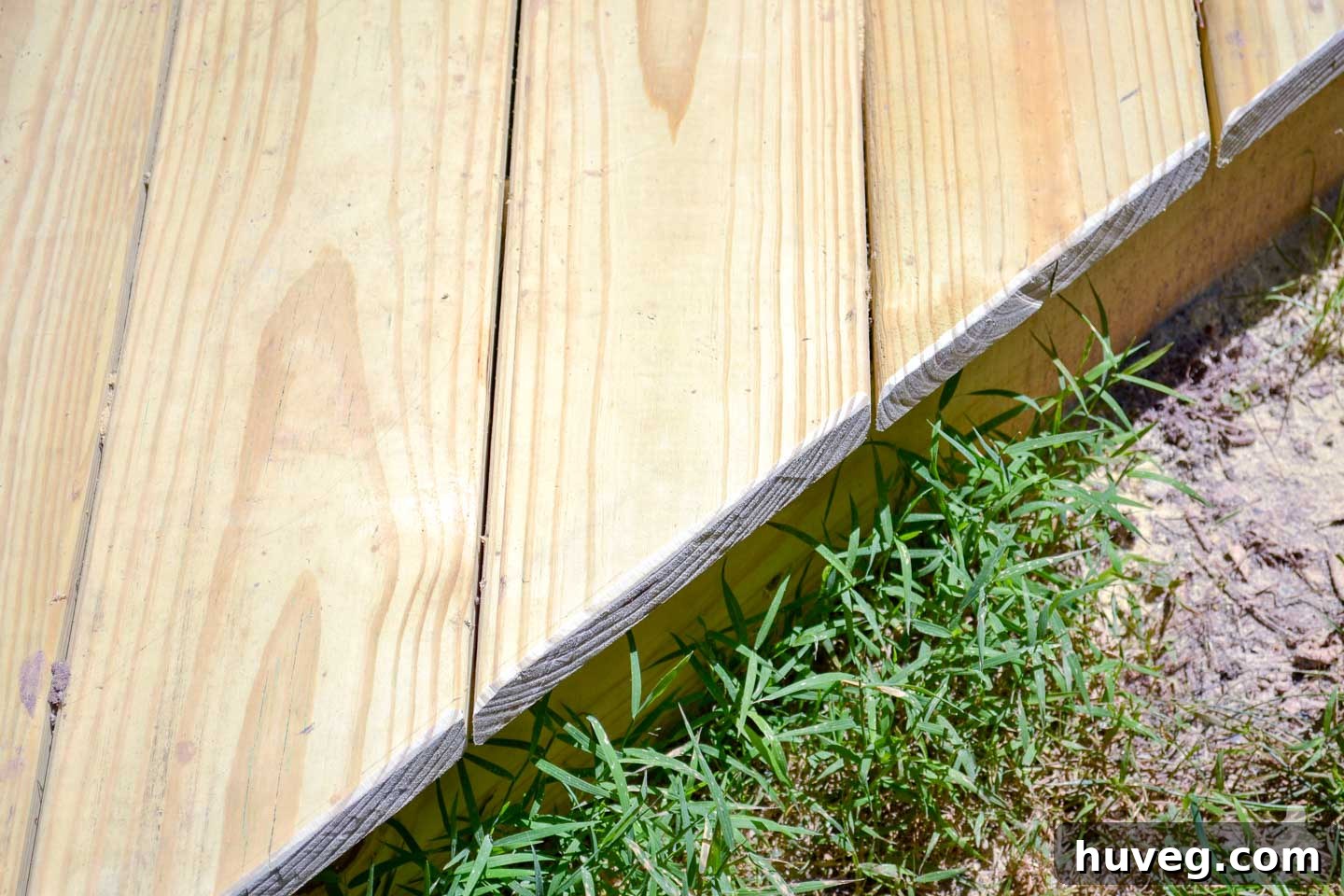
Embracing Imperfection for a Satisfying Result
Now, to be completely honest, did the angle grinder produce an edge as flawlessly uniform and perfectly rounded as my router would have? Absolutely not. If you are a staunch perfectionist, or if you don’t have considerable recent practice and a steady hand with an angle grinder, a router remains the superior choice for achieving pristine, consistent radii. However, for my purposes, the angle grinder, used with care and a light touch, delivered an edge that was sufficiently rounded to eliminate sharpness, prevent splinters, and significantly improve the deck’s overall feel and safety. It achieved the desired functional outcome far more quickly than it would have taken me to locate, set up, and precisely operate the router. In the realm of DIY, where balancing speed, effort, and acceptable quality is key, this was undoubtedly a win-win scenario for me. The result was imperfect, but it was exactly what I needed, and I was genuinely happy with the enhanced finish.
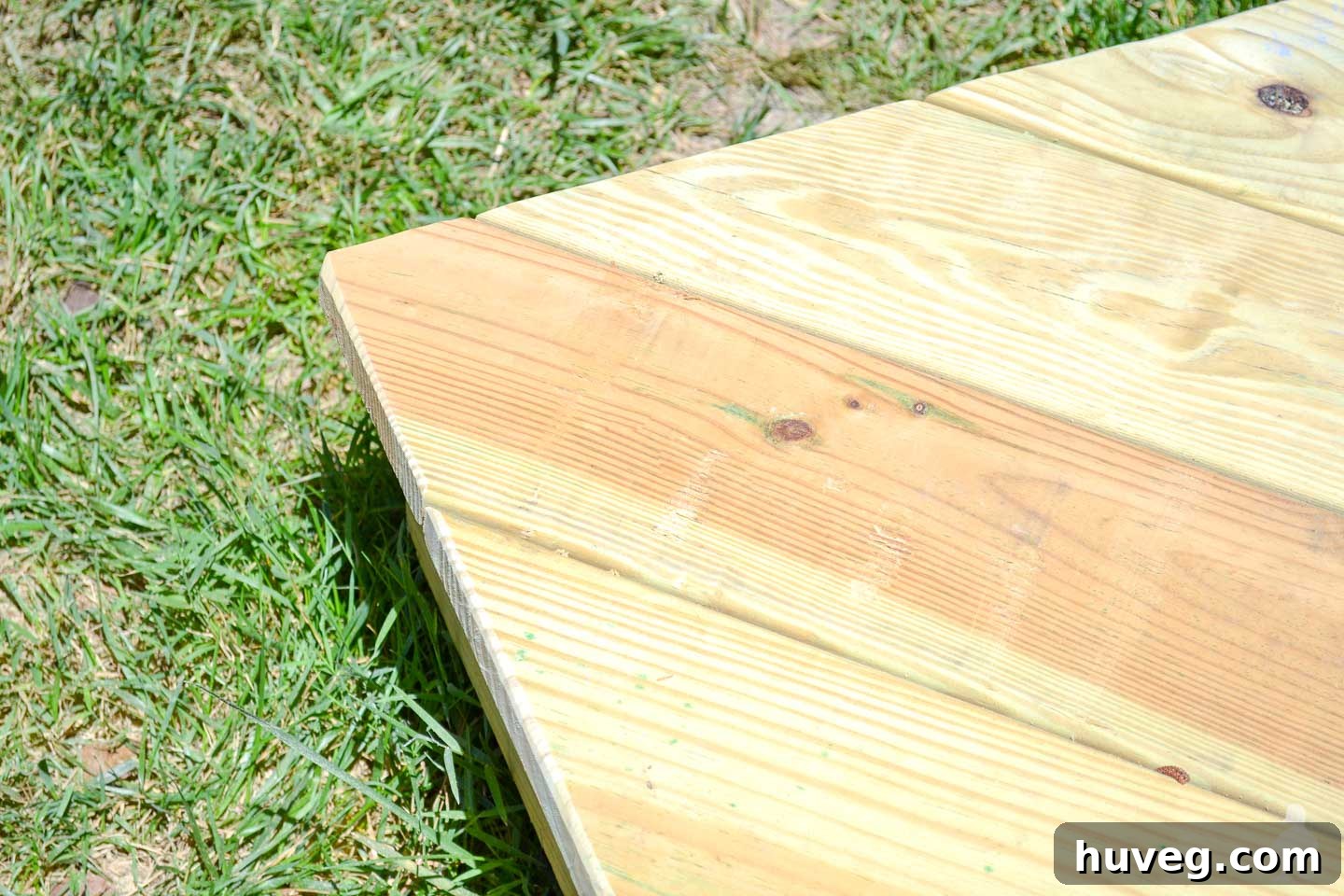
This pragmatic approach to edge finishing proved so effective that I continued to employ the angle grinder for other outdoor woodworking projects requiring a similar finished edge. This included the platform for my pub shed and the pub shed bar itself, both of which I look forward to sharing more details about in future posts. It’s a testament to adapting tools to suit the task and prioritizing efficient, satisfactory results.
What’s Next: Stairs, Staining, and Styling the Deck
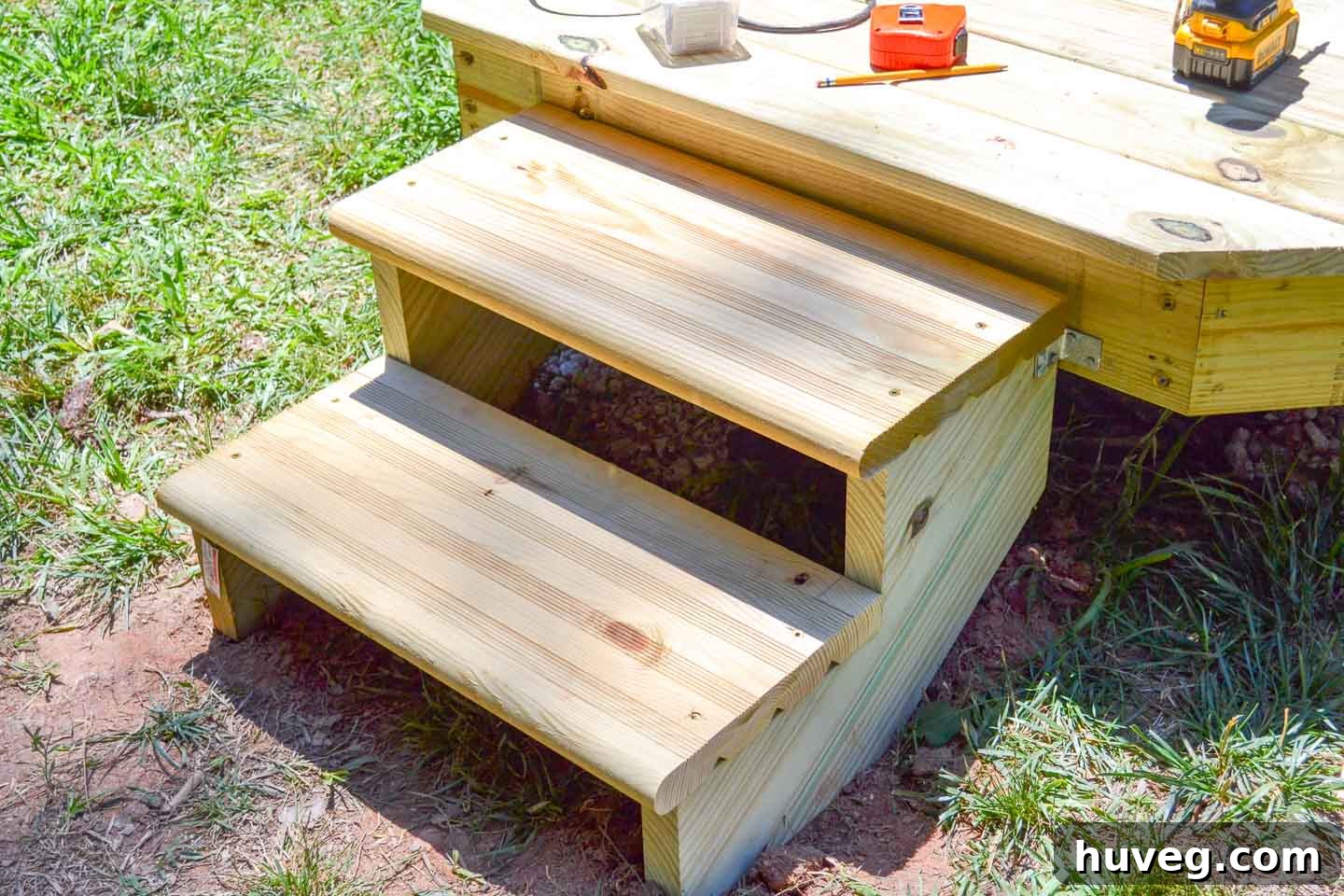
And with that, in a nutshell, the structural and finishing stages of the deck were complete! My new deck was fully installed, meticulously trimmed, and its edges safely rounded – truly ready for action. While the major construction was done, a few final functional elements remained: adding a small, convenient step on the narrow lip leading to the fire pit (which is now done!), and applying a protective, beautiful stain (also happily completed!). To be honest, I’m not entirely certain I installed those steps with 100% textbook accuracy; I confess to a bit of “winging it” in that particular endeavor (I can share more about that process later if there’s interest!). However, given that this is a low-to-the-ground floating deck, the steps are minimal and unlikely to bear significant weight or heavy traffic, so it’s not a major concern.
The exciting next phase is decorating and landscaping, which is precisely what I’m immersed in as we speak! In fact, be sure to check out my Instagram stories today to see the current “dilemma” I’m facing: tracking down all the necessary cushions for the yet-to-be-built sectional sofa. I’m currently missing three crucial cushions, and none of the local stores seem to have them in stock. It looks like it’s problem-solving time, unless I can miraculously find those last three pieces!
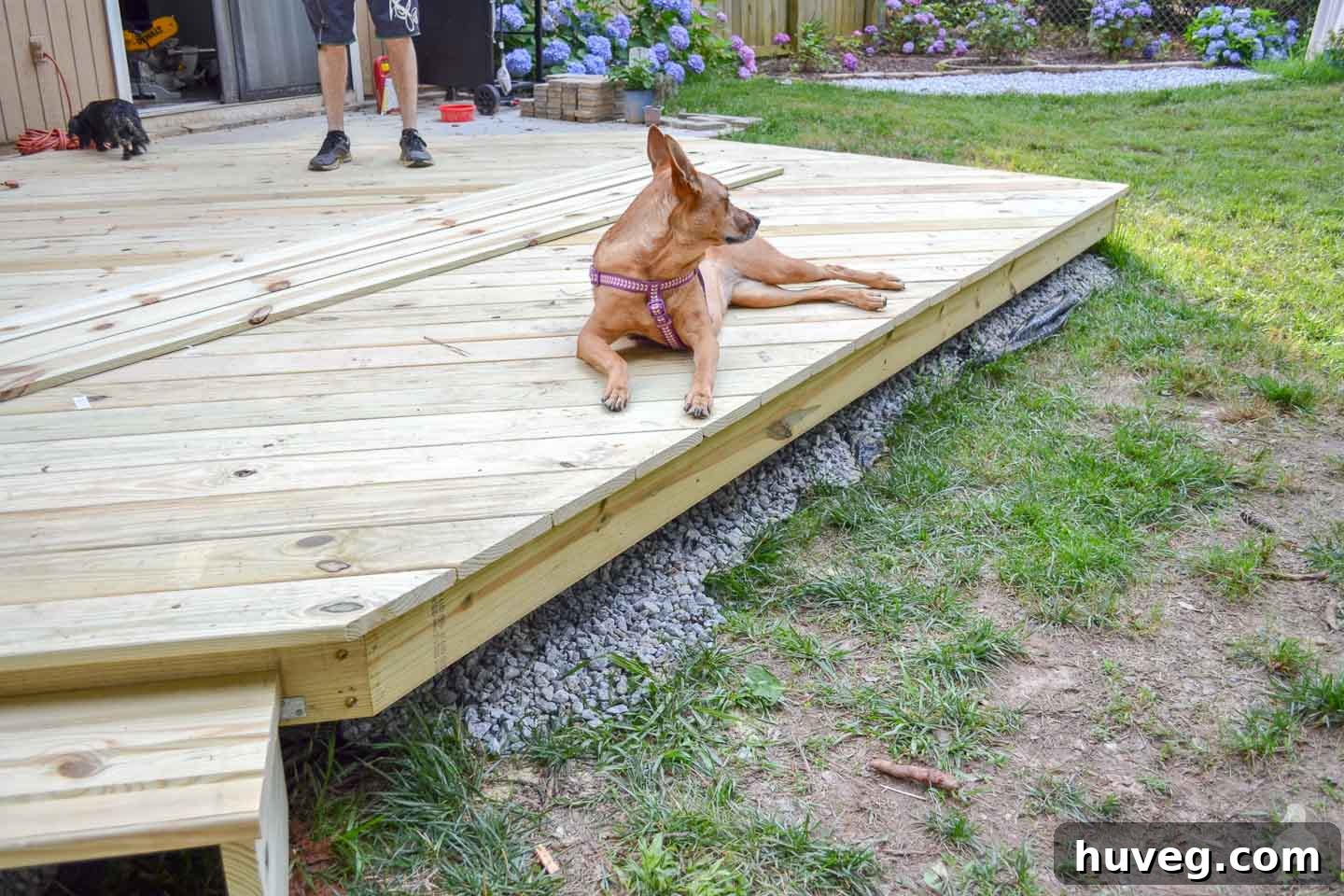
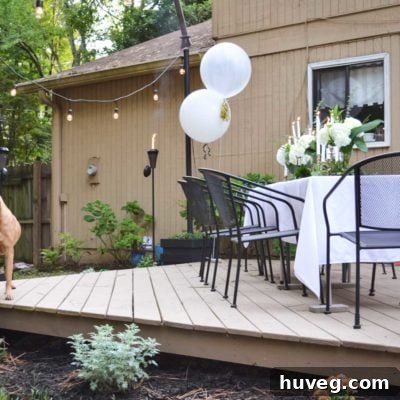
And what about my beloved canine companions? They absolutely adore the new deck and can be found enjoying it every single day. Charlie, in particular, seems to have adopted it as his personal posing platform! Stay tuned and follow along with the rest of this comprehensive DIY series below for all the upcoming revelations and tutorials!
DIY Floating Deck Series