Unbothered


The journey of transforming a house into a home is often paved with paint cans, swatch cards, and more than a few moments of existential dread. It’s a tale I know all too well, especially when it comes to the complex world of color choices. For me, a deep affection for cool tones, particularly gray, has been a guiding principle in my design decisions. My primary bedroom, for instance, is a sanctuary painted in what I affectionately call “driftwood,” though Valspar aptly names it Montpelier Ashlar Gray. This sophisticated shade creates a serene backdrop, fostering a tranquil atmosphere perfect for relaxation. The beauty of gray extends throughout my home, gracing spaces like the guest bedroom with Benjamin Moore’s Sea Pearl (matched to my trusted Behr, a nearly-white shade that acts as a perfect blank canvas for vibrant accents), and the powder room, where Martha Stewart’s Gull (also matched to Behr) provides a pearly, yet subtly greenish, base, eagerly awaiting the infusion of art and color. These selections highlight the versatility of gray, demonstrating its capacity to create both calming retreats and lively backdrops for artistic expression.
The Great Living Room Paint Odyssey: Learning from Color Calamities
My passion for gray, however, wasn’t an immediate revelation. It blossomed only after navigating a series of rather unfortunate paint choices for my living room walls. Twice, in fact, I embarked on a repaint journey before truly discovering my aesthetic north star. My initial foray into living room color involved a warm beige, a shade I genuinely believed was beautiful on the swatch. Yet, once applied to the walls, it took on an unappealing sallow hue. This house, already burdened by an “old lady” charm – both in scent and general disposition – desperately needed a facelift, not a color that made it appear even more unwell. The experience was a stark reminder that what looks good on a small sample can transform dramatically under a room’s specific lighting conditions and existing elements.
Undeterred by my first misstep, I returned to the paint store, determined to correct my course. This time, I veered in the complete opposite direction from buttery tan, opting for a cool sand color: Valspar’s Sandy Shell. For a time, I loved it. It felt modern, crisp, and a vast improvement over its predecessor. But as the seasons turned and I settled into my home, a new problem emerged. What once felt fresh gradually began to morph my living room into a veritable cave. The irony wasn’t lost on me; I had spent countless hours obsessing over finding the perfect shade of tan, only to witness it steal the light and vibrancy from my most-used communal space. A photograph from last Christmas, taken during the brightest part of the day, painfully illustrates the persistent gloom. It became clear: this shade, despite its initial appeal, was dragging the room into perpetual twilight. It was a significant design lesson in how a color’s perceived warmth or coolness can profoundly impact the overall brightness and mood of a space.
Embracing Light: The Quest for Brighter Neutrals
The subtle transformation of my guest bedroom and powder room into bright, almost-white havens proved to be an unexpected catalyst. As I admired their newfound luminosity, a crucial realization slowly dawned: my entire home, particularly its more frequented areas, desperately needed a shot of brightness. A significant factor contributing to the house’s inherent darkness is the surprising lack of overhead lighting in many rooms – a challenge we’ve previously tackled with kitchen lighting upgrades, but one that persists elsewhere. It was like playing a real-life version of the Sesame Street game, “One of these things is not like the others…” The tan living room walls, in stark contrast to the emerging lightness of other spaces, stood out as the primary culprit, pulling our main living area back into what felt like the dark ages of interior design.
This revelation ignited a new mission: to find a brighter, more uplifting neutral that would harmonize with the cooler tones I instinctively gravitate towards in the rest of my home. The goal is to create a seamless flow, where each room feels connected yet distinct, all while maximizing natural light. By choosing a brighter base for the living room, I envision a space where future decor choices, such as a much-anticipated rug, can truly pop and become exciting focal points rather than merely blending into a monotonous backdrop. This strategic shift is about more than just aesthetics; it’s about enhancing the psychological comfort and energy of the home. A well-chosen light neutral can reflect more ambient light, making a room feel larger, airier, and significantly more inviting. It’s about leveraging color to counteract architectural limitations and cultivate an atmosphere of openness and warmth.
The Grand Scale of a Home-Wide Paint Project
Every home improvement project comes with its unique set of challenges, and this ambitious paint endeavor is no exception. While paint itself is generally considered an affordable way to dramatically transform a space, the costs can quickly escalate when the project’s scope expands. My current dilemma is a prime example: I anticipate needing at least four gallons of paint. Why such a significant quantity? Because the walls of my living room aren’t isolated entities. They seamlessly extend into the downstairs entryway, creating a continuous visual flow that demands a unified paint scheme.
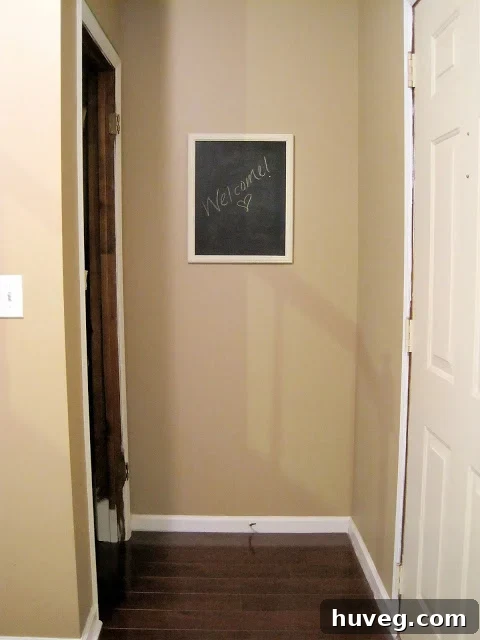
From the entryway, these walls then gracefully transition down the hall, leading directly into the kitchen area. This open-concept design, while beautiful for fostering connection, presents a logistical challenge for color transitions. Any change in paint color must be carefully considered to ensure a harmonious flow and prevent jarring visual breaks between spaces that are, in essence, one continuous canvas.

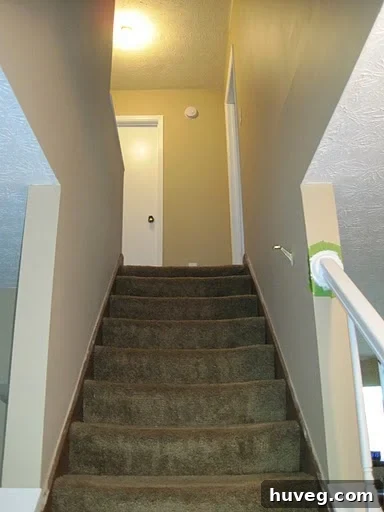
Adding another layer of complexity to this expansive project are the walls that ascend the stairs. This entire stairwell, a significant vertical expanse, is also part of the interconnected living space. (The photo below, taken before we bravely ripped out the old carpet, gives a good sense of the scale.) Painting such a large, continuous area requires not only a substantial amount of paint but also careful planning, patience, and often, specialized tools for reaching higher sections. It’s a testament to how even a seemingly straightforward task like painting can become a comprehensive home-wide transformation when dealing with modern architectural layouts.
Introducing Subtle Variance: A Stairway with its Own Identity
Here’s where my creative vision takes a slightly unconventional turn. While the overarching goal is a brighter, cohesive neutral palette, I’m contemplating a subtle yet distinct approach for the stairway. My inclination is to paint the stairway a different color from the main living room walls, but in a tone-on-tone fashion. This means selecting a shade that is closely related to the living room’s new neutral but possesses its own unique character – perhaps a slightly deeper hue from the same color family, or one with a nuanced undertone. The motivation behind this isn’t rooted in a profound design theory; it’s simply “just ’cause.” Sometimes, the most compelling design decisions emerge from an intuitive desire to create visual interest and delineate spaces, even within an open floor plan.
The challenge, of course, lies in executing this transition with grace. The objective is to make the change so subtle and harmonious that it enhances the aesthetic without prompting the bewildered question, “Why did she do that?” when the project is complete. Achieving this requires meticulous swatch testing, observing how the proposed colors interact under different lighting conditions, and ensuring that the undertones align perfectly. A successful tone-on-tone approach can add depth, sophistication, and a bespoke feel to a home, creating an engaging visual journey as one moves between levels without breaking the overall sense of unity. It’s about crafting a layered look that feels thoughtfully designed, even if the initial spark was simply a whim.
Navigating the Paint Journey: From Persuasion to Practicality
Broaching the subject of another extensive painting project with my partner, Scott, was predictably met with a look that clearly communicated, “You’ve gone crazy.” His reaction is entirely understandable, especially given my history of “paint-induced freakouts” over living room walls. I recall vivid moments of frustration, tears, and feeling utterly overwhelmed by color choices when we first moved in. Indeed, the very first major meltdown I experienced as a homeowner revolved solely around the living room wall color – a dramatic and perhaps irrational response, but a genuine one nonetheless. This time, I’ve decided against bringing a barrage of paint swatches into the house prematurely, allowing the idea to gently simmer before overwhelming him with options. However, let there be no doubt: this transformation is happening.
The timing, however, is crucial. This grand painting endeavor is slated for summer. The warm months offer the perfect conditions to leave doors and windows wide open, ensuring ample ventilation throughout the house. This is not a trivial consideration; we’re talking about painting a substantial amount of wall space, which translates to a significant volume of paint fumes. Even though I conscientiously choose low-VOC (Volatile Organic Compound) Behr paints, which are designed to emit fewer harmful chemicals and odors, proper ventilation remains paramount for comfort and safety. Planning for summer allows for a more pleasant and healthier painting experience, minimizing the disruption to our daily lives while ensuring the space airs out thoroughly. As I envision the final outcome, I lean towards a bright, cool palette. This will create a stunning contrast with our warm, dark floors and beige/cream furniture, making them truly pop and contributing to an overall atmosphere that is both super relaxing and undeniably fun.
Join the Conversation: Your Paint Stories and Insights
So, what are your thoughts on my latest paint endeavor? Am I truly plunging off the deep end by contemplating paint colors number three and four for the same living room? Surely, I’m not alone in this rollercoaster of color decisions! Has anyone else experienced similar struggles with finding the “just right” shade, only to realize months or years later that it was all wrong? Or, perhaps, you are one of those enviable “perfect paint people” who nail it every single time? I’d love to hear your stories, your triumphs, and especially your tribulations. There must be someone out there (ahem, Michelle, are you reading this?) who understands the intricate dance between desire and execution in the world of home paint! Share your wisdom and commiserations in the comments below.