Your Guide to Flawless Porcelain Tile Replacement

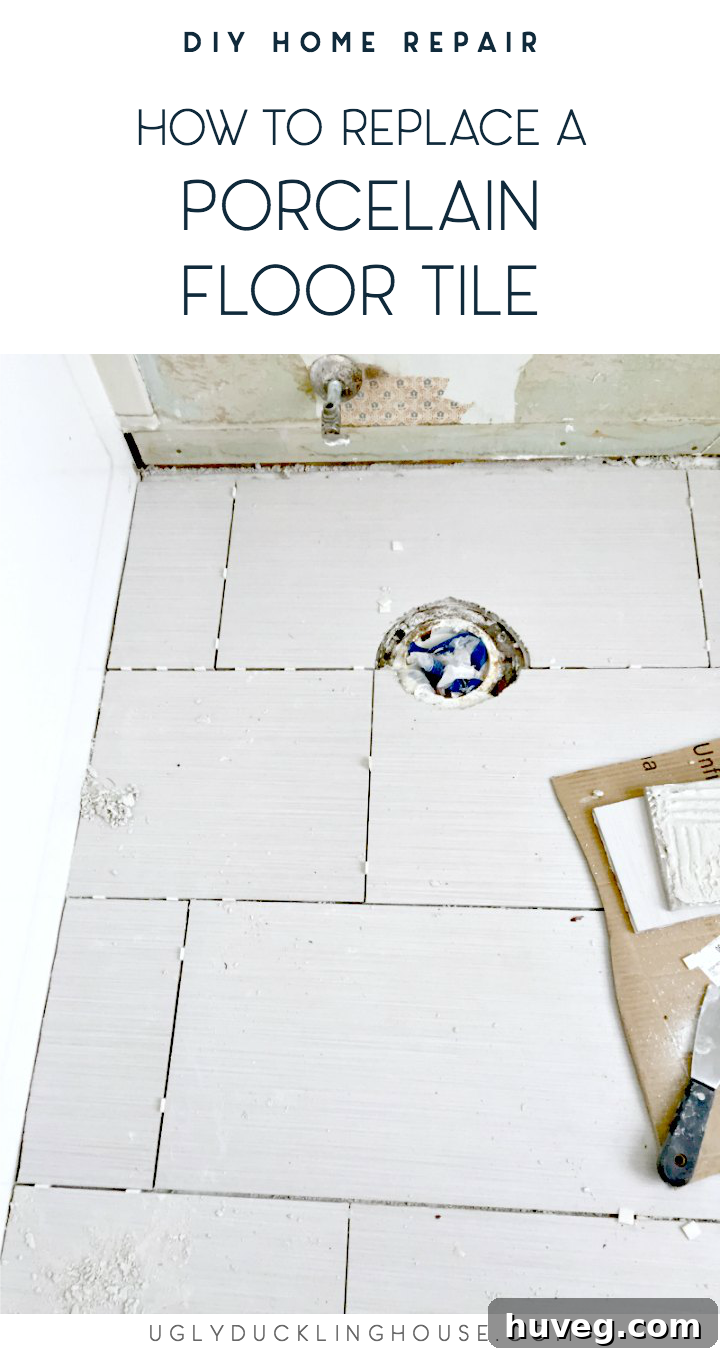
Master Bathroom Tile Repair: A Comprehensive Guide to Replacing Porcelain Floor Tile
The journey of home renovation is often a mixed bag of satisfaction and unexpected challenges. While the recent push to transform my primary bathroom has brought a fresh shower tile installation, precise grouting, and a shiny new shower head, it also meant being deeply immersed in DIY during what should have been a relaxing Independence Day weekend. Instead of fireworks and festivities, my hair became acquainted with water splashes from the wet saw (a missing splash guard, the ultimate hair texturizer!) and my fingernails discovered thinset, serving as an unconventional nail whitener. This wasn’t quite the “vacation” I envisioned.
Coming soon are the detailed posts covering the shower waterproofing process, the installation of new tiles, and a host of clever gadgets that proved invaluable. But before we dive into those fresh updates, it’s high time we revisit a persistent problem on the floor – a porcelain tile issue that has been patiently awaiting its permanent fix.
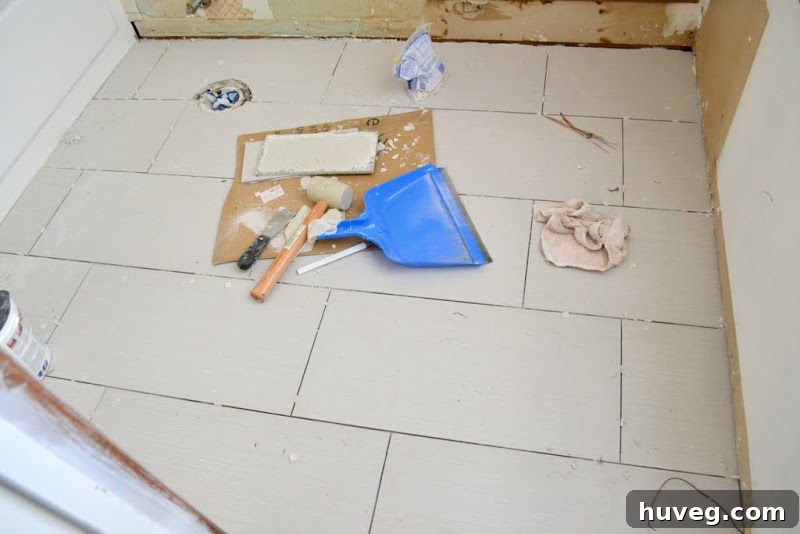
The Long Road to a Level Floor: My Bathroom Renovation Saga
For those who followed the original primary bathroom tile floor installation story, the eventual need for this repair likely comes as no surprise. If you missed it, you can catch up here. In essence, my experience can be summarized with a crucial DIY lesson:
If you identify as an accomplishment-seeking, DIY perfectionist, never delegate a task that you know you’ll ultimately be more satisfied doing yourself, even if it means extending your project timeline. The meticulous attention to detail a homeowner dedicates to their own space is unmatched. Furthermore, involving a family friend in such projects can introduce complex dynamics, making it challenging to address substandard work.
The decision to accept help with the initial tile installation led to almost instant regret. I returned home to discover tiles that were far from level, grout lines that meandered unevenly, and a generous, messy application of tile adhesive everywhere. As someone whose instincts lean heavily towards “wait until I can do it MYSELF,” this error left me kicking myself. My frustration wasn’t primarily directed at the installer, a family friend who was simply trying to lend a hand and lighten my daunting to-do list. Had it been a professional, my approach to confronting the situation would have been vastly different. Instead, my anger stemmed from my own failure to recognize that I should have simply paused the project until I was ready to tackle it.
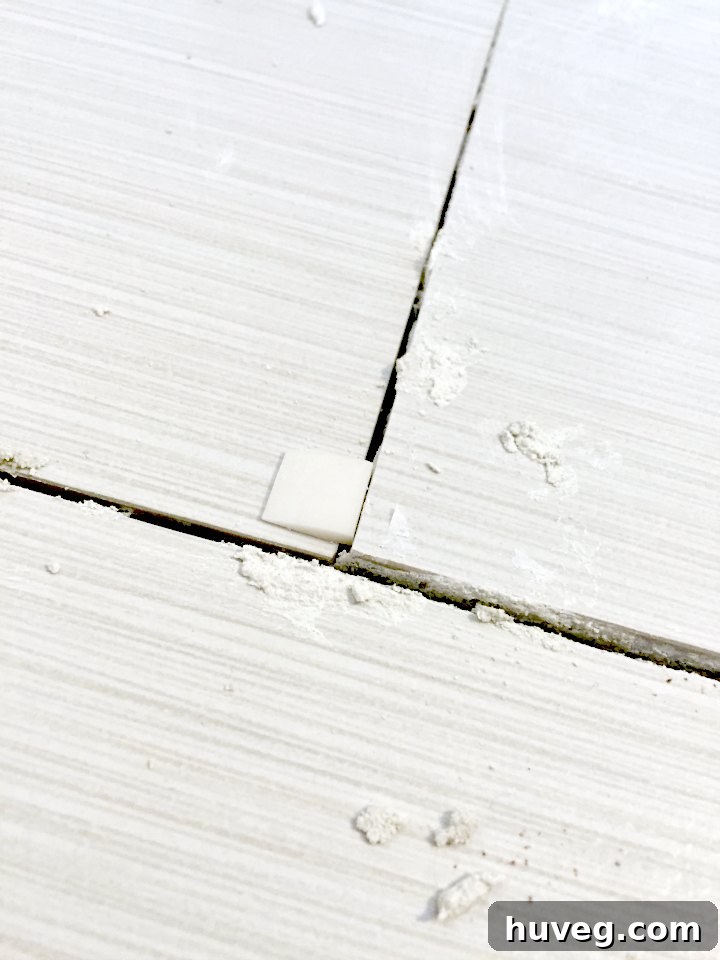
To be absolutely clear, I am not advocating for you to simply accept and then personally correct mistakes made by a hired professional. My situation was unique due to the “family friend” dynamic. Rather than navigate the intricate politics of expressing anger or dissatisfaction with someone I cared about, I chose to cut my losses and personally rectify the situation. That nagging “what if” thought, familiar to anyone who’s scrutinized another’s work in their own home, always loomed.
In some ways, I was fortunate: upon my return home, the adhesive in the most egregious areas hadn’t fully cured. This allowed me to carefully pry up a few tiles and adjust them in time. Despite admittedly being frustrated to the point of tears, the damage wasn’t as severe as it could have been if I had arrived even an hour or two later.
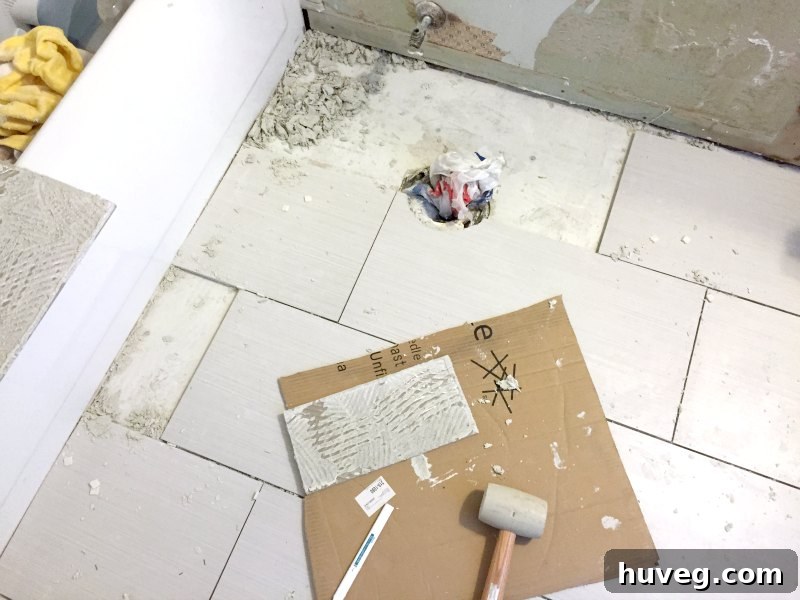
However, some tiles had unfortunately dried enough that attempting to pry them up risked damaging the surrounding, acceptable tiles. Since I hadn’t purchased enough tile to redo the entire floor twice, I decided to let the adhesive fully cure. My plan was to then thoroughly inspect everything once I had enough time to distance myself from the project and regroup. For me, significant setbacks in a DIY project can sometimes trigger reactions typically reserved for toddlers or overly enthusiastic party guests – a clear sign it’s best to step away for a while.
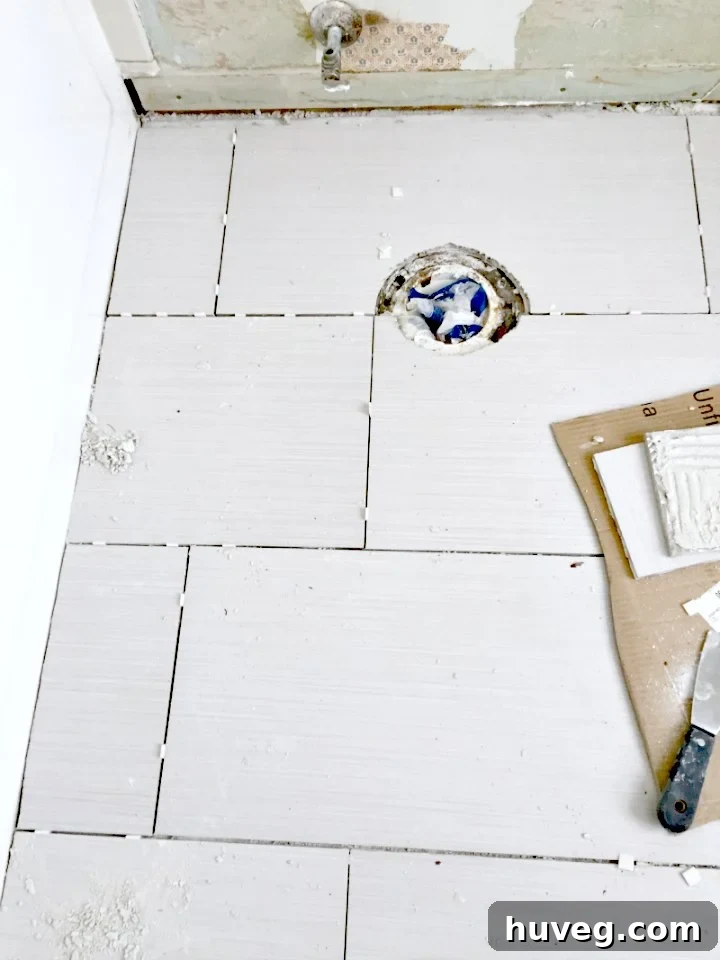
That much-needed “break” stretched from weeks to months, until finally, now. My “bad luck bathroom” and its series of peculiar setbacks since its initial demolition had left me feeling so bitter and frustrated that ignoring the problem and relying on the guest bathroom became the easier path. Ironically, the guest bath is actually closer to my primary bedroom due to the primary bath’s long hallway leading to the closet and then the bathroom itself.
What finally brought my focus back to this lingering issue?
- Firstly, bringing other rooms in the house, like the laundry room, back to full functionality. Seeing how much more pleasant and less chaotic things are when they’re in proper working order was a strong motivator.
- Secondly, recent collaborations with sponsors provided both a budget and, crucially, deadlines. While sponsored posts can sometimes be viewed critically (and a bad match is truly noticeable), the combination of financial support and a firm deadline can be a powerful antidote to chronic procrastination! These sponsors will be revealed in their respective blog posts and projects, but their involvement undoubtedly propelled me back into the bathroom, constantly reminding me of the proximity of this unfinished fix.
And so, one evening, after completing the shower tile work, I found myself sitting on the floor, hammer in hand, ready to tackle the last remaining problematic tile. Its initial cut around the toilet flange was incorrect, with one edge resting on the flange instead of fitting neatly around it. This resulted in the entire tile lifting significantly on one side, and it cured in that uneven position. This meant that once the toilet was installed, it would almost certainly rock precariously on this uneven joint.
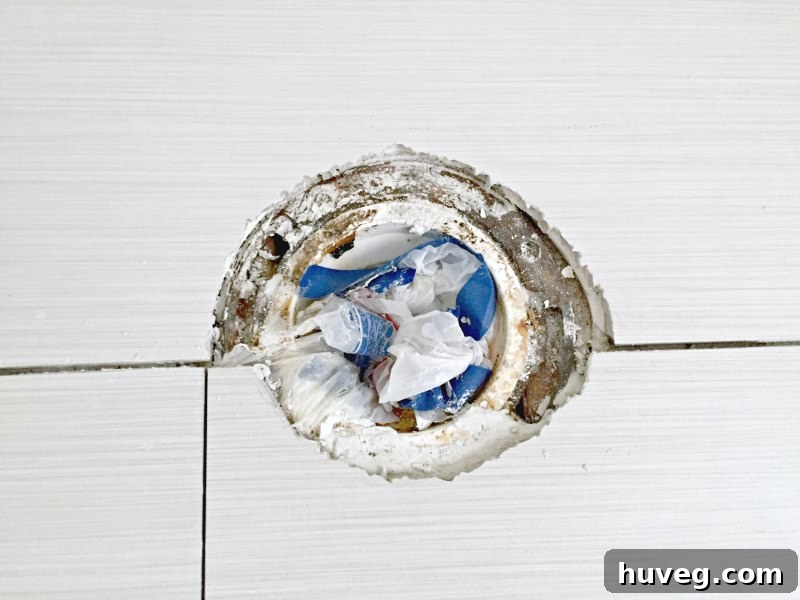
While many things that rock are quite enjoyable – think rocking horses, rocking chairs, or rock concerts – a rocking toilet is definitely not one of them. I’ve experienced this annoyance at my sister’s house, and every time I use that bathroom, I forget and am startled anew by the instability. That’s an experience I absolutely do not want in my primary bathroom.
*This post contains affiliate links, which means I may earn a small commission if you make a purchase through them, at no extra cost to you.*
DIY Guide: How to Replace a Porcelain Floor Tile Like a Pro
Porcelain tiles, particularly rectified ones like those I used, present a different challenge compared to standard ceramic tiles. My usual arsenal, effective for drilling into ceramic tiles in my laundry room, proved inadequate against these exceptionally dense and durable porcelain tiles (a quality I originally sought them out for!). Attempts to use power tools for grinding were deafeningly shrill, even with ear protection, and trying to pry them risked damaging adjacent, sound tiles. The most effective approach, therefore, was to break them apart manually.
Step 1: Preparation and Safety First – Remove Grout (If Needed) and Grab a Hammer
Before beginning any tile removal, it’s essential to assess the situation. In my case, the grout hadn’t been applied yet, simplifying the initial stage. However, if you are replacing a broken tile within an existing, fully grouted floor, your first crucial step will be to thoroughly remove the surrounding grout lines. This can be done with a grout saw or a multi-tool with a grout removal attachment. Clearing the grout ensures that the tile you’re removing is not bonded to its neighbors, preventing damage to the good tiles.
Once the grout is cleared (or if it was never applied), it’s time to equip yourself with the right tools and, most importantly, safety gear. For this method, a claw hammer is ideal. Equally important are earplugs and eye protection. When you start striking the tile, small, sharp fragments will inevitably fly off, and protecting your eyes is paramount. Ear protection will save you from the sharp, jarring noise of cracking porcelain.
With safety gear in place, begin by repeatedly striking a single spot on the tile with the face of your hammer. The goal is to concentrate the force. Don’t jump around; focus multiple blows on one precise area until you see the first crack appear. Once a crack forms, move your hammer a few inches away to an adjacent spot and repeat the process. Continue this method, breaking the tile into smaller, manageable pieces. The key is to systematically work across the tile, creating new fracture points rather than trying to shatter the entire thing in one go. This focused approach is far more effective and less likely to cause collateral damage to surrounding tiles, showcasing the porcelain’s impressive resistance to general wear and tear, even as you intentionally break it.
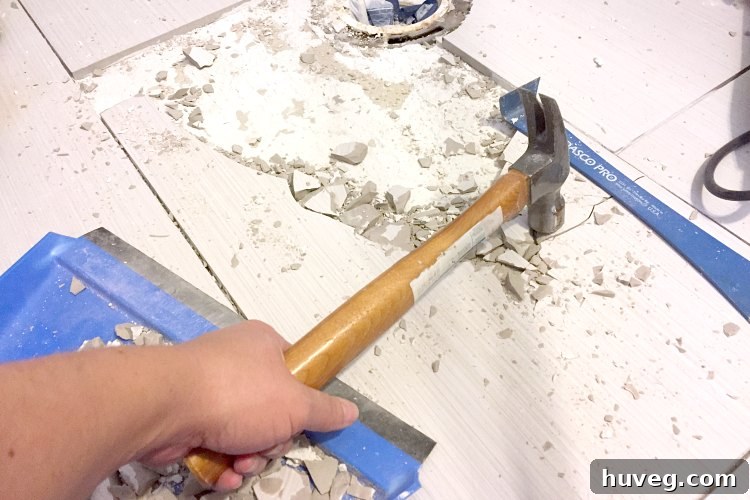
Step 2: Breaking the Old Tile and Clearing Debris
While this method might not be the quickest, it’s straightforward and highly effective for hard porcelain. Ensure you maintain your ear and eye protection throughout this process, as fragments will continue to fly. Once you’ve broken the tile into enough pieces, use a dustpan and brush to scoop them into a trash receptacle. Systematically work through the entire area until the problematic tile is completely removed, leaving an open space ready for the next phase of repair.
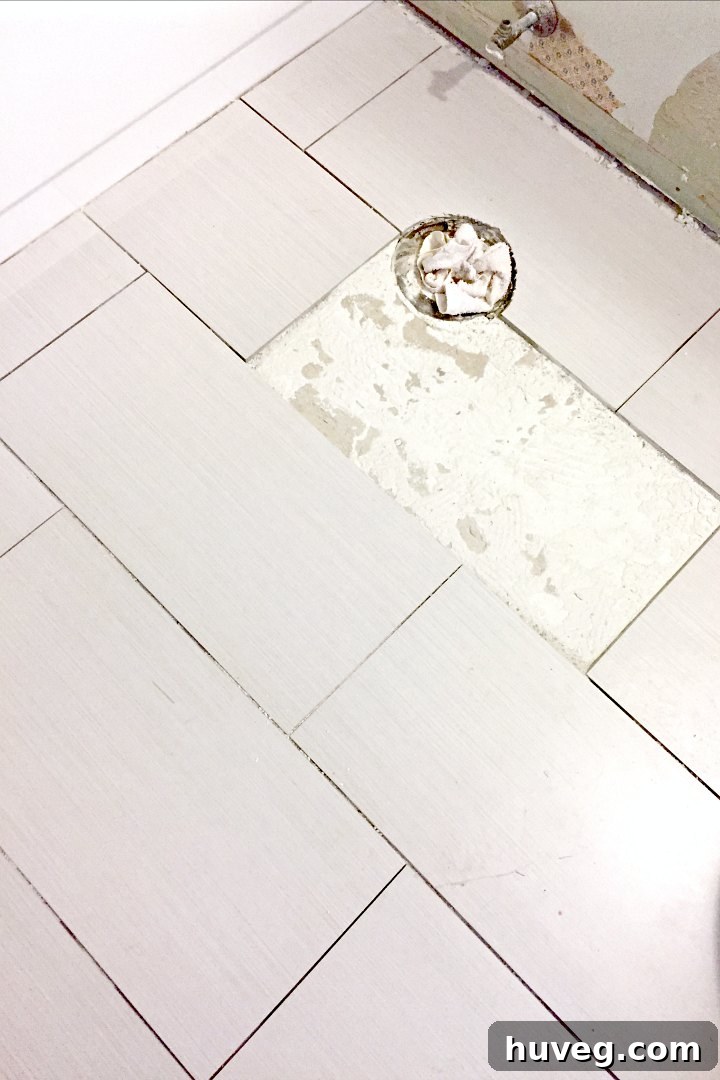
Step 3: Thoroughly Remove Cured Tile Adhesive
This is often the most critical and painstaking step for a successful tile replacement. I initially hoped to skip it. After cutting a new tile, meticulously ensuring it fit around the toilet flange (never on top, not even slightly!), I performed a dry fit. It immediately became clear: the added height from the existing dried adhesive, combined with a new layer of adhesive and the new tile itself, would undeniably result in an uneven surface. This would be a nightmare for grouting and, more importantly, would fail to solve the problem of the rocking toilet. The only viable solution was to completely remove the old, cured adhesive.
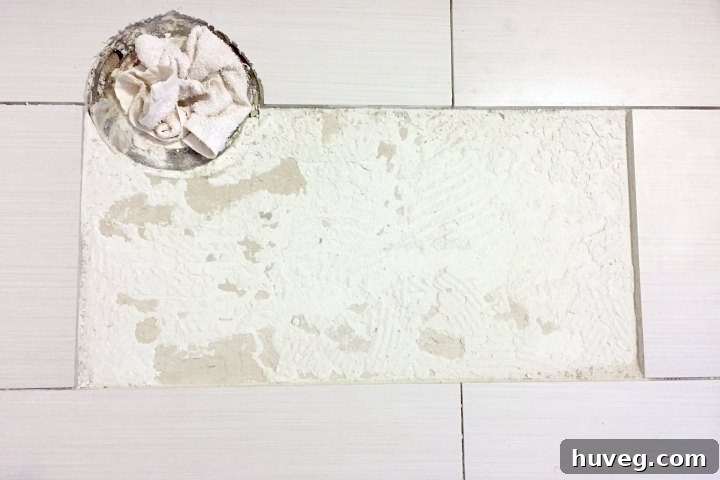
My first attempts involved scraping with a small pry bar set and one of my putty knives. While these tools removed a decent amount, a significant portion of the old adhesive remained stubbornly attached to the subfloor.
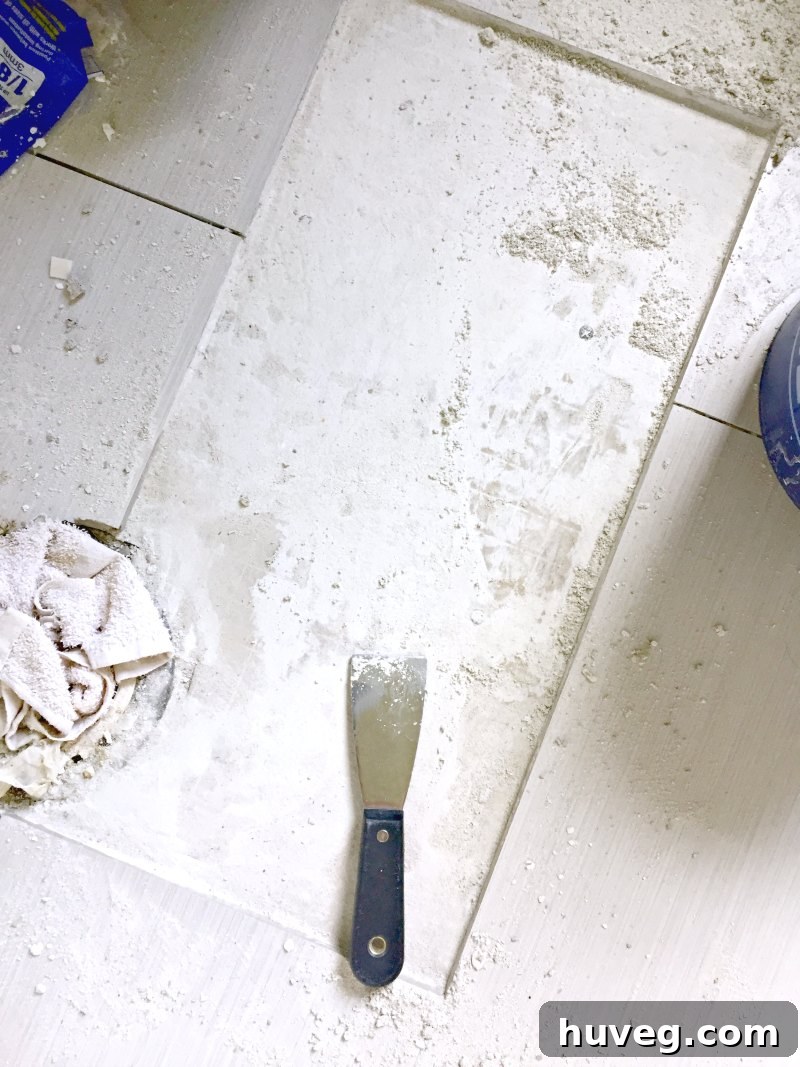
However, serendipity was finally on my side. The adhesive I had used for this porcelain floor, unlike thin-set typically used in wet areas like showers, was vulnerable to water exposure. This type of adhesive is perfectly suitable for dry floor areas and offers a remarkable advantage for removal. My solution was simple yet effective: generously pour water onto the remaining adhesive, allowing it to sit and absorb. Initially, the water might bead up, but given enough time, it will penetrate and soften the adhesive, making it much easier to scrape.
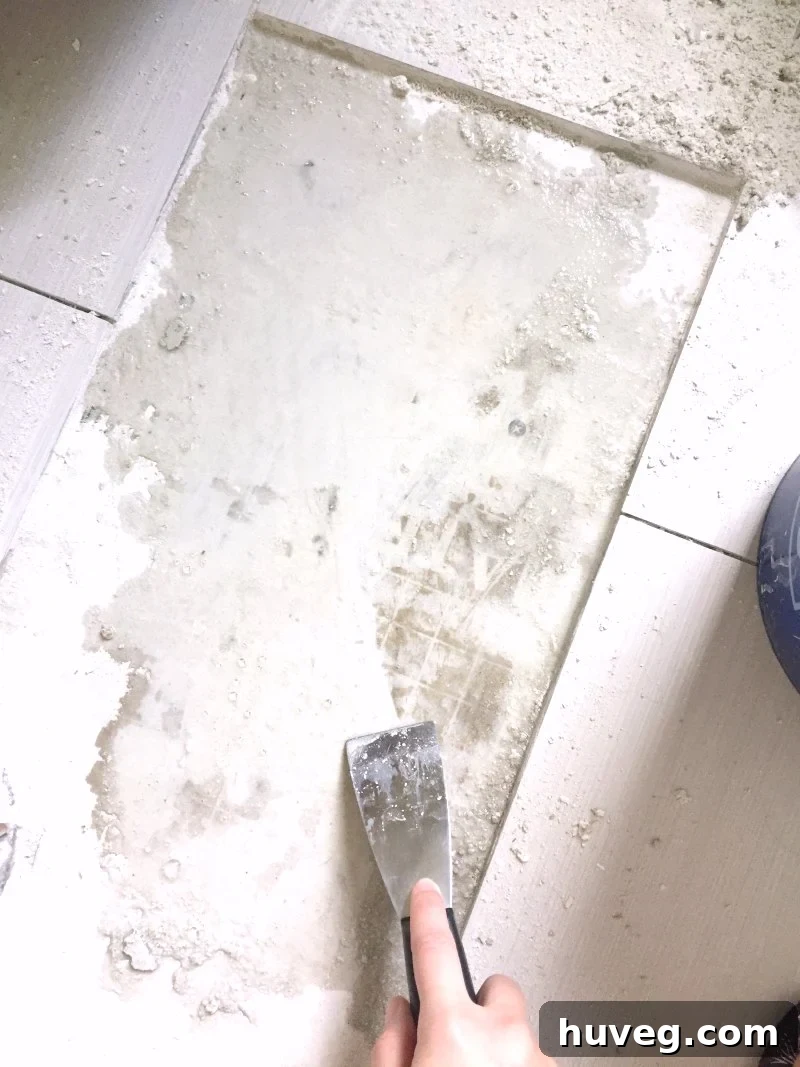
For scraping, I found my heavy-duty 6-in-1 painting tool incredibly useful. Its nice tapered edge provided much better leverage and scraping power than a standard putty knife. With a bit of elbow grease and the softened adhesive, most of the bumps, ridges, and cured adhesive remnants were either completely removed or smoothed out sufficiently to create a perfectly level base for the new tile. Achieving a clean, flat surface is non-negotiable for a professional-looking and lasting tile repair.
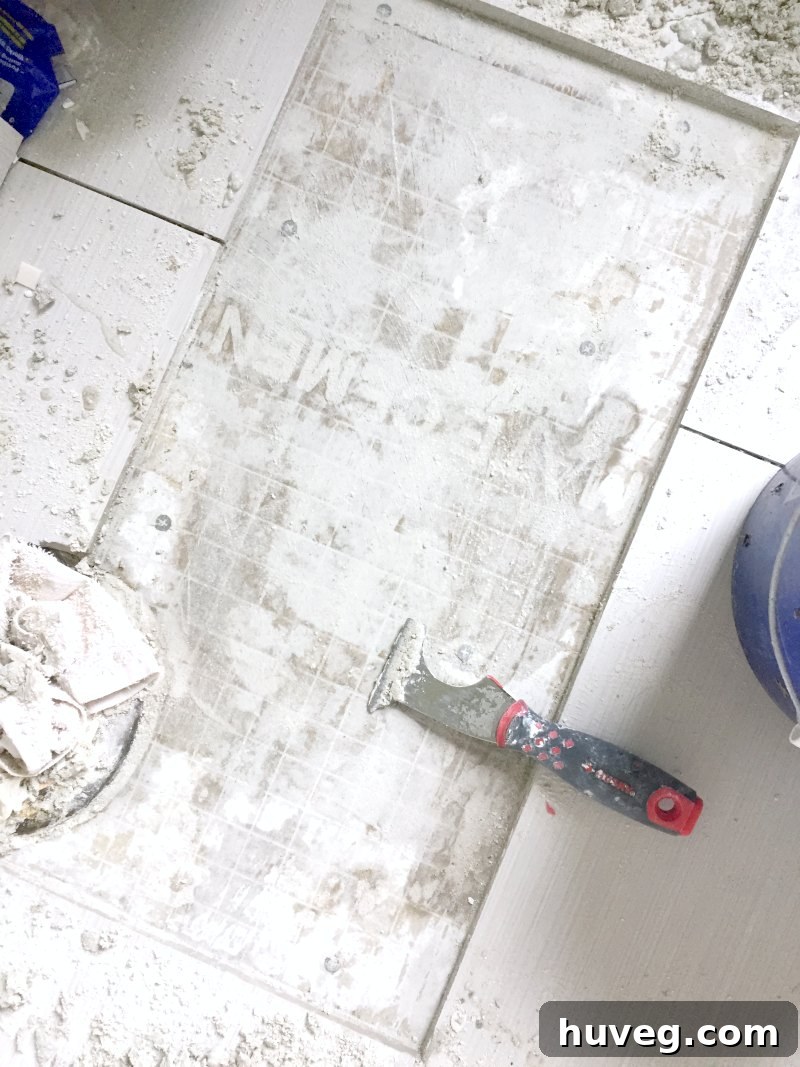
Step 4: Precise Tile Cutting and Installation of the New Tile
With the old tile and adhesive meticulously removed, it’s time for the new tile. If your replacement tile requires intricate cuts, such as around a toilet flange or other existing features, measure carefully and execute the cut using a wet tile saw. Accuracy is paramount here; remember the critical rule: cut the tile to fit around the fixture, not to rest on it. As I was also busy installing and grouting new shower tiles, I simply incorporated this specific floor tile cut into my larger batch of tile work, optimizing my time.
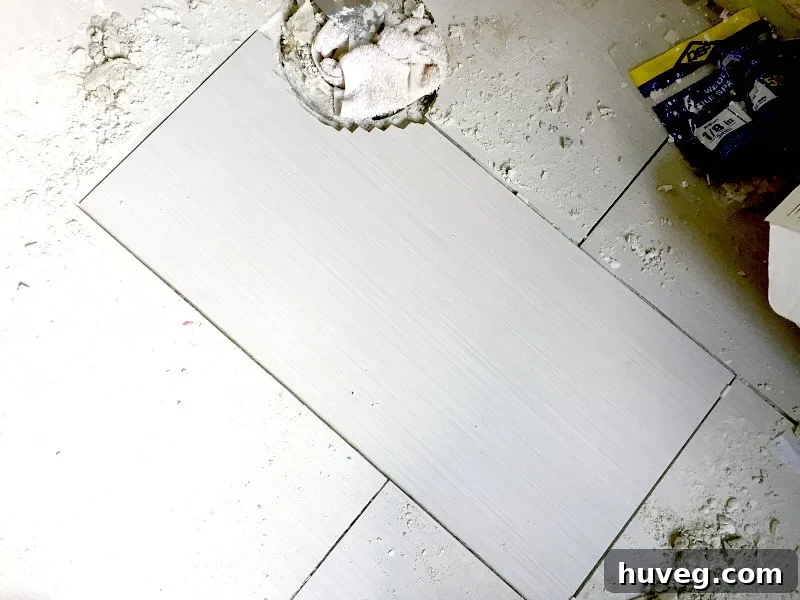
Before setting the tile, prepare it by back buttering. This involves applying a thin, even layer of adhesive to the back of the tile itself, in addition to spreading it on the subfloor. This technique ensures maximum adhesion and helps prevent voids under the tile, which can lead to cracking. Carefully place the back-buttered tile into the prepared space, using spacers that precisely match the width of your existing grout lines. I personally prefer these specific spacers for their reliability in creating consistent gaps. Press the tile firmly into place, ensuring it is level with its neighbors. A small level can be invaluable here to check for evenness across the new tile and its surrounding tiles.
- Related: For more detailed guidance on intricate cuts, explore our guide: How to Fit Tile Around an Existing Feature (Windows, Outlets, etc.).
Step 5: Grouting for a Flawless Finish
Once the adhesive has fully cured (always refer to the adhesive manufacturer’s recommendations for curing times, typically 24-48 hours), the final step is grouting. This stage seamlessly integrates the new tile into the existing floor, providing a uniform, water-resistant, and aesthetically pleasing finish. This is next on my to-do list for this section of the floor, but as you can see, the process of replacing the tile itself is quite straightforward once you break it down.
Reflections and Future Projects
With this particular floor tile issue finally resolved, the updates on the shower are next on the agenda. However, that phase will encompass several parts, as I nearly managed to botch everything right from the outset! Seriously, it feels as though this room has genuinely put up a fight every step of the way, proving that even experienced DIYers face unexpected hurdles.
Finishing this repair, however, brings immense satisfaction and underscores the value of patience and perseverance in home improvement. Trusting my instincts to take the time and do it right myself ultimately yielded the desired perfection that only a homeowner can truly achieve for their own space.
P.S. Remember, clicking on affiliate links (like those found in this post or shared on social media) is a fantastic way to support The Ugly Duckling House at no extra cost to you. It helps keep the site running and provides free content! Whether you’re eyeing some new smart home products or simply making a routine purchase, your support is invaluable. Thank you for being awesome!
- Amazon Echo Dot – An incredibly versatile smart speaker, perfect for any home.
- Instant Pot – A multi-functional kitchen appliance that pressure cooks, slow cooks, acts as a rice cooker, and more. A true game-changer for busy households!
- Roomba – The ultimate robot vacuum, making floor cleaning effortless. Need I say more?