Running on Empty

Transforming Spaces: Mastering the Art of Bathroom Tile Installation
Embarking on a home renovation journey is always an adventure, full of exciting discoveries and a fair share of challenges. This week, as I delve deeper into my latest DIY project – revamping the bathroom – I stumbled upon a fascinating term: broke joints. What might sound like a mishap is, in fact, an alternative name for the popular brick pattern often used with rectangular tiles. This learning curve is precisely what makes DIY so rewarding, continuously expanding your knowledge while transforming your living space.
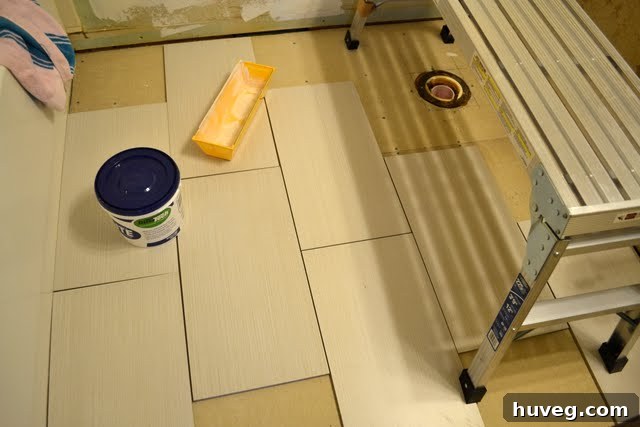
Unveiling the “Broke Joint” Pattern: A DIYer’s Guide to Tile Layout
For anyone tackling a tiling project, understanding different patterns is crucial. While a straight lay offers simplicity and a clean look, and diagonal patterns can add a dynamic touch, the brick pattern (or staggered pattern) remains a timeless choice, especially for rectangular tiles. This is where the term “broke joints” comes into play – essentially referring to the offset seams that mimic the appearance of a brick wall. It’s a classic, aesthetically pleasing layout that also offers practical benefits, such as helping to conceal slight irregularities in tile manufacturing or subfloor imperfections.
Why Choose a Staggered Pattern for Rectangular Tiles?
When working with large format rectangular tiles, like the 12×24 inch porcelain tiles I’ve chosen for this bathroom, a staggered pattern is often preferred for several reasons:
- Visual Appeal: It breaks up the monotony of straight lines, adding visual interest and a sense of movement to the floor.
- Minimizing Lippage: Larger rectangular tiles, particularly those with a length-to-width ratio greater than 2:1, can be prone to lippage (where one edge of a tile is higher than an adjacent tile). A common technique to mitigate this is to use a 1/3 offset pattern instead of a 1/2 offset. This means each tile’s end joint aligns with the 1/3 point of the tile in the row above or below, rather than the midpoint. This lessens the chance of the slight crown in the center of a tile meeting the edge of another, where lippage is most noticeable.
- Durability and Stability: The interlocking nature of a staggered pattern can contribute to the overall stability of the tiled surface.
- Timeless Design: From rustic farmhouses to contemporary urban lofts, the brick pattern seamlessly blends with diverse interior styles, ensuring your renovation remains stylish for years to come.
My 12×24 inch tiles, sourced from the reliable Floor & Decor Outlets (the same place I found my dark laminate flooring previously), are perfect for creating this staggered effect. The generous size of these tiles means fewer grout lines, contributing to a more expansive and contemporary feel in what is admittedly a compact bathroom space.
The Pivotal Decision: Tile Direction in a Small Bathroom
One of the most significant design dilemmas in any tiling project, especially in a smaller room, is determining the optimal tile direction. The orientation of the tiles can dramatically influence the perception of space, flow, and ease of installation. For my bathroom, the choice narrows down to two main options:
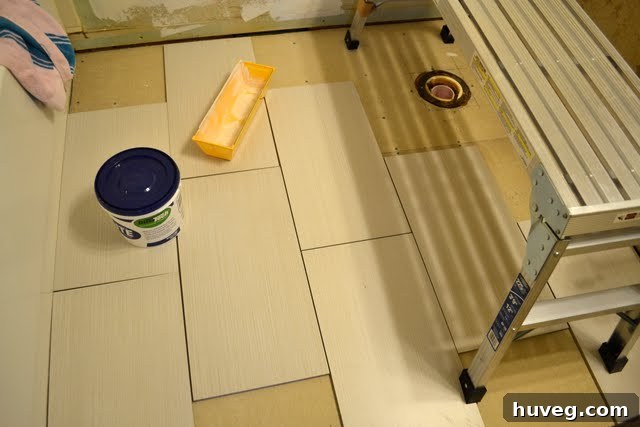
- Parallel to the Tub: This direction aligns the longer edge of the rectangular tiles with the length of the bathtub. As seen in the first image above, this orientation can create a sense of depth, making the room appear longer. From a DIY perspective, this might also translate to fewer complex cuts if the main body of the floor aligns well with the longest walls, potentially simplifying the process, especially when working alone.
- Parallel to the Door: This orientation would mean the longer edge of the tiles runs parallel to the bathroom door frame. Often, this choice is favored for creating a seamless transition from an adjacent hallway, leading the eye smoothly into the room. It can sometimes make a narrow room feel wider, depending on the overall dimensions. However, it might introduce more intricate cuts around fixed elements like the tub or toilet, potentially increasing the installation complexity.
This decision is not purely aesthetic; it also weighs heavily on the practicalities of installation, particularly for a solo DIYer. While aligning tiles parallel to the tub might offer an “easier” installation path – and in DIY, “easier” often translates to “better” – I’m still mulling it over. The vanity and toilet will return to their original positions against the right wall, as outlined in my previous update, which adds another layer to the layout puzzle.
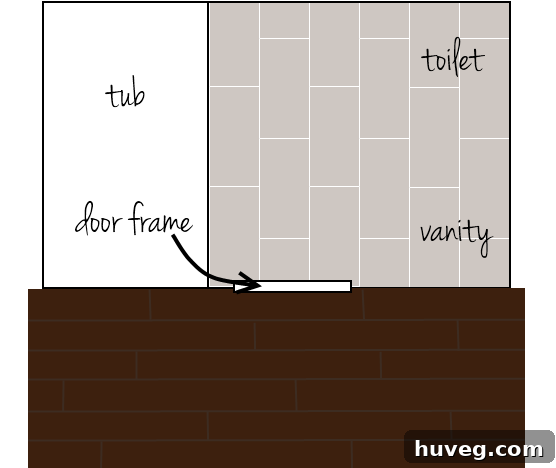
I would genuinely appreciate your insights here! Would you lean towards aligning the tiles with the tub (as depicted in the first picture, enhancing length) or with the door (the direction from which I took the photograph, potentially impacting width and hallway flow)? Every opinion helps in making the most informed decision.
Essential Preparations: Tackling Door Jambs and Beyond
Before any tile adhesive sees the light of day, preparation is paramount. One critical step for a professional-looking tile installation is undercutting door jambs and casings. This allows the tiles to slide neatly underneath, creating a clean, seamless finish without requiring awkward cuts around the trim or unsightly caulk lines. I faced this task previously when installing the laminate floors. If you’re new to my journey, I recommend reading this post for a fuller backstory.
This time around, I plan to use a hand saw for the jambs instead of an electrical jamb saw. While the electric saw is undeniably fun and efficient, the precision required for tile thickness, combined with the smaller scope of this project, makes a hand saw a perfectly suitable and controlled alternative. Remember to place a scrap piece of your new tile on the subfloor as a guide when cutting the jamb, ensuring the perfect height for the tile and thin-set mortar.
Beyond the jambs, other preparatory steps are non-negotiable for a lasting tile job: ensuring the subfloor is clean, dry, and perfectly level; addressing any loose boards or squeaks; and, for a bathroom, applying a suitable waterproofing membrane, especially in shower areas or where splash is likely. These foundational steps, though often overlooked, are key to preventing future issues like cracked tiles or moisture damage.
The Importance of a “Dry Fit,” Even in Compact Spaces
Despite the bathroom’s modest size, I couldn’t resist doing a dry fit. Laying out tiles without adhesive is a crucial step in any installation, serving as a dress rehearsal for the final act. It allows you to:
- Visualize the Layout: Confirm your chosen pattern and direction look as intended.
- Plan Cuts: Identify where cuts will be needed, especially around fixtures, and strategize to minimize waste and awkward slivers. Aim to avoid small cuts at the most visible edges of the room.
- Ensure Centering: Determine if your layout starts from the center of the room or a focal point, ensuring symmetry and balance.
- Check for Imperfections: Sometimes, minor variations in tile size become apparent during a dry fit, allowing for adjustments before commitment.
It was during this dry fit that I learned another small but significant lesson: in a bathroom this small, there really isn’t much floor space to spread out for a comprehensive dry fit! However, even a partial layout or simply taking mental notes by placing a few tiles can offer invaluable insights into how the pattern will unfold and where the challenging cuts will lie.
Addressing Key Questions & Best Practices for Tile Installation
Since sharing my progress, a few common questions have surfaced, which I’m happy to address:
- Hallway Laminate Direction: The laminate flooring in the hallway, which lies on the other side of the bathroom door frame, runs parallel to the door frame. This means it is perpendicular to the direction of the tile currently depicted in the first picture (parallel to the tub). This information is crucial for planning the transition, as aligning the tile with the door would create a more consistent flow from the hallway, while the tub direction creates a clear break. Ultimately, the choice depends on whether a continuous line or a directional contrast is desired at the threshold.
- Minimizing Cuts for DIY Ease: As many experienced DIYers know, the fewer cuts you have to make, the easier and faster the project tends to be. Based on the room’s dimensions and the placement of fixtures, opting for the tile direction parallel to the tub would likely result in the least number of cuts. This translates to less time spent on the wet saw, fewer opportunities for error, and a smoother installation process overall – a definite win for a solo project.
- The Importance of Mortar Coverage: With large format tiles, ensuring proper mortar coverage (at least 85% for dry areas, 95% for wet areas) is vital to prevent hollow spots and potential tile cracking or loosening over time. Using the correct trowel size and applying mortar in a consistent, even manner, often “back-buttering” the tiles, are critical techniques to master.
- Grout Line Considerations: The width of your grout lines can significantly alter the final appearance. For rectified (precisely cut) tiles like mine, narrow grout lines (1/16 to 1/8 inch) are common and contribute to a sleek, modern look. Non-rectified tiles may require slightly wider lines. Choosing a grout color that complements or subtly contrasts with your tile will also enhance the overall design.
As I move closer to setting these tiles, the anticipation builds. Each step, from learning new terminology like “broke joints” to deliberating over tile direction and meticulous preparation, brings me closer to seeing this bathroom transformed. The journey of DIY renovation is as much about skill acquisition as it is about creating beautiful, functional spaces. Stay tuned for the next phase of this exciting project!