Mastering Overhead Light Fixture Replacement with Ease

Happy Friday, fellow DIY enthusiasts! It’s been an interesting week, one that saw me temporarily stray from my usual hands-on projects. Confession: for the past seven days, my trusty tools have mostly stayed idle. I know, a bit shocking for someone who usually finds solace in the hum of a power tool or the satisfying thud of a hammer. My reasons were varied, though all quite enjoyable: a fulfilling surge of design work, a delightful series of friends’ birthday celebrations, and some much-needed warm-weather relaxation with a special someone (dating, it turns out, can be quite the time commitment!).
However, this break has only reinforced a crucial realization: a week is truly my limit. Around the seven-day mark, an irresistible urge takes over – a yearning to create, to fix, to transform. It’s a powerful pull, almost an addiction, though perhaps not dramatic enough for a reality TV show like My Strange Addiction. I’m happy to leave the spotlight to those who date cars or eat unusual things; my addiction is far more practical: the thrill of a successful DIY project and the satisfaction of working with my hands. This underlying passion is precisely why the right tools are not just helpful, but essential.
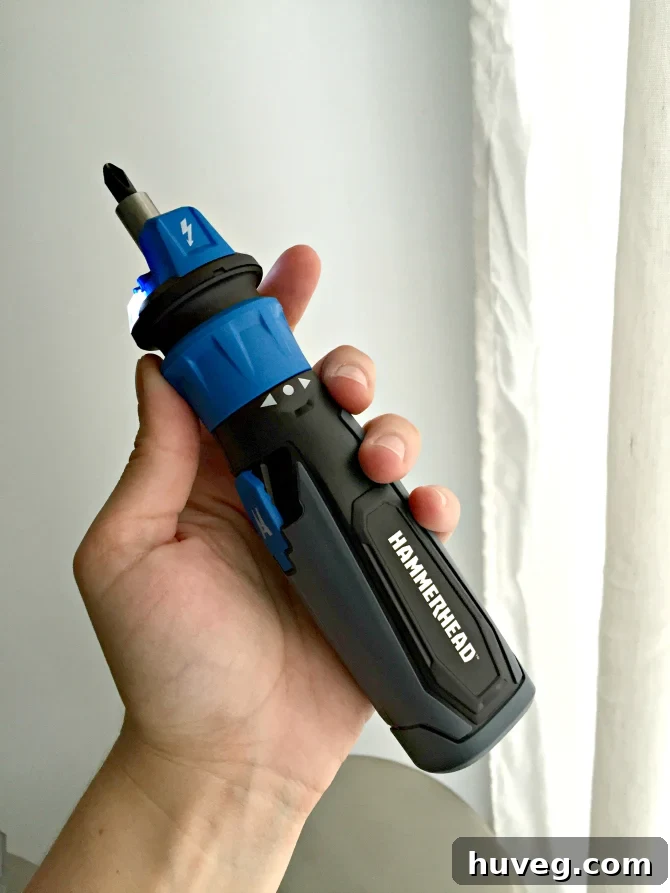
Today, with tools firmly back on my mind, I want to circle back to a particular gadget that has significantly improved my DIY experience: the cordless screwdriver I mentioned a few weeks ago. On the surface, a small tool like the Hammerhead cordless screwdriver might not seem like much to rave about. But once I put it to use installing my new DIY light fixture in the breakfast nook, its impact was undeniable. It streamlined the process so dramatically, reducing my usual level of frustration (and associated colorful language) that I knew I had to share its features and how it can revolutionize your next DIY lighting project. This isn’t just about a tool; it’s about making home improvements more enjoyable and less prone to headaches.
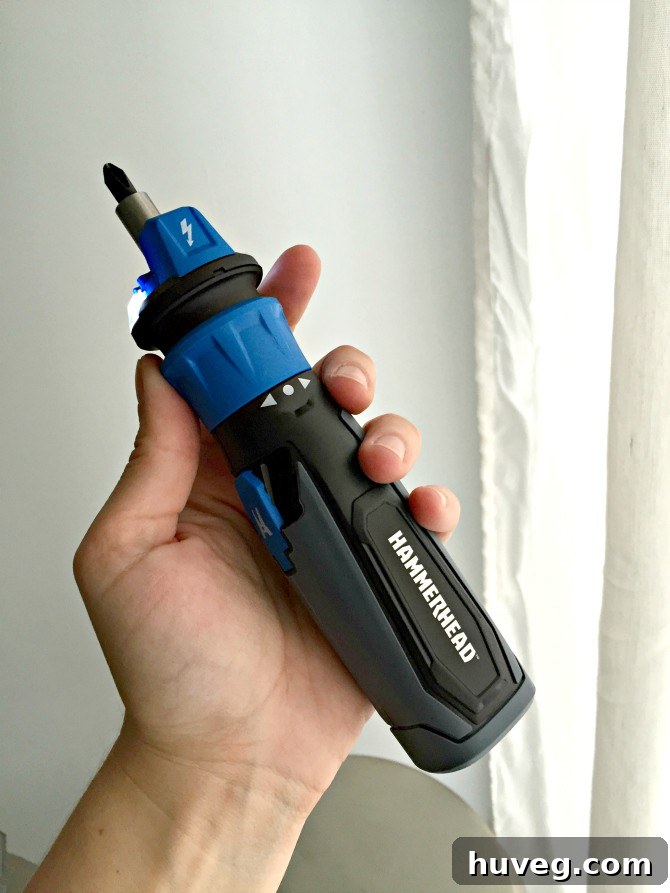
A quick note: this post is not sponsored. I received this Hammerhead cordless screwdriver as a thoughtful Christmas gift from my friend Ken. While you absolutely don’t need this specific tool to install a light fixture, I’m genuinely excited to share my honest opinions and the valuable insights I’ve gained. As with all my reviews on this blog, my goal is to provide useful information, alongside some general tips for installing ceiling lights. Transparency is key, so please be aware that this post may contain affiliate links; should you make a purchase through them, I may earn a small commission, which helps support the continued operation of this blog. The photos you’ll see below are a compilation from various light installations, illustrating how this versatile tool has consistently simplified my projects. Keep an eye out for upcoming posts where I’ll reveal more of my recent lighting transformations!
Mastering Ceiling Light Installation: My Failsafe Method (Without the Fury)
Installing light fixtures has historically been one of my least favorite DIY tasks. It’s not inherently complex – simply turn off the power, connect a few wires, and switch the power back on. Yet, the challenges often outweigh the simplicity. Picture this: you’re perched precariously on a ladder, holding a somewhat bulky fixture above your head, trying to manipulate tiny wires with limited visibility and even fewer spare hands. There’s the added anxiety of remembering all your tools, the risk of dropping something crucial, and the ever-present concern for electrical safety. Honestly, my claim of “without cursing or throwing tools” might be a slight exaggeration; I’m prone to a bit of casual swearing, but there’s a distinct difference between that and the full-blown “rage-swearing” that typically erupts when a project goes awry (or when I drop a heavy tool on my foot!). This guide aims to minimize those rage-inducing moments.
One of my biggest frustrations when working with overhead lights is the perpetual feeling of needing two extra hands. And without fail, I always seem to leave a critical tool like my wire strippers or wire nuts at the bottom of the ladder. This is precisely why the Hammerhead cordless screwdriver captured my heart (and my emoji-filled excitement). It’s more than just a screwdriver; it’s a multi-functional marvel that consolidates several essential tools into one compact device. This integration alone dramatically improved the installation process, even surpassing my normal multi-function wire stripper/cutter. I transformed from snarling in frustration at an old fixture to genuinely excited about the new one, largely because this tool eliminated the urge to hurl it across the room before it was even in place.
Essential Materials for a Smooth Light Fixture Upgrade:
- The New Light Fixture: Choose a design that complements your space. I’ve included some ideas at the end of this post if you’re looking for inspiration!
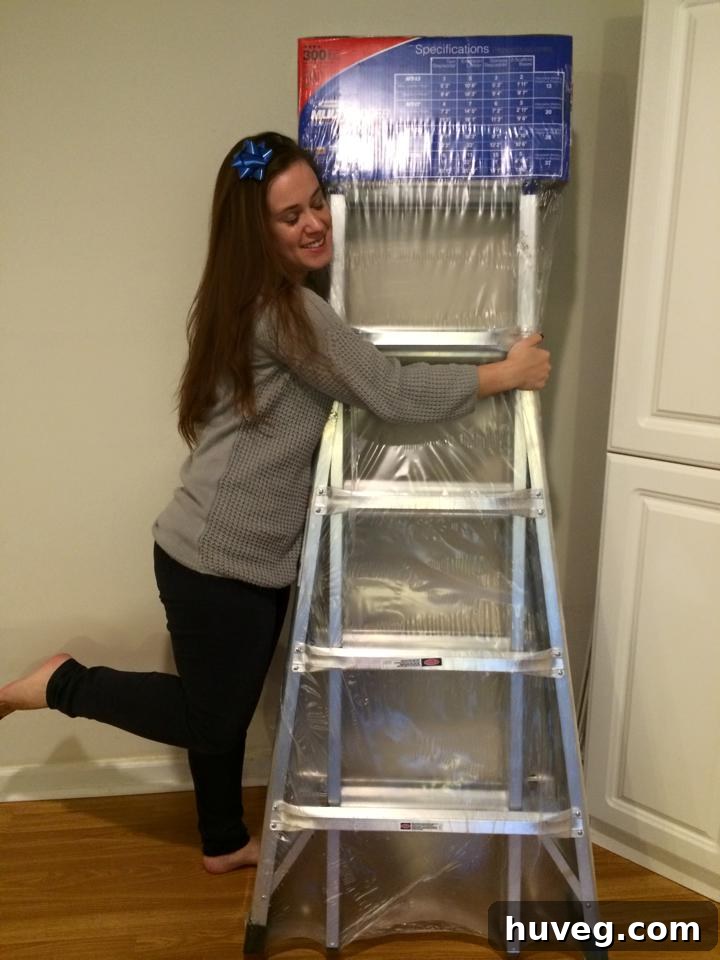
- A Sturdy Tall Ladder: The right height is crucial. Aim for a ladder that allows you to comfortably work at ceiling height without excessive arm strain. Being able to rest the fixture on the top of the ladder, rather than holding it for the entire duration, can save significant arm exhaustion. Safety first – ensure it’s stable on a flat surface.
- Wire Nuts: These small but mighty connectors are typically included with store-bought light fixtures and kits. While you usually don’t need to worry about purchasing them separately, it’s worth noting that they come in various sizes, often color-coded to distinguish them. Always ensure you’re using the correct size for the wires you’re connecting to ensure a secure and safe connection.
- Hammerhead Cordless Screwdriver (or similar multi-tool): This compact device, with its integrated wire stripper and voltage tester, is a game-changer for efficiency and safety.
Step 1: Prioritize Safety – Always Turn Off the Power!
Many DIYers might be tempted to simply flip the light switch off and proceed with replacing a light fixture. However, my unwavering advice for any DIY electrical work is this: even if the light switch is off, you absolutely must go to your home’s main electrical panel (the breaker box) and turn off the power to that specific circuit. This is a non-negotiable safety step. You need to be certain that the exposed wires you’ll be handling are completely “dead” before you risk a potentially dangerous electrical shock. Moreover, you can’t always guarantee that previous installers wired everything correctly, especially in older homes where you might find multiple wire pairs in a ceiling box, not all necessarily connected to the same circuit or fixture.
Therefore, after turning off the corresponding circuit breaker, the next critical step is to use a circuit tester directly on the wires in the ceiling box. This verifies that no wires are “hot,” meaning live and carrying voltage. A simple method to identify the correct breaker is to turn the light on, then systematically switch breakers on and off until the light goes out. Properly labeling your circuit breakers can significantly help, though I often find myself forgetting to update mine between projects (and the existing labels are often pure guesswork!).
Step 2: Remove the Old Fixture and Verify Wire Safety
Begin by carefully removing all light bulbs from the old fixture. This prevents accidental breakage – replacing a bulb is much cheaper and safer than dealing with broken glass or stitches from stepping on a shard. Next, locate and remove the nuts or screws that secure the old fixture to the ceiling. The method varies depending on your fixture type:
- “Boob lights” (a common and often disliked flush-mount style): Unscrew the finial, remove the glass bowl, then unscrew the base to reveal the crossbar and wires.
- Chandelier or semi-flush mount lights: You’ll typically find a decorative canopy (a cover plate) flush against the ceiling. This canopy is usually attached with screws, and the wires will be directly underneath. The image below shows a gumball light with a similar base where the bowl fits.
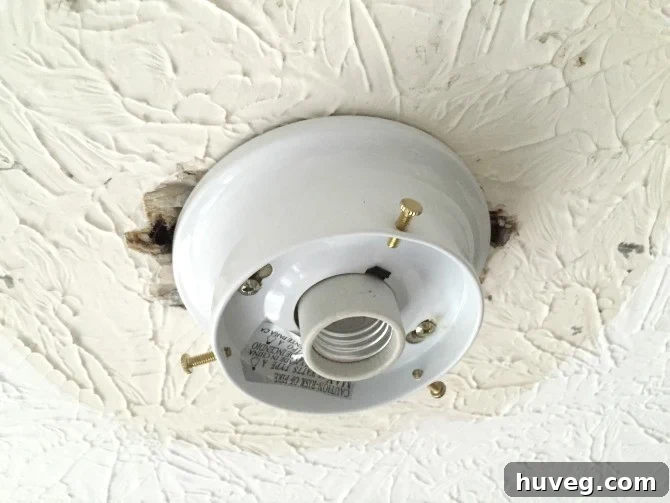
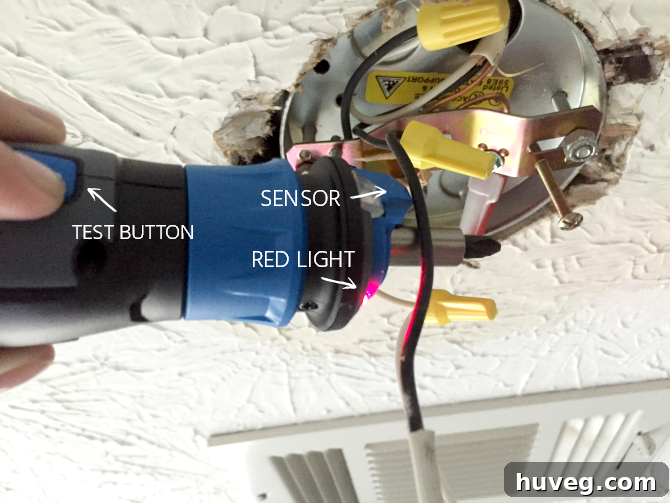
Regardless of the fixture style, continue unscrewing until you expose the electrical wires. Before touching any wires with your hands, it is imperative to use a voltage tester on the exposed ceiling wires to confirm the power is truly off. This is where the Hammerhead cordless screwdriver truly shines: it has a circuit tester built right in, eliminating the need to carry a separate tool! Simply press the live-wire detection button; if the wire is hot, both a buzzer will sound and a red light will illuminate. While my photo below was staged (I always ensure power is off well in advance), it clearly demonstrates the red light indicator. This handy feature saves you hassle and enhances safety, effectively eliminating the need for an additional tool. (Additional tools eliminated: 1)
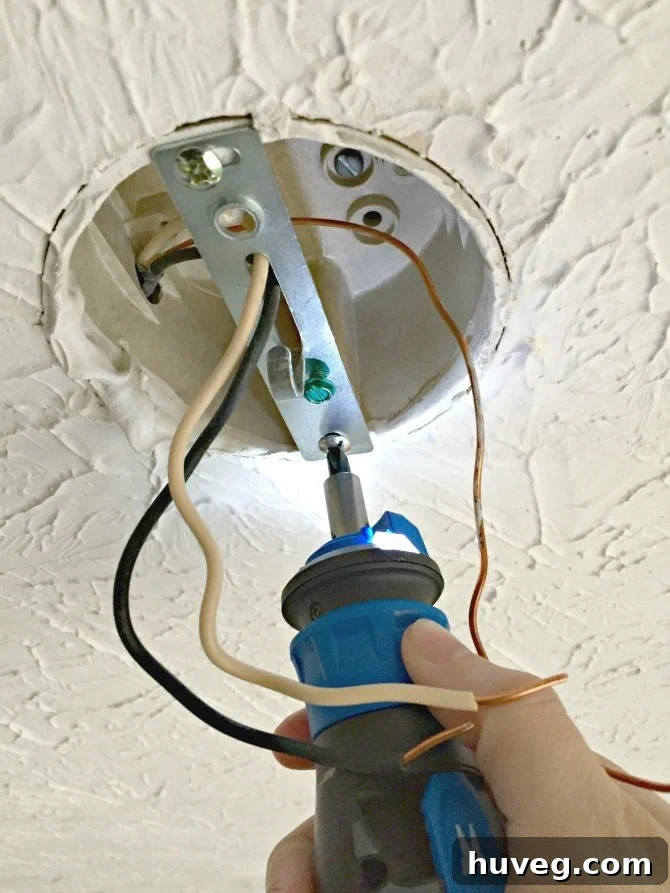
Once you’ve confirmed the wires are safe, detach the wires connecting the old fixture from the ceiling wires. This will lighten the load, allowing you to safely set the old light fixture aside. Then, unscrew and remove the old crossbar, assuming your new light fixture comes with its own (which is almost always the case).
Step 3: Identify the Electrical Wires
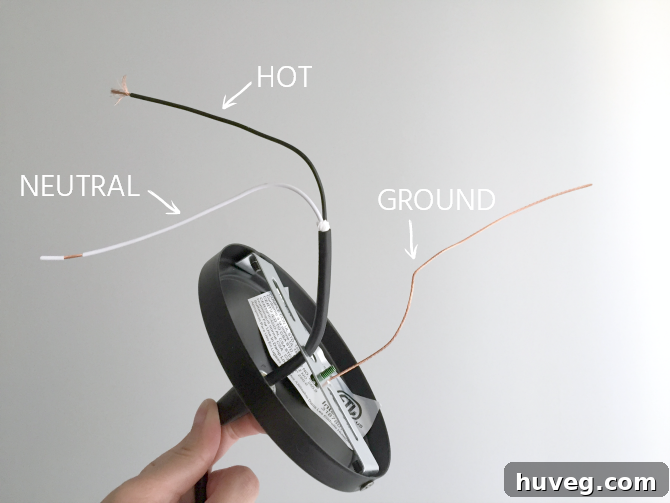
With the old fixture removed, you should now see the ceiling electrical box with three main color-coded wires:
- Ground Wire: Typically green insulated wire or bare copper. This is a crucial safety wire, providing a path for stray electricity to prevent shocks.
- Neutral Wire: Usually white insulated wire. This wire carries current away from the fixture.
- Hot Wire: Generally black insulated wire. This wire carries the electrical current to the fixture.
These colors will (usually) correspond to the same colored wires on your new light fixture. Keep in mind that older homes might deviate from these standard color codes or have additional wires, so always consult your fixture’s instructions and exercise caution. For the purpose of these tutorials, I always illustrate with what’s commonly found in modern wiring, as seen in my own home.
Step 4: Secure the New Crossbar
Take the new crossbar that came with your lighting kit. This metal bracket is essential for supporting the weight of your new fixture. Align it with the holes in your ceiling electrical box and securely attach it using the screws provided in the kit. Ensure it’s flush and firmly mounted, as it will bear the entire weight of your new light.
Step 5: Prepare Wires by Snipping and Stripping (as needed)
With the initial preparatory work complete, it’s time to assemble your new light fixture and get its wires ready for connection. The exact assembly process will vary depending on your specific fixture, especially if you’ve modified it to create a custom design as I did (if you do, remember to take plenty of photos to aid reassembly!).
The wires emerging from your ceiling box should already have exposed copper ends from the previous fixture. However, you might need to make adjustments to the wires on your new light fixture. In my case, I often need to shorten the cord to ensure the fixture hangs at an appropriate height, preventing accidental head bumps. Always cut from the end that already has exposed wires (the end that connects to the ceiling), not the end connecting to the light bulb housing. While this may seem obvious, it’s a crucial detail for ensuring the fixture remains functional. For shorter individuals like myself, shortening the cord means cutting a significant amount of extra length! While some decorative fixtures are designed to hang very low, for most standard ceiling installations, shortening the cord is a necessary step. You can use a utility knife or sturdy wire cutters for this, being careful to only cut through the outer cord sheathing and not damage the individual wire insulation underneath.
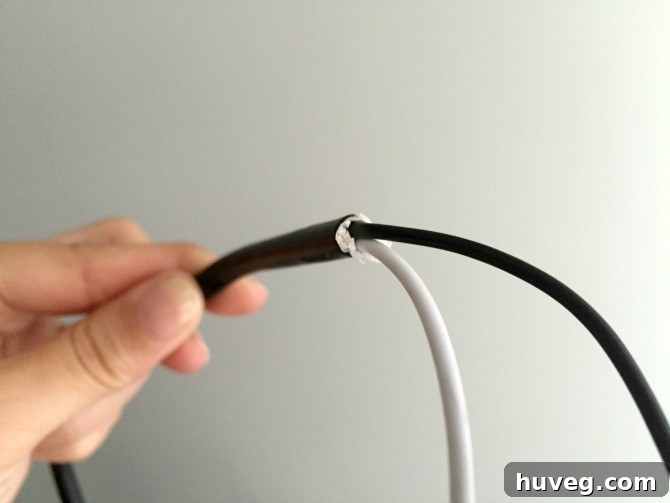
Once you’ve adjusted the cord length, you’ll need to re-expose the copper ends of the wires. Strip away about half an inch to three-quarters of an inch of insulation from each wire. This length is ideal for securely twisting the wires together before capping them with a wire nut. The Hammerhead tool I used boasts both a wire bender (which I didn’t need for this project) and a handy wire stripper, which proved incredibly useful.
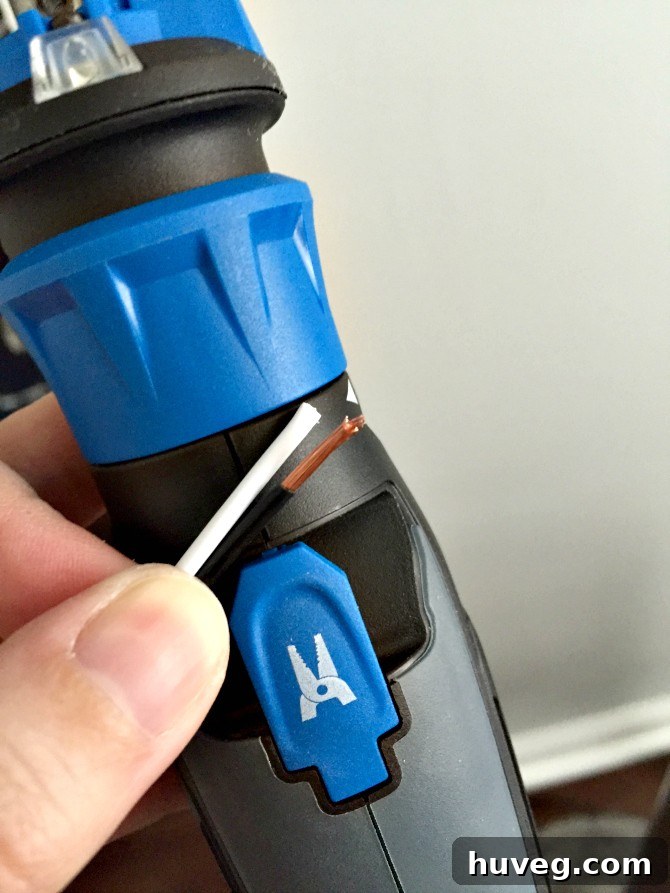
Stripping wires effectively takes a bit of practice. The goal is to cleanly cut and remove the insulation without nicking or damaging the delicate copper strands underneath. To use the Hammerhead’s stripper, simply thread the wire through the appropriate graduated slot (sized according to your wire gauge), push down to clamp the wire firmly at a slight angle, and then pull smoothly to strip off the insulation. If the insulation doesn’t budge easily, try wiggling the stripper slightly while maintaining pressure. It’s a technique that becomes easier with experience. Given how easily copper wires can fray, sometimes threading the stripped wire through the tool’s channel for subsequent steps can be a tad finicky. However, for the most part, this integrated stripper worked brilliantly. It was a huge relief not to have to remember (or frantically search for) a separate wire stripper. (Additional tools eliminated: 2)
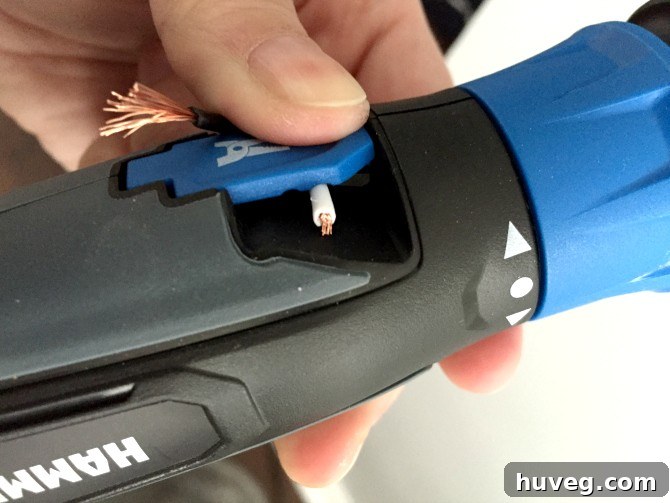
Step 6: Connect the Ground Wire First for Safety
Now that your light fixture is fully assembled and its wires are prepped, climb back up your ladder. For paramount safety, always begin by connecting the ground wire. Take the bare copper (or green insulated) ground wire coming from the ceiling box and wrap it securely around the green ground screw attached to the new crossbar. Once wrapped, twist the end of the ceiling’s ground wire together with the ground wire from your new light fixture. Use a properly sized wire nut to cap this twisted connection, twisting it clockwise until it’s snug and secure. This establishes a critical safety pathway, grounding the fixture and minimizing electrical hazards.
(Apologies, dear readers! I seem to have inadvertently deleted the photo for this crucial step during my editing process. I promise to update this post with a new image from my next light fixture installation this coming weekend!)
Step 7: Connect the Remaining Wires
Following the same method as with the ground wire, connect the neutral and hot wires. Remember the standard color code:
- Neutral to Neutral: Twist the white wire from the ceiling together with the white wire from the new light fixture.
- Hot to Hot: Twist the black wire from the ceiling together with the black wire from the new light fixture.
For each connection, I typically twist the exposed copper ends of the corresponding wires together firmly by hand first. Then, I twist a wire nut onto the twisted wires, turning it clockwise until it feels completely secure and tight. Give a gentle tug on each wire to ensure they are firmly held by the wire nut and won’t easily pull free.
Step 8: Mount the Canopy to the Crossbar
This is where my little Hammerhead screwdriver once again proved invaluable. Maneuvering a larger, traditional screwdriver to align tiny screws through a decorative canopy into a crossbar, all while supporting a light fixture overhead, can be incredibly challenging. With the Hammerhead, its compact size and motorization made the task far easier. I could support the fixture with one hand and precisely operate the small, motorized screwdriver with the other, smoothly aligning the screws and securing the canopy. While having a helper is always beneficial, tools that can effectively do half the job for you, especially in awkward positions, are truly priceless and prevent a lot of arm fatigue and frustration!
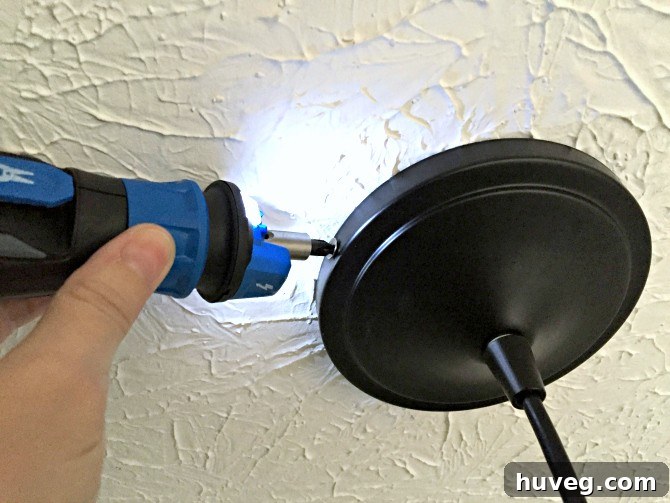
Step 9: Restore Power and Enjoy Your New Light!
With all connections made, the canopy securely mounted, and the fixture firmly in place, it’s time for the moment of truth. Carefully screw in your light bulb (or bulbs, depending on the fixture). Then, head back to your electrical panel and flip the circuit breaker back to the “on” position. Your new light fixture should now illuminate, beautifully transforming your space! Congratulations, you’ve successfully installed a new ceiling light, and hopefully, with far less stress and colorful language than before.
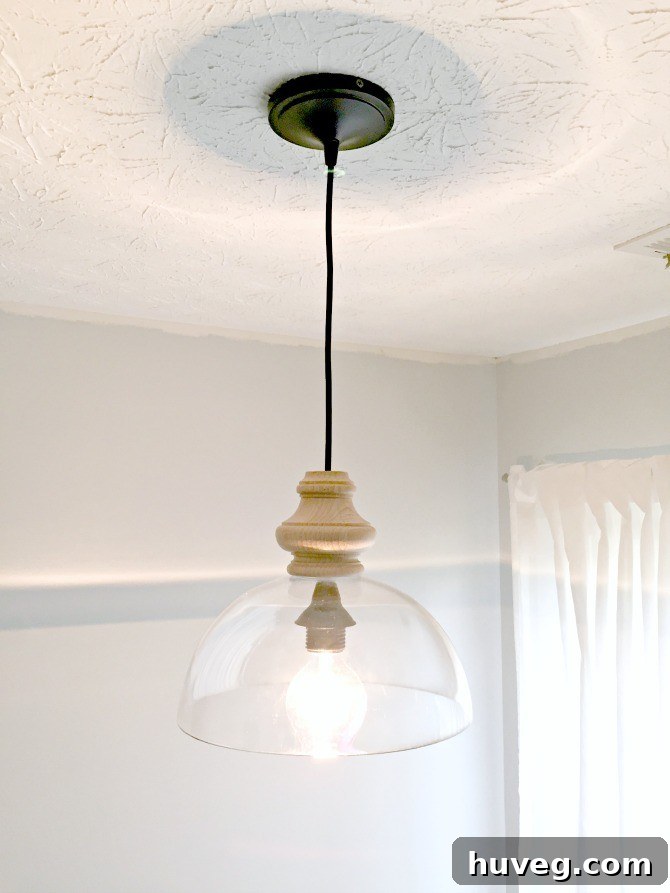
And that’s the secret to creating a pleasant before-and-after experience – significantly reducing the snarling and glaring often associated with DIY projects. It’s amazing what the right tools and a clear process can do for your home and your sanity.
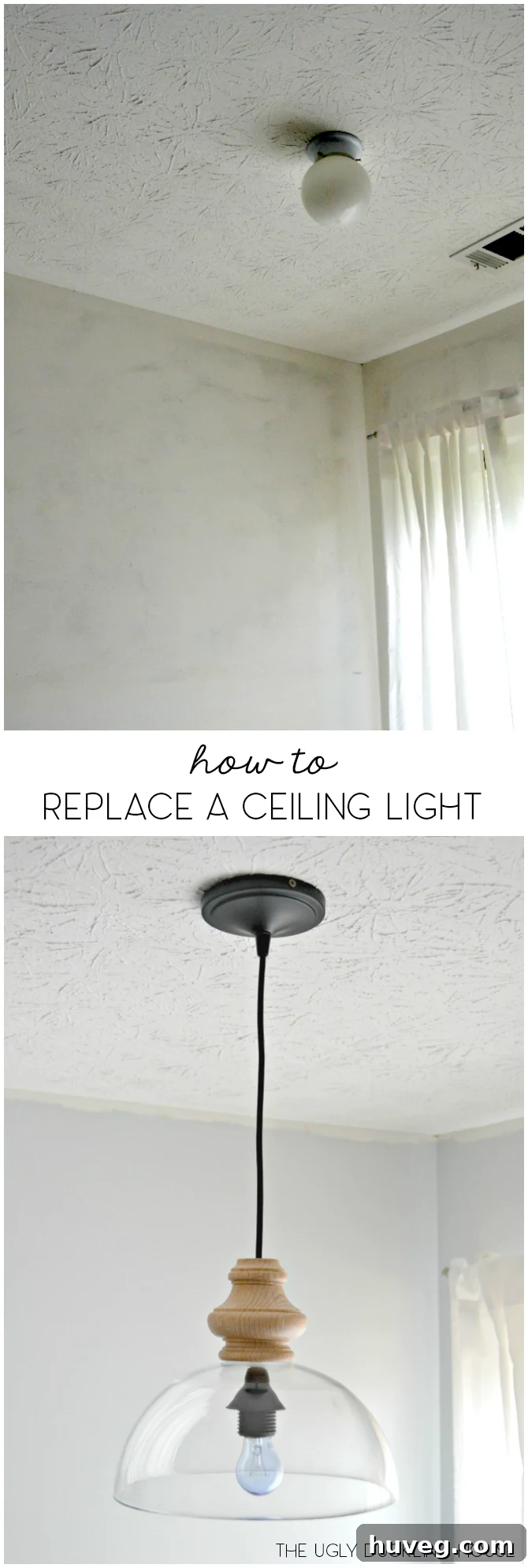
For more details on the specific light fixture featured above, including how it was created, check out this dedicated post.
Not feeling the DIY spirit? Explore these stylish light fixture options:
If tackling the installation yourself isn’t appealing right now, there are countless beautiful light fixtures available to enhance your home. Consider these popular styles to instantly upgrade your space:
- Modern Flush Mounts: Sleek and unobtrusive, perfect for lower ceilings or minimalist aesthetics.
- Elegant Chandeliers: A timeless choice for dining rooms or entryways, adding a touch of grandeur.
- Industrial Pendants: Great for kitchen islands or as accent lighting, offering a contemporary edge.
- Semi-Flush Mount Lights: A versatile option that provides more decorative flair than a flush mount without the dramatic drop of a chandelier.
- Drum Shade Fixtures: Offer soft, diffused light and come in a variety of fabrics and patterns to match any decor.