Curated Corridor

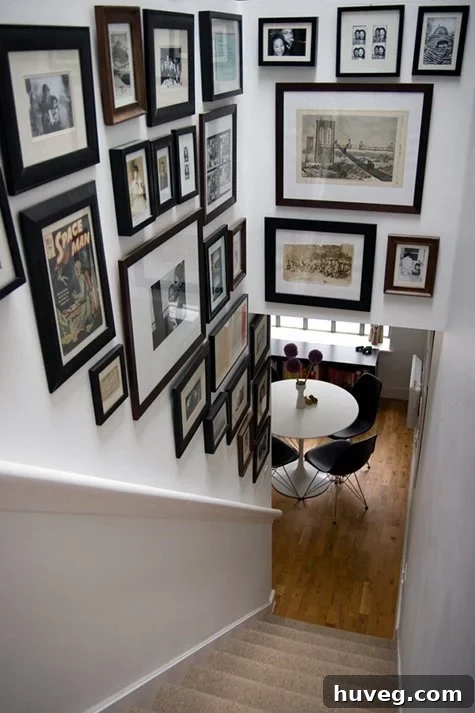
For as long as I’ve admired interior design, a consistent belief held firm in my mind: gallery walls, particularly those ascending a staircase, were exclusively reserved for spacious, open hallway designs. My own residence features a decidedly narrow staircase, a characteristic I always thought rendered the idea of a vibrant gallery wall utterly impossible. The vision of an elaborate display in such a confined space conjured images of visual clutter and an overwhelming sense of enclosure, leaving me convinced that this charming trend simply wasn’t meant for my home.
design*sponge Best of: Gallery Walls, photographer Rion Nakaya
The Breakthrough Moment: A New Perspective on Staircase Gallery Walls
Witnessing that specific photograph was nothing short of a revelation. It instantly transformed my perception of what’s achievable in compact spaces. The image showcased a gallery wall ascending a staircase that appeared strikingly similar to my own in its narrowness, complete with walls on both sides. This was precisely the setup I believed made a gallery wall impractical, if not impossible. My previous logic dictated that with photos only a couple of feet from one’s eyeballs, the sheer volume of imagery would be overbearing, creating a dizzying, claustrophobic effect. Yet, this example defied all my preconceived notions, working not just adequately, but exceptionally well.
The immediate impact of this visual was so profound that I’m now entirely convinced it’s the exact project I want to undertake once I embark on the much-needed repainting of the hallway and living room. It demonstrated that with thoughtful execution, a narrow staircase can indeed host a breathtaking gallery wall, transforming a previously overlooked area into a significant focal point.
Demystifying the Narrow Staircase Gallery Wall: Overcoming Design Challenges
The common apprehension about installing a gallery wall in a narrow staircase stems from valid concerns about overwhelming the space. In a confined environment, visual clutter can quickly make a hallway feel even smaller and less inviting. The challenge lies in creating a display that enhances, rather than detracts from, the architectural elements and natural flow of the area. However, the inspirational image provided a masterclass in how to navigate these constraints with elegance and simplicity.
The key, as I’ve come to understand, is not about the quantity of items, but the quality of their curation and presentation. Thoughtful design choices can turn what seems like a limitation into an opportunity for a highly personalized and impactful display. It’s about crafting an experience that unfolds as one ascends or descends, rather than bombarding the viewer with too much information at once.
Crafting Cohesion: Key Design Elements for Impact
The Power of Monochromatic Palettes: Frames, Mats, and Photos
One of the most striking aspects of the inspirational gallery wall was its cohesive aesthetic, primarily achieved through a monochromatic palette. The use of dark frames, crisp white mats, and predominantly black and white photos contributed significantly to its understated elegance, preventing any sense of visual overwhelm. This controlled color scheme creates a sense of unity and sophistication, allowing the individual pieces to stand out without competing with each other or the surrounding architecture.
Dark frames, whether black or a deep espresso brown, provide a strong, clean line that defines each piece. They anchor the artwork and photographs, giving them a sense of presence. Paired with wide, white mats, they create a visual breathing room around each image, preventing the collection from looking too busy. White mats draw the eye inward, highlighting the content within the frame, and also provide a consistent backdrop that unifies diverse images.
Moreover, opting for largely black and white photographs is a genius move for narrow spaces. Without the distraction of varied colors, the focus shifts to the subject matter, composition, and emotional resonance of each image. Black and white photography inherently possesses a timeless quality, adding a layer of classic sophistication that works seamlessly with a minimalist frame and mat combination. This approach maintains a simple enough design, ensuring the entire display feels deliberate and curated, rather than haphazard. The beauty of this simplicity also means it should be a pretty straightforward DIY project; black frames and white mats are readily available, and achieving a unified look with spray paint is a budget-friendly and effective solution.
Curation and Storytelling: What to Display
The content of a gallery wall is where its true personality shines through. For me, personal memories and experiences are paramount. My photos from traveling to Prague, Germany, and my unforgettable study abroad experiences in college would look absolutely fantastic displayed in an area like this. These aren’t just pictures; they are visual narratives, snippets of my life’s journey that transform a mere passageway into a personal museum of memories.
Beyond personal photographs, consider incorporating a mix of art prints, illustrations, abstract pieces, or even typographic art to add visual interest. The key is to select pieces that resonate with you and contribute to the overall theme or feeling you wish to evoke. A cohesive theme, whether it’s travel, family, nature, or abstract forms, helps tie the disparate elements together, creating a harmonious display. Don’t shy away from mixing different mediums, but always ensure a consistent element, such as frame color or matting, binds them together.
The Allure of the Unfinished: Blank Frames and Evolving Displays
An intriguing aspect that captured my imagination from the inspiration photo, and something I intend to incorporate, is the idea of including some completely blank frames. This concept isn’t about laziness or an incomplete project; rather, it’s a deliberate design choice that adds an element of anticipation and intrigue. Leaving certain frames empty makes it look like I’ve got plans, adventures to embark on, and places yet to explore – a continuous journey of discovery that my home is ready to embrace.
There’s something incredibly poetic and dynamic about an evolving gallery wall. Blank frames can symbolize future aspirations, serve as placeholders for upcoming art acquisitions, or simply offer a moment of visual pause within the display. This deliberate “unfinished” look hints at ongoing creativity and personal growth, making the gallery wall feel alive and reflective of a life in progress. To make blank frames look intentional, ensure they fit perfectly within the overall layout and maintain the consistent framing and matting style. This clever touch transforms a static display into a living, breathing testament to a life well-lived and yet to be fully lived.
Your Step-by-Step Guide to a DIY Staircase Gallery Wall
Planning and Measurement: The Foundation of Success
Embarking on a DIY staircase gallery wall requires careful planning. Start by measuring the entire wall space along your staircase, taking into account the rise and run of the steps. Visualizing the layout is crucial; consider taking photos of the bare wall from different angles. Use painter’s tape or craft paper cutouts of your frame sizes to experiment with various arrangements directly on the wall. This allows you to adjust spacing, height, and overall flow before making any permanent decisions. Aim to position artwork at eye level for an average viewer, which usually means hanging them a bit lower on the descent and higher on the ascent, creating a natural diagonal line that mimics the stairs.
Sourcing Materials: Affordability Meets Style
Finding the right frames doesn’t have to break the bank. Thrift stores, second-hand shops, and online marketplaces are treasure troves for unique and affordable frames. Don’t worry about mismatched colors or styles initially; this is where the magic of spray paint comes in. A few cans of high-quality spray paint in a chosen color (like matte black or deep charcoal) can unify a collection of disparate frames, giving your gallery wall a polished, cohesive look. For mats, pre-cut white mats are widely available at art supply stores or online. Ensure they are acid-free to protect your photographs over time.
Layout and Arrangement: Making Sense of the Space
Once you have your frames, experiment with different layouts. A grid pattern offers a clean, modern look, while a more organic, free-form arrangement can feel artistic and eclectic. For a staircase, a staggered layout that follows the upward slope of the stairs is often most visually appealing. Begin with a central piece or two, and then build outwards. Pay attention to the negative space between frames; it’s just as important as the framed art itself. Aim for balance, ensuring that the visual weight is evenly distributed along the wall. The template method (using paper cutouts) is invaluable here, allowing you to fine-tune the arrangement without putting a single nail in the wall.
Hanging with Confidence: Tools and Techniques
For a secure and aesthetically pleasing installation, gather your essential tools: a tape measure, a level, a pencil, a hammer, and picture hanging hooks or command strips. For precise alignment, particularly with multiple frames, consider using a laser level. Mark your hanging points carefully, double-checking measurements before drilling or nailing. For heavier frames, use appropriate wall anchors. If you’re hesitant about traditional methods, high-quality adhesive picture hanging strips offer a damage-free alternative, perfect for renters or those who like to frequently rearrange. Remember to step back frequently to assess your progress from various vantage points along the staircase.
Beyond the Basics: Elevating Your Staircase Gallery
To truly elevate your staircase gallery, consider incorporating elements beyond just framed art. Strategic lighting can dramatically enhance the display. Small, adjustable picture lights mounted above individual pieces can highlight your favorite photos, adding a sophisticated, gallery-like ambiance. Natural light sources from nearby windows should also be considered, as they can bring the display to life throughout the day. Additionally, incorporating a mirror or two into your gallery wall can work wonders in a narrow space, reflecting light and creating an illusion of greater depth and openness. Small decorative elements like a subtle wall clock, a tiny floating shelf with a small succulent, or even framed quotes can add texture and dimension, breaking the monotony of purely flat frames.
The Verdict: Are Gallery Walls for Narrow Staircases a Design Triumph?
My initial skepticism about whether gallery walls were suitable for narrow staircases has completely dissipated. What I once thought was an impossible design endeavor, destined to create an overwhelming and cluttered experience, has revealed itself to be a fantastic opportunity for personalized expression. The example I encountered proved that with careful consideration of elements like frame style, matting, photo selection, and overall arrangement, a narrow staircase can be transformed into an engaging and beautiful visual journey.
To address the question of whether gallery walls have been overdone, I firmly believe the answer lies in execution. While the concept of a gallery wall is popular, its potential for unique personalization ensures it remains a fresh and relevant design choice. A thoughtfully curated gallery wall, especially one that tells a personal story, can never truly be “overdone.” It offers a vibrant alternative to the traditional single focal point wall, creating a dynamic progression of visuals that engages the viewer from start to finish. Instead of being overwhelming, a well-designed gallery wall in a narrow staircase offers a delightful surprise, adding character, warmth, and a unique twist to an often-neglected space. I am loving this idea so much that I’m wiping drool off my face. Or maybe that’s just a leftover side effect from yesterday’s trip to the dentist. Who knows. But seriously, it’s a design triumph, and I encourage anyone with a similar narrow space to embrace this transformative idea!