Boundaries


Navigating the Puppy Parenthood Journey: The Power of “No” and the Path to a Harmonious Home
Bringing a new puppy into your home is an adventure filled with boundless joy, unexpected challenges, and a steep learning curve for both pet and owner. Since my lively pup, Charlie, joined our family, one word has become a constant in my vocabulary: “no.” It’s a word I utter with increasing frequency, an attempt to instill basic obedience in a tiny creature brimming with curiosity and mischief. While I strive to teach her the rules of our home, Charlie, in turn, is diligently schooling me in the virtues of patience and the art of functioning on significantly fewer, lighter hours of sleep. Both lessons, for both of us, are proving to be quite demanding.
Beyond the immediate training demands, I’m also quickly discovering a new reality: procrastination is no longer an option. The small messes I might have once left for another day now demand immediate attention. Why? Because Charlie, with her innate ability to amplify any imperfection, will inevitably make them worse. This newfound urgency, however inconvenient, has become a surprisingly effective motivator. Even with a sleep-deprived brain, I find myself rationalizing the extra effort, reminding myself that a cleaner, more organized house, despite the added work, is always a worthwhile investment in our shared well-being.
Understanding Puppy Behavior: The Rapid Learning Curve of “No”
Despite being less than three months old, Charlie is astonishingly quick to grasp the meaning of “no.” Her intelligence truly amazes me. In just a matter of days, she seems to understand my directives, and more importantly, she actually *acts* on them. This rapid comprehension is both a blessing and a testament to the fact that puppies, even at such a young age, are incredibly capable of learning when given clear, consistent guidance.
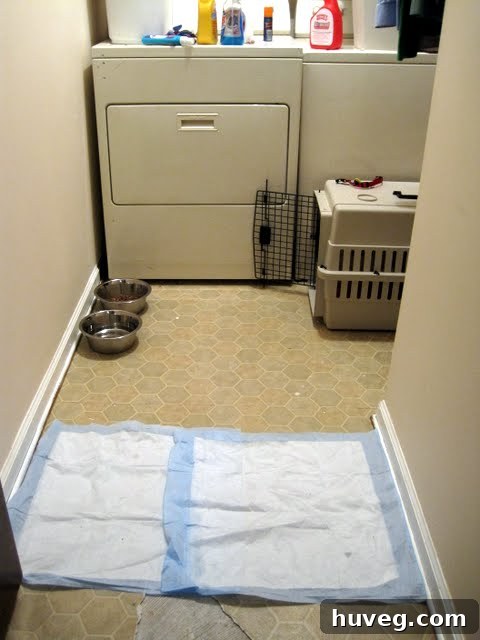
Yet, even the smartest and most adorable puppies have their moments of rebellion, or perhaps more accurately, moments born from inexperience and lack of proper training. Charlie’s undeniable cuteness is often her saving grace, a powerful antidote to any rising frustration. This was particularly true the other day when I returned home to a scene of absolute chaos. Charlie, in her infinite wisdom, had decided that my laundry room—her designated safe space complete with puppy pad, crate, and food—was sorely in need of a redecoration. Her chosen medium? Poop. And it was everywhere. On the appliances, splattered across the floor, and, as if to emphasize her artistic vision, even smeared on the walls. It was a truly disheartening sight.
Decoding the Message: When Accidents Become Motivators
In hindsight, I suppose that was Charlie’s rather pungent way of telling me she agreed with my long-held thought that the laundry room needed a new paint color. However, brown was definitely not the hue I had in mind for a fresh aesthetic. While I appreciate her input and her very limited color palette, Charlie, I’ve got this particular design decision covered!
This rather dramatic incident underscored a critical point: Charlie’s “episode” was not a reflection of a naughty puppy, but rather a direct consequence of my own unpreparedness and lack of proper training on her first full day alone in the house. As a new puppy parent, I was the one who needed to step up. This realization prompted an immediate deep dive into puppy training resources. I’ve since been thoroughly researching effective methods (for those curious, I’m implementing this particular series of training techniques, and the results have been truly amazing).
Establishing Foundations: Crate Training, Potty Training, and Positive Reinforcement
Successfully integrating a puppy into your home hinges on a few core training pillars. The word “no” is fundamental, but it must be paired with clear alternatives and positive reinforcement. When Charlie does something undesirable, a firm “no” stops the behavior, but immediately redirecting her to an appropriate activity and rewarding her for that positive choice reinforces what she *should* do. This isn’t just about stopping bad behaviors; it’s about teaching good ones.
Crate training has been another game-changer. It provides Charlie with a safe, den-like space where she can feel secure. It also becomes an invaluable tool for potty training and managing her when I can’t supervise her 100%. Puppies naturally don’t want to soil their sleeping area, so a properly sized crate aids in developing bladder control. Consistent potty breaks, taken frequently and immediately after waking up, eating, and playing, are crucial. Praising her enthusiastically and offering a small treat every time she relieves herself outside reinforces the desired behavior. These early weeks are all about establishing a routine, building trust, and communicating effectively.
The commitment to researching and implementing effective training methods has truly paid off. It’s not just about stopping accidents; it’s about building a strong bond based on understanding and respect. Learning about puppy development stages, their communication cues, and appropriate responses has transformed what could have been a frustrating experience into a rewarding journey. It’s about setting both of us up for success, ensuring Charlie grows into a well-behaved, happy, and confident companion.
The Rewards of Consistency: A Happier Home for All
As I type this, in the quiet of the evening (though it will post tomorrow morning), I’m incredibly happy to report that my little bug is peacefully resting in her crate. This moment of tranquility is a direct result of the concerted effort and consistent training we’ve undertaken. Preventing a repeat of her initial traumatic (and let’s face it, exhausting and time-consuming) experience in her new home requires continuous vigilance and dedication on my part. But I know, with absolute certainty, that this investment of time and energy will lead to a much happier outcome for both of us.
The journey of puppy parenthood is a marathon, not a sprint. There will be more challenges, more messes, and certainly more lessons for me to learn. But with each successful training step, with every moment of quiet contentment like this, the bond between Charlie and me deepens. We are learning to communicate, to trust, and to thrive together. Ultimately, this consistent effort means not only a better-behaved puppy and a cleaner home but also the promise of more peaceful nights and a few extra winks of sleep for a very grateful puppy parent. The path to a harmonious home, despite its initial bumps, is undeniably worth every bit of effort.
Did you enjoy this post and find it helpful? Please subscribe to get the latest updates and tips delivered directly to your reader or inbox for free!